Cyanotic Neonate (Blue baby)
Cyanotic Neonate (Blue baby)
General principles of treatment
Remember to look for central rather than peripheral cyanosis. Peripheral cyanosis (acrocyanosis) can be caused by poor perfusion including just a cold ambient temperature!
Differential diagnoses:
- Pulmonary disease: HMD, TTN, MAS, Pneumonia, Cong Lung abn, pneumathorax, Upper airway obstruction.
- Cardiac disease: Cyanotic heart disease (5 T's and others) , Pulm Hypertension, cardiac failure
- CNS disease: IVH, meningitis, seizures, cong neuromuscular disorders, maternal sedative drugs
- Others: Shock / Sepsis, polycythaemia, hypothermia, hypoglycemia, methemoglobinaemia.
Immediate Questions:
- Does the baby have respiratory distress?
- Does baby have a heart murmur?
- What is the antenatal and delivery history?
Investigations
- CXR: Lung disease, heart size and shape, pulm blood flow and vascular markings
- ECG: Axis deviation, ventricular hypertrophy, patterns
- Baseline work-up FBC/U&E/CRP if indicated
- Saturation monitor / Arterial Blood Gas
- Hyperoxic test
- Echocardiography
Hyperoxic test: To decide if cyanosis is due to a cardiac lesion or other causes. Give 100% Fi02 for 10 min and measure infant’s saturation. If sats improve by 10 %, then a cardiac cause is less likely. On arterial blood gas if Pa02> 20 kPa, this excludes a cardiac cause. If it is 13-20 kPa then a cardiac cause is unlikely. If <13 kPa then a cardiac cause (or persistent pulmonary hypertension in a neonate) is probable.
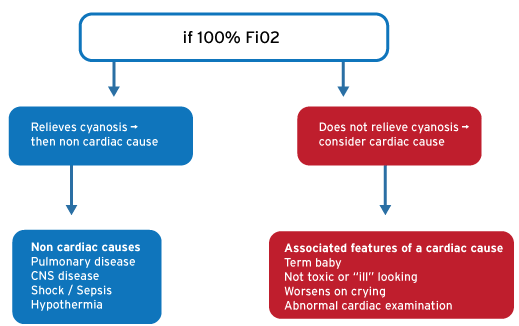
In a cardiac cause seek help and cardiology opinion early! It is important for cardiologist to determine if the defect is duct dependent, such as transposition of great arteries, tricuspid atresia, pulmonary atresia and severe TOF. Till then, treat with Prostaglandin E2 125mcg diluted in 2.5ml water (Prostin E . tab) hourly PO. If there is no response then increase to . tab every 30 minutes. If there is no response, then IV Prostin must be commenced. Be ready and competent to intubate as IV prostin causes apnoea.
In term baby with MAS/HIE, consider PPHN especially if Sats are very labile. Do Sats in right hand and foot. If >10% difference (or 1.5kPa on BG), get expert opinion. Turn FiO2 to 1.0 (might need intubation), consider 20ml/kg normal saline bolus and do a blood gas to rule out acidosis.
General principles of treatment
- Treat underlying cause if known
- Maintain adequate hydration -> heart needs adequate preload
- Maintain temperature -> hypothermia can be fatal; hyperthermia changes autonomic effect
- Treat electrolyte/Acid Base abnormalities, maintain normal blood sugar and correct anaemia if present
- Treat sepsis aggressively
- Use anti failure treatment only if in obvious CCF
- Oxygen therapy should be used with caution. If there is a duct dependent lesion, supplemental oxygen may close the PDA, therefore give only at low concentrations.
Referral
Stabilize and appropriately refer all cyanotic babies. Seek expert advice early.