Definition and Classification of Diabetes Mellitus
Definition and Classification of Diabetes Mellitus
Definition of diabetes mellitus
Classification of diabetes and other categories of glucose tolerance
Clinical Stages of glucose tolerance
Aetiological classification of diabetes mellitus
(See Strength of Recommendations Taxonomy (SORT) for explanation of Grade A-C)
| SEMDSA 2017 Recommendations | ||
|
Recognise that the clinical stages of hyperglycaemia include intermediate hyperglycaemia (impaired fasting glucose and impaired glucose tolerance) and diabetes mellitus. Intermediate hyperglycaemia represents a high-risk state for future diabetes and cardiovascular disease
|
C | |
|
Always consider the aetiological classification of diabetes mellitus at diagnosis and review this periodically. Be aware that latent auto-immune diabetes of adulthood, maturity onset diabetes of the young, other endocrinopathies, glucocorticoid-induced diabetes and pancreatic diabetes are not uncommon disorders
|
C | |
|
The clinical distinction between type 1 and type 2 diabetes can be difficult especially in younger individuals, and in those with ketosis-prone (type 2) diabetes. These individuals should be referred to an endocrinologist without delaying treatment
|
C | |
|
The need for insulin treatment at diagnosis cannot be used as the basis for aetiological classification
|
C | |
|
Be aware that the classification of hyperglycaemia first detected in pregnancy has been updated by the World Health Organisation and adopted by SEMDSA, See: Diabetes in pregnancy.
|
C |
Since 1965, there have been several guidelines for the classification and diagnosis of diabetes mellitus. The first standardised guidelines were published 30 years ago. It was recognised that, as more information relevant to the diagnosis became available, there would be a need to review the classification and diagnostic criteria. There are no major changes to the definition of diabetes mellitus. The classification of hyperglycaemia in pregnancy has been updated, and the importance of making a correct aetiological diagnosis of diabetes is highlighted.
DEFINITION OF DIABETES MELLITUS
Diabetes mellitus (diabetes) is a metabolic disorder with heterogeneous aetiologies, which is characterised by chronic hyperglycaemia and disturbances of carbohydrate, fat and protein metabolism resulting from defects in insulin secretion, insulin action or both. The long-term relatively specific effects of diabetes include development of retinopathy, nephropathy and neuropathy. People with diabetes are also at increased risk of other diseases, including cardiac, peripheral arterial and cerebrovascular disease.1,2,3,4
Diabetes may present with characteristic symptoms such as thirst, polyuria, polydipsia, blurred vision, weight loss and sometimes polyphagia. The most severe clinical manifestation is ketoacidosis or non-ketotic hyperosmolar state, which may lead to stupor, coma, and, in the absence of treatment, death.
However, often, symptoms are not severe or may be absent, and consequently in the absence of routine biochemical screening, hyperglycaemia sufficient to cause pathological and functional changes may be present for a long time before the diagnosis is made. There is a major need for improved screening for diabetes, particularly as a significant percentage of cases (30–80%) remain undiagnosed.1,4,5
Several pathogenic processes are involved in the development of diabetes. These include processes that impair or destroy the function of the pancreatic beta cells, with consequent insulin deficiency, and others that result in resistance to insulin action (insulin resistance versus insulin insensitivity). Abnormalities of carbohydrate, fat and protein metabolism are due to the deficient action of insulin on target tissues, resulting from insensitivity to or lack of insulin, or both.1,2,3,4
Table I: Aetiological classification of diabetes mellitus1,3,5,6
|
I. Type 1 diabetes (β cell destruction, usually leading to absolute insulin deficiency)
II. Type 2 diabetes
May range from predominantly insulin resistance with relative insulin deficiency, to a predominantly secretory defect with insulin resistance. Also includes a subset who have ketosis-prone diabetes. III. Other specific types
Maturity onset diabetes of the young (MODY) – currently 11 subtypes, neonatal diabetes mellitus, mitochondrial DNAs
Type A insulin resistance, Donahue syndrome (Leprechaunism), Rabson-Mendenhall syndrome, lipoatrophic diabetes, others
Pancreatitis, trauma/pancreatectomy, neoplasia, cystic fibrosis, haemochromatosis, fibrocalculous pancreatopathy, others
Acromegaly, Cushing’s syndrome, glucagonoma, phaeochromocytoma, hyperthyroidism, others
Glucocorticoids, nicotinic acid, thyroid hormone, β-adrenergic agonists, thiazides, phenytoin, interferon, pentamidine, diazoxide, atypical antipsychotics, highly active antiretroviral therapy (HAART)
Congenital rubella, cytomegalovirus, others
“Stiff-man” syndrome, anti-insulin receptor antibodies, others
Down syndrome, Klinefelter syndrome, Turner syndrome, Wolfram syndrome, Friedreich ataxia, Huntington chorea, Laurence-Moon-Biedl syndrome, myotonic dystrophy, porphyria, Prader-Willi syndrome, others
IV. Hyperglycaemia first detected in pregnancy
|
Note: Patients with any form of diabetes may require insulin treatment at some stage of their disease. Such use of insulin does not, of itself, allow for aetiological classification. |
CLASSIFICATION OF DIABETES AND OTHER CATEGORIES OF GLUCOSE TOLERANCE 1,2,3,4,5,6
The classification encompasses both the clinical stages and aetiological types of diabetes, and other categories of hyperglycaemia (Figure I and Table I).1,3,5,6 References 1 and 3 can be consulted for more details.
Clinical Stages of glucose tolerance
Regarding the clinical stages, the spectrum of glucose tolerance extends from normoglycaemia, to intermediate hyperglycaemia [impaired fasting glucose (IFG) and impaired glucose tolerance (IGT)}, to diabetes, regardless of underlying aetiology.
IFG and IGT are high-risk states for diabetes or categories of increased risk for diabetes. The 2011 World Health Organisation (WHO) Consultation4 affirmed the position taken by the 2006 WHO/IDF (International Diabetes Federation) consultation5, that no further change should be made to the 1999 WHO recommendations1 on the diagnostic criteria for these states, discourages the use of the term “pre-diabetes” to describe IGT and IFG because of its misleading implication that all such individuals will inevitably progress to diabetes, and endorses the continued use of the collective term “intermediate hyperglycaemia”.
IFG and IGT should not be viewed as clinical entities in their own right,but rather as risk factors for diabetes and cardiovascular disease (CVD). IFG and IGT are associated with obesity (especially central or visceral), dyslipidaemia with high triglycerides and/or low HDL cholesterol, and hypertension, a constellation collectively referred to as the metabolic syndrome.2,3 This is discussed in further detail in Cardiovascular risk and the management of dyslipidaemia in patients with type 2 diabetes mellitus.
It is important to note that it may only be possible to establish the aetiology of diabetes retrospectively. Diabetes, regardless of the aetiology, progresses through several clinical stages during its natural history, and an individual may progress from stage to stage in either direction. Persons who have, or who are developing, diabetes can be categorised by clinical stage according to clinical characteristics, even in the absence of information on the underlying aetiology (Figure I). Classification is important for determining therapy, but some individuals cannot be clearly classified as type 1 or type 2 diabetes at the time of diagnosis.1,2,3,5,6 Any difficulty in accurate classification should not delay initiation of therapy in symptomatic patients.
Figure I: Disorders of glycaemia: aetiological types and clinical stages1,3,5,6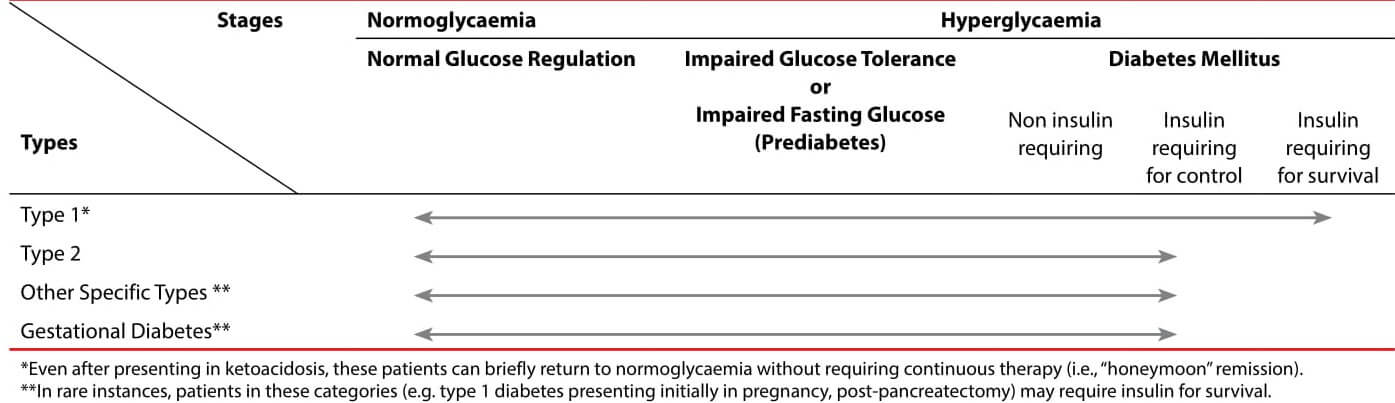
Aetiological classification of diabetes mellitus
The aetiological types of diabetes are type 1, type 2, other specific types and gestational diabetes (Table I). Patients with any form of diabetes may require insulin treatment at some stage of their disease. Such use of insulin does not, of itself, allow for an aetiological classification.
Type 1 diabetes, which accounts for only 5-10% of cases, results from pancreatic beta-cell destruction leading to absolute insulin deficiency. These patients are prone to ketoacidosis, coma and death. Type 1 diabetes may be immune-mediated or idiopathic (no known aetiology). Latent autoimmune diabetes in adults (LADA) is also classified as type 1 diabetes.
Type 2 diabetes is the most common aetiological type (90-95% of cases) and is due to a progressive loss of insulin secretion on the background of insulin resistance (disorder of insulin action); it ranges from predominantly insulin resistance with relative insulin deficiency to predominantly an insulin secretory defect with insulin resistance.
Other specific types of diabetes include a wide variety of conditions, primarily specific genetically defined forms of diabetes or diabetes associated with other diseases or drugs. Some of these are not uncommon and practitioners should be aware of these.
The clinical distinction between type 1, type 2 and other specific types of diabetes can sometimes be difficult, particularly in adolescents and young adults. Type 1 and more especially type 2 diabetes are essentially clinical diagnoses of exclusion i.e. they require the practitioner to at least consider and reasonably exclude other causes of diabetes mellitus. It is estimated that about 15% of patients in general practice are misdiagnosed or misclassified7 and this can have important therapeutic and prognostic implications.
Table II: Clinical differences between type 1 diabetes and type 2 diabetes
| Type 1 diabetes |
Type 2 diabetes |
| Usually younger (<30 years*) but not always. |
Usually older but prevalence in children, adolescents and young adults increasing |
| Usually lean weight |
Mostly overweight or obese |
| Onset is acute |
Onset is insidious / gradual |
| Almost always symptomatic (polyuria, polydipsia, weight loss) |
Often asymptomatic |
| Prone to ketosis, often ketoacidotic at diagnosis |
Not usually ketosis prone but ketoacidosis may be present at diagnosis |
| Diagnosis – usually has unequivocal hyperglycaemia |
Diagnosis often during routine screening |
| Insulin necessary from diagnosis for survival |
Usually controlled with non-insulin therapies, or may need insulin for symptom control |
| Otherwise normally healthy |
Often have comorbidities (hypertension, dyslipidaemia, sleep apnoea, fatty liver disease, polycystic ovary syndrome); often diagnosed after emergency admission for myocardial infraction or stroke |
*<35 years in African populations.
Table II highlights the clinical differences that may assist in making the distinction between type 1 and type 2 diabetes in childhood, adolescents and young adults. Type 2 diabetes includes a subset of adults who have ketosis-prone diabetes. Although diabetic ketoacidosis occurs more commonly in patients with type 1 diabetes, it is becoming increasingly evident that there is a sub-set of patients with type 2 diabetes that present with or develop ketoacidosis, yet, after a few months, can be weaned off treatment with insulin and maintain euglycaemia only with oral agents. Most of these patients have a family history of type 2 diabetes and have the typical phenotype of type 2 diabetes, namely acanthosis nigricans and increased waist circumference.8
Maturity onset diabetes of the young (MODY) represents a group of autosomal dominant single gene disorders resulting in impaired insulin secretion, with the onset of diabetes in adolescence or early adulthood.9 These patients typically have no or mild symptoms, lack the typical phenotype of the obese insulin-resistant type 2 diabetes patient, and have a strong family history of early onset (typically before age 25) diabetes in preceding generations. MODY is estimated to account for 1-2% of diabetes cases and is often misdiagnosed as type 1 or type 2 diabetes. The differences in treatment and prognosis, as well as the need for genetic counselling behoves the clinician to have a strong index of suspicion for MODY in patients presenting with “type 2 diabetes” before age 25.
Latent autoimmune diabetes of adulthood (LADA) is a form of type 1 diabetes often misdiagnosed as type 2 diabetes.10 It is characterised by a slower autoimmune destruction of beta cells than is seen in typical type 1 diabetes, and hence a slower more smouldering onset of hyperglycaemia, not unlike type 2 diabetes. Phenotypically, patients with LADA are older than the typical type 1 diabetes patient (older than 25 years but more usually older than 35 years), are more likely to be non-obese and lack the strong family history of diabetes that is so typical of type 2 diabetes. However these features are not invariable. Approximately 10% of patients over the age of 35 labelled as having type 2 diabetes, may actually have LADA.10,11 Patients with LADA should be treated with insulin.
Hyperglycaemia in the range characteristic of diabetes, IFG or IGT is also a common feature of other endocrinopathies such as thyrotoxicosis, hypothyroidism, Cushing’s syndrome and acromegaly. The clinician should always have a high index of suspicion for these secondary causes of hyperglycaemia and investigate or refer when clinically appropriate. Although the concurrent hyperglycaemia may necessitate treatment in its own right, patients with these conditions should be re-evaluated for diabetes if and when the underlying disorder has been treated.
Any doubt about the aetiological classification of diabetes should trigger referral to an endocrinologist for clinical and laboratory evaluation without unnecessarily delaying treatment of the hyperglycaemia.
Gestational diabetes (GDM), was until recently referred to as hyperglycaemia (glucose intolerance) with onset or first recognition during pregnancy. The terminology and classification has been updated since the 2012 SEMDSA guideline. The ADA defines GDM as diabetes diagnosed in the second or third trimester of pregnancy that is not clearly either type 1 or type 2 diabetes.2,3 The recent report of the WHO recommends that hyperglycaemia first detected at any time during pregnancy should be classified as either ‘diabetes mellitus in pregnancy” if the diagnostic criteria for diabetes in non-pregnant adults are met, or “gestational diabetes” for lesser degrees of hyperglycaemia defined by fasting, 1-hour and 2-hour post-glucose load values.8
SEMDSA endorses and adopts the WHO recommendations.12This is discussed further in Diabetes in Pregnancy.
Author: Ayesha A. Motala
Editors: Aslam Amod and Joel A. Dave
References
- Alberti KG, Zimmet PZ. Definition, diagnosis and classification of diabetes mellitus and its complications. Part 1: diagnosis and classification of diabetes mellitus provisional report of a WHO consultation. Diabet Med.1998;15(7):539-553.
- American Diabetes Association. Classification and diagnosis of diabetes. Sec. 2. In Standards of Medical Care in Diabetesd2016. Diabetes Care 2016;39(Suppl.1):S13–S22
- American Diabetes Association. Diagnosis and classification of diabetes mellitus.Diabetes Care 2014; 37(Suppl.1): S81–S90
- World Health Organization. Use of glycated haemoglobin (HbA1c) in the diagnosis of diabetes mellitus: http://www.who.int/diabetes/publications/report-hba1c_2011.pdf. (accessed 25 January 2016)
- World Health Organization. Definition and diagnosis of diabetes mellitus and intermediatehyperglycaemia: http://whqlibdoc.who.int/publications/2006/9241594934_eng.pdf (accessed 21 January 2016)
- Canadian Diabetes Association Clinical Practice Guidelines Expert Committee.Canadian Diabetes Association 2013 Clinical Practice Guidelines for the Prevention and Management of Diabetes in Canada. Can J Diabetes 2013;37(suppl 1):S1-S212.
- Smiley D, Chandra P, Umpierrez GE. Update on diagnosis, pathogenesis and management of ketosis-prone Type 2 diabetes mellitus. Diabetes Manag. 2011;1(6):589-600. doi:10.2217/dmt.11.57.
- Hope S V., Wienand-Barnett S, Shepherd M, et al. Practical Classification Guidelines for Diabetes in patients treated with insulin: a cross-sectional study of the accuracy of diabetes diagnosis. Br J Gen Pract. 2016;66(646):e315-e322.doi:10.3399/bjgp16X684961.
- Anık A, Çatlı G, Abacı A, Böber E. Maturity-onset diabetes of the young (MODY):An update. J Pediatr Endocrinol Metab. 2015 Mar;28(3-4):251-63. doi: 10.1515/jpem-2014-0384.
- Stenstrom G, Gottsater A, Bakhtadze E, Berger B, Sundkvist G. Latent Autoimmune Diabetes in Adults: Definition, Prevalence, -Cell Function, and Treatment. Diabetes.2005;54(Supplement 2):S68-S72. doi:10.2337/diabetes.54. suppl_2.S68.
- Turner R, Stratton I, Horton V, Manley S, Zimmet P, Mackay IR, Shattock M, Bottazzo GF, Holman R, UK Prospective Diabetes Study (UKPDS) Group: UKPDS
25: autoantibodies to islet-cell cytoplasm and glutamic acid decarboxylase for prediction of insulin requirement in type 2 diabetes. Lancet350 :1288 –1293,1997 - World Health Organization. Diagnostic Criteria and Classification of Hyperglycaemia First Detected in Pregnancy. Geneva: World Health Organization; 2013. Available from: http://www.ncbi.nlm.nih.gov/books/NBK169024/