Definition, Management Approach and Goals of Chronic Non-Cancer Pain
This guideline is endorsed by the following professional groups: Cape Pelvic Pain Society, PainSA, South African Rheumatism and Arthritis Association, and South African Society of Anaesthesiologists.
CNCP requires a multimodal management approach
Communication and responsibility
Goals of therapy and patient expectations
Definition of chronic pain
Chronic pain is defined as pain persisting for longer than 90 days and beyond an expected time frame for tissue healing. It may be continuous or intermittent and may continue in the presence or absence of demonstrable pathologies. Chronic pain may not be amenable to routine pain control methods and complete resolution of the pain may never occur.
Chronic non-cancer pain requires a multimodal management approach
Chronic non-cancer pain (CNCP) is a complex condition that may involve biological, psychological, social and environmental factors. When chronic pain is accompanied by comorbidities, impaired function, or psychological disturbances (e.g. anxiety and depression), chronic opioid therapy (COT) is likely to be most effective as part of multimodal treatment that addresses all of these domains.
Consequently, management of CNCP requires a multidisciplinary approach and clinicians who prescribe COT should routinely consider non-opioid therapies (e.g. analgesics, antidepressants, anxiolytics), psychotherapeutic interventions, functional restoration and other medical and social interventions as indicated (Fig. 1).
Figure 1: Algorithm for the initiation and use of COT
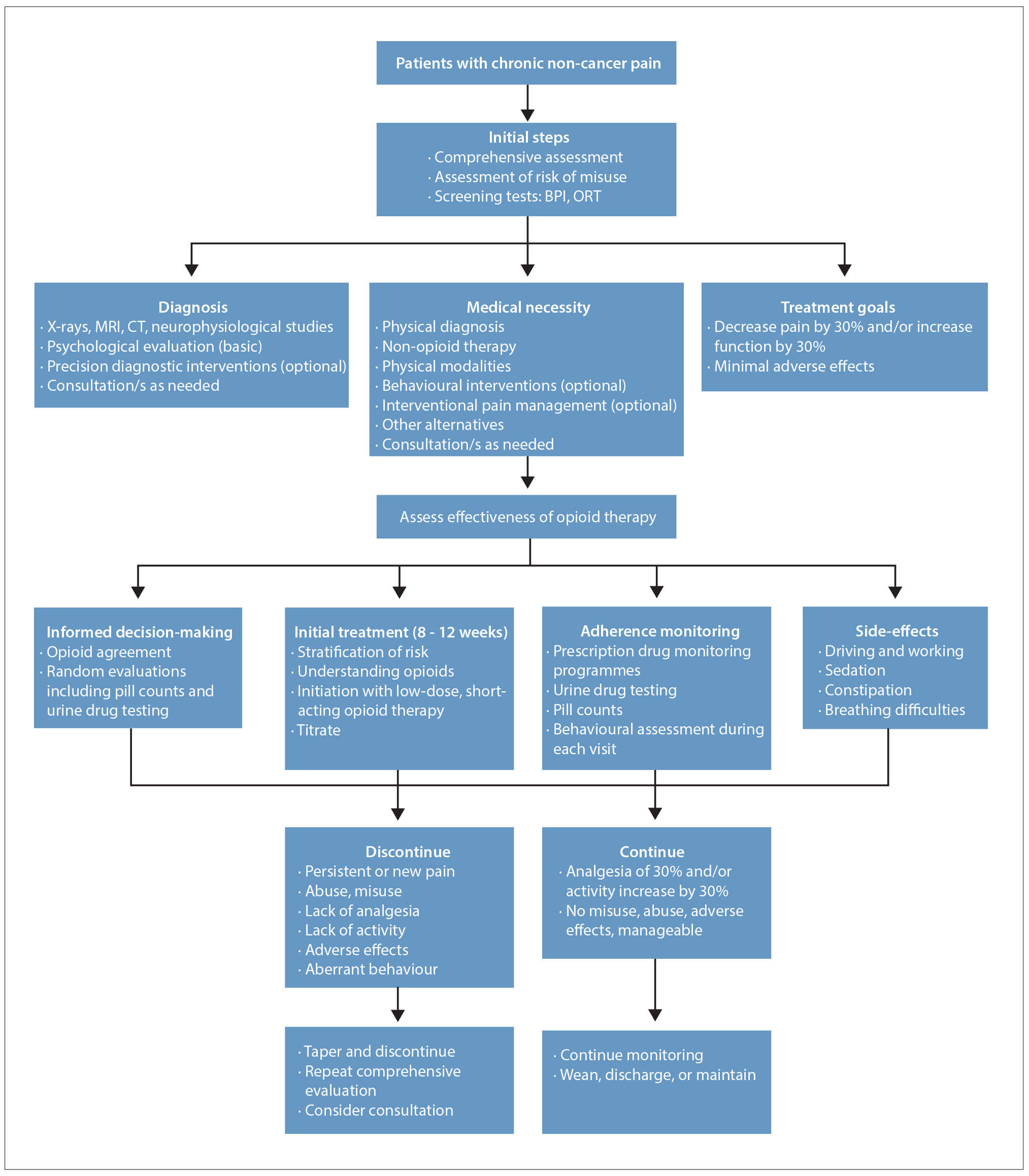
Adapted with permission from Manchikanti et al.[5] (COT = chronic opioid therapy; BPI = Brief Pain Inventory; ORT = Opioid Risk Tool; MRI = magnetic resonance imaging; CT = computed tomography.)
Click on image to enlarge
Communication and responsibility
Communication between healthcare providers caring for the patient is mandatory. However, patients on COT should identify with one doctor, mostly their general practitioner and not necessarily the one prescribing COT, who accepts primary responsibility for their overall medical care and who should co-ordinate communication and consultation among clinicians. Patients should be referred back to the general practitioner after specialist consultation. Likewise, to help ensure correct use of medication and to reduce prescription fraud, all opioids (and preferably all other medications) for a particular patient should be dispensed through a single designated pharmacy.
Goals of therapy and patient expectations
Complete relief of pain is rarely achieved in patients with CNCP and the physician should ensure that the patient’s expectations of therapy are realistic. The goals of management are to reduce pain intensity and to improve the patient’s functional levels in relation to physical, vocational, social and emotional wellbeing. Clinically meaningful improvements are at least 30% reduction in pain (or ≥2 points on a 0-10 numeric rating scale) and/or 30% improvement in function. COT forms only one component of the broad approach required to achieve this.