Definitions of Pain
General principles and management of cancer pain in adults
The International Association for the Study of Pain (IASP) defines pain as “an unpleasant sensory and emotional experience associated with actual or potential tissue damage, or described in terms of such damage”14.
Another proposed definition of pain is “Pain is what the experiencing person says it is, existing whenever (s)he says it does."9,15
The IASP definition attempts to define pain in clinical terms while acknowledging an emotional component of the experience. The second definition tends to focus on the subjective nature of the pain experience. The concept of ‘total pain’ first introduced by Dame Cicely Saunders in the 1960s is used to define the interrelationship between the social, emotional, physiological, cultural and spiritual aspects of pain.15
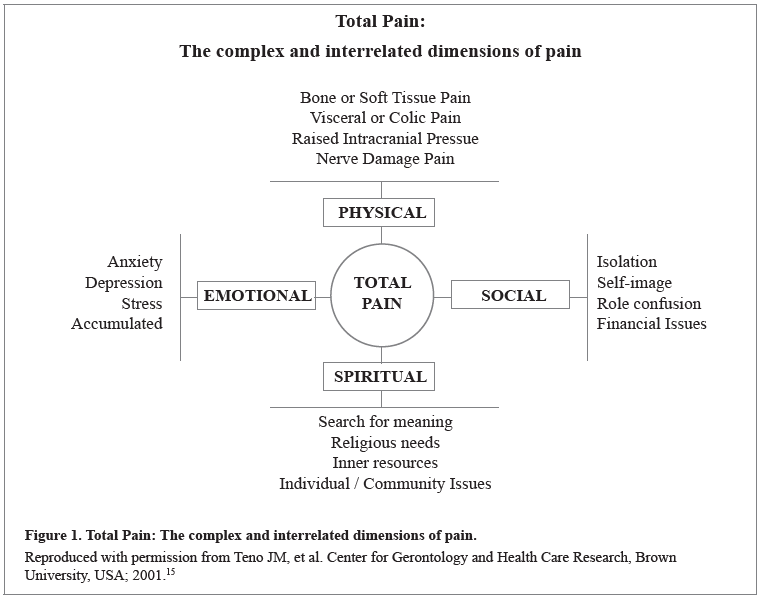
Click on image to enlarge
Pain is feared. In patients with advanced, progressive illness it has physiological and psychological consequences that affect both them and their loved ones. It is isolating, emotionally draining and impacts adversely on social relationships, daily functions, sleep and self-worth. Thus the perception of physical pain is affected by the patient’s emotional and psychological well-being, social circumstances and cultural and spiritual beliefs. It is impossible to directly measure pain and individual suffering may be difficult to fully appreciate or understand.
Effective management of pain therefore requires skills in communication and an adequate understanding of assessment and treatment.
Furthermore, there are patients, such as the young, disabled, obtunded and demented who may not be able to describe their individual experience.
There is a wide spectrum of different types of pain that may occur in patients with cancer. Common terms used to describe pain and painful syndromes are listed in Table 1.
|
Table 1: Definitions of Pain 14,16-19
|
|
| Acute pain | Sudden, recent onset pain, usually sharp in quality. Serves as a warning of disease or a threat to the body |
| Breakthrough pain | Transient exacerbation of pain of moderate or severe intensity arising on a background of controlled pain |
| Central pain | Neuropathic pain arising from a lesion in the central nervous system (brain or spinal cord) |
| Chronic pain | Pain that persists beyond an expected time frame for tissue healing. Chronic pain results from a chronic pathologic process and from poorly treated acute pain. Pain signals remain active in the nervous system for weeks, months or years. |
| Complex regional pain syndrome (CRPS) | A syndrome of spontaneous burning pain, allodynia and hyperpathia after an injury, often combined with vasomotor and sudomotor dysfunction and later trophic changes. CRPS type I (reflex sympathetic dystrophy) typically follows minor injuries or fracture of a limb. CRPS type II (causalgia) develops after injury to a major peripheral nerve. |
| End of dose pain | Pain occurring when the blood level of the medicine falls below the minimal effective analgesic level near the end of the dosing interval. End of dose pain indicates that the next analgesic dose is due and should not be confused with breakthrough pain. |
| Incident pain | Pain that occurs in relationship to a particular posture or motor activity (e.g., standing, sitting up, coughing, sneezing, straining). It may be chronic, but, because it is intermittent, it is better managed with local measures where possible. |
| Neuropathic pain | Pain caused by a lesion (abnormality or trauma) or disease (e.g., stroke, diabetes, vasculitis) of the somatosensory nervous system. It may involve the central or peripheral nervous system. Central and peripheral sensitisation and ectopic transmission and spontaneous discharge at the level of peripheral nerves means that pain may persist beyond the tumour or disease process. |
| Nociceptive pain | Pain that is transmitted by an undamaged nervous system consequent to actual or threatened damage to non-neural tissue. |
| Procedural pain | Pain related to a procedure or intervention. This is especially important in children with chronic illnesses and is an important cause of anxiety that can be prevented. |
| Definitions of Responses to Medication | |
| Addiction | Compulsive drug use associated with drug-seeking behaviour (multiple sources, legal and illegal), noncompliance with suggested changes to drug use, craving and abrupt withdrawal reactions. |
| Dependence | Physiological adaptations occurring as a consequence of drug administration. Physical dependence is associated with withdrawal syndrome when the dose is reduced. |
| Pseudoaddiction | Drug seeking behaviours such as drug hoarding, requests for additional prescriptions or increased doses, occurring in patients with inadequate treatment. These behaviours maybe mistaken as signs of addiction, but occur in an attempt to obtain better pain relief and cease when pain is controlled. |
| Tolerance | Reduced analgesic effect for an equivalent dose, or requirement of an increased dose to achieve the same effect. |