Delirium
An approach to symptom management to guide decision-making in the management of patients with life-threatening illness
The importance of recognising delirium
Consider disease-specific palliative therapy
Explanation to patient and family
Institute non-pharmacological interventions
Review assessment and management
Definition
Delirium is an altered state of mind characterised by confusion of recent onset and variable severity. It is a collective term for the various causes of acute confusion rather than a specific diagnosis.
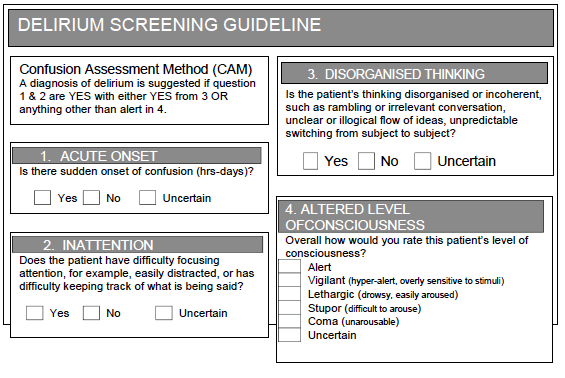
There are 4 key features of delirium that need to be present to make the diagnosis:
- A changed level of consciousness. The patient has difficulty focusing, sustaining or shifting their attention. The patient may be agitated and restless or may be abnormally drowsy. Disorientation may be present but is not an essential feature in making the diagnosis.
- A disturbance of the process of thinking (cognition). The patient has short term memory loss, disorganised thinking, speaking and problem solving. (Exclude pre-existing dementia.) Hallucinations and delusions may be present but are not essential features in making the diagnosis.
- The above changes are of recent onset and may fluctuate over a period of hours.
- There is definite clinical evidence that the disturbance is caused by the abnormal physiology of an underlying general medical condition.
Types of delirium
There are 3 clinical sub-types of delirium
- Hyper-active delirium: The patient is restless, irritable, agitated and may become aggressive or inappropriate in their behaviour.
- Hypo-active delirium: The patient is inactive, disinterested and incoherent.
- Mixed delirium: The patient fluctuates between hypo- and hyperactive delirium. This is the most common sub-type (>50%).
Delirium may be present on admission or it may develop later. Risk factors for delirium include advanced age, poor vision, deafness, existing cognitive impairment/dementia, liver and brain metastases, use of benzodiazepines (Daily dose equivalent (DDE) >2mg lorazepam), opioids (DDE>90 mg morphine) and cortisone (DDE>15 mg dexamethasone)
Screening for delirium
The Confusion Assessment Method (CAM) is a simple way of screening for delirium. The following table has been developed from the CAM by the Institute for Palliative Medicine at San Diego Hospice, California (used with permission). The CAM’s sensitivity is 94-100% and its specificity is 90-95%.
Appropriate assessment to identify cause and severity of symptoms
Patients with advanced, life threatening illnesses may suddenly begin behaving strangely.
- They may become agitated, demanding or respond in an irrational way.
- They may appear anxious, tearful or depressed.
- They may become restless and try to get out of bed.
Initially it may be difficult to understand what is causing the problem and they may even be thought of as being difficult or uncooperative. In such a situation it is important to consider delirium as this is the most common reason for this pattern of behaviour.
Differential diagnosis
Delirium should be differentiated from depression, dementia and major psychotic illness.
The following table may help to do so:
| Delirium | Depression | Dementia | Psychosis | |
| Alertness | Abnormal | Normal | Normal | Normal |
| Onset | Sudden and recent | Gradual | Gradual | Gradual |
| Course | Fluctuates frequently | May vary slightly and be worse in morning | Progressive, may be slightly worse in evening ("Sundowning") | No fluctuation |
Elderly patients with dementia can develop delirium on top of their dementia. Establish from the main care giver what the person’s baseline function was previously and how they appear in comparison during this examination.
The importance of recognising delirium
Delirium is distressing to the patient and the family; it disrupts effective patient care and may even lead to injuries. Early intervention is necessary to identify possible reversible causes and to take effective action to prevent the problem from getting out of hand.
Prevalence:
Delirium is common in a palliative care setting. About 30-40% of admissions are due to sudden confusion and more than 80% will develop some degree of delirium during the terminal phase of their illness.
Correct reversible factors
Underlying causes
The underlying mechanism for delirium is thought to an imbalance of neurotransmitters (a deficiency of acetylcholine and an excess of dopamine). The cause of this imbalance is multi-factorial. The following are some of the risk factors that may lead to delirium:
- advanced age,
- dehydration,
- psycho-active medication,
- infection,
- liver, bone and brain metastases,
- underlying dementia,
- head trauma,
- impaired vision and hearing.
Most delirious patients will have 3 or more contributing causes.
For those who like mnemonics: “DIMTOP”
- Drugs e.g. opioids, anticholinergics, benzodiazepines, regular drugs (especially alcohol) omitted
- Infection e.g. UTI, chest, meningitis or wound
- Metabolic e.g. hypo/hypernataemia, hypercalaemia
- Trauma e.g. hypoperfusion, fat embolism (fractures)
- Oxygen lack/hypercarbia
- Pressure (intracranial) psychiatric, pain, poisons
Special Investigations
Delirium can often be adequately assessed and managed without any special investigations. In selected cases where resources are available, appropriate investigations may be helpful. It is, however, inappropriate to blindly screen for every possible abnormality “just in case.”
Empirical treatment for common causes is appropriate where resources are limited.
Reversibility
While some studies have shown that up to 50% of episodes of delirium may be reversible, reversibility is dependent on a number of interrelated factors. The prognosis is poorer in the presence of advanced age, severe cognitive impairment and poor vital organ function. There is no easy way of predicting reversibility. “It remains prudent to treat all cases of delirium as potentially reversible while remaining sensitive to the needs of patients that have actively entered the final 24-48 h of life where the balance between minimising risk factors for delirium versus achieving optimal levels of comfort requires careful consideration.”
Consider disease-specific palliative therapy
- Where appropriate rehydrate patients (orally or by hypodermoclysis).
- Review all medications, stop or reduce the dosage of all non-essential drugs and recheck for previous excessive alcohol or illicit drug use.
- A trial of steroids for suspected brain metastases.
- Further options include confirmation by scanning if the patient’s general performance status is good and if the patient is keen on further treatment.
- Solitary, accessible metastases may benefit from surgery. (Less than a third of cerebral metastases are single.)
- Whole brain irradiation could be considered for multiple metastases for the relief of severe headache. Whole brain irradiation does not improve survival. It should not be considered if there are metastases in other organs and if the patient’s performance status is poor.
- Chemotherapy could be considered for certain lymphomas, small cell lung cancer and germ cell tumours.
- Most infections should be appropriately treated unless the patient has signs of impending death (within 24-48 hrs).
- Consider using rehydration and bisphosphonates for hypercalcaemia.
Explanation to patient and family
This is a particularly stressful time for the family. Arrange a family meeting and facilitate a clear understanding of what is going on and what can be done. Here are some suggestions:
- Allow the family to explain how they see things and what their chief fears are
- Ask the family to help you get to know their loved one as a person. This helps them refocus on the person and not just the drama of the current events.
- Explain that their loved one is not mad or being difficult – their behaviour is as a result of their illness which has caused a temporary disturbance of brain’s function.
- Ask about previous mental and physical status
- Explain the nature of delirium, its causes and its significance
- Discuss the management options available and the likely outcomes.
- Ask about family and patient preferences
- Review goals of care: The need for care and safety as well as a focus on comfort.
- Clarify the role of the family and the roles of the health professionals
- Give a rough estimate of expected prognosis acknowledging the uncertainty of the future.
- Allow the family to share something special about the delirious person. This helps the discussion to end on a positive note.
Institute non-pharmacological interventions
- Calm reassurance of the delirious patient
- Regular orientation for time and place
- Presence of a family member. Limit visitors.
- Identify and maintain care giver consistency were possible
- Familiar personal objects or photos
- Encourage walking, or if bedridden, range of motion exercises
- Appropriate lighting at night
- Soothing music
- Gentle back massage and a glass of warm milk rather than a sleeping tablet
- Noise reduction as far as possible
- Optimise vision and hearing (check hearing aid)
Important: Physical restraints are not necessary.
They may aggravate the situation and cause injury.
Effective calming and if necessary, sedation is possible by means of appropriate medication at effective dosages.
Prescribe appropriate first-line treatment
| Mild delirium without agitation | |||
| Drug | Dose | Frequency | Comment |
| Haloperidol (Serenace) | 0.5 - 2mg PO | Every hr p.r.n. x3 (Notify Dr if 3 doses not effective This allows a review of the situation so that the dose can be adjusted if needed) | Usual effective dose is 0.5 - 2mg/day Maintenance: Previously day's total used given as a single daily dose and the same p.r.n. dose for break through symptoms NB: Medication is not always needed but as agitation may occur unexpectedly in a new environment consider its use for a short period |
| Delirium with mild agitation but no aggression | |||
| Drug | Dose | Frequency | Comment |
| Haloperidol (Serenace) | 1-2mg SC | Every 30 min p.r.n. x3 (Notify doctor if 3 doses not effective) | Usual effective dose is 6-12mg/day Maximum 100mg/day Maintenance: Previous day's total used given as a single or divided dose plus the same p.r.n. dose |
| Delirium with agitation, restlessness and aggression | |||
| Drug | Dose | Frequency | Comment |
| Haloperidol (Serenace) | 3-5mg SC, IM or IV | Every 30 min p.r.n. x3 (Notify doctor if 3 doses not effective) | Up to 1200mg IV per day has been safely used. Occasionally prolongation of the Q-T interval may occur An aggressive delirious patient may be dangerous and calming the patient must be an urgent priority for all staff. (See second line drugs) |
Important: Benzodiazepines such as lorazepam (Ativan) or diazepam (Valium) should not be used alone as first line treatment as they may result in increasing confusion, disinhibition and falls.
They are however, useful when sedation is needed in patients with delirium due to alcohol withdrawal.
Alternative first line drug
| Drug | Dose | Frequency | Comment |
| Chlorpromazine (Largactil) | 12.5-50mg PO, IM or IV | Every 2-4 hours p.r.n. x3 (Notify doctor if 3 doses not effective) | More sedating than haloperidol May cause hypotension |
Consider additional second-line treatment where sedation is needed
| Drug | Dose | Frequency | Comment |
| Lorzepam (Ativan) | 1-2mg PO, SL, IV | Every hr p.r.n. x3 (Notify doctor if 3 doses not effective) | |
| Midazolam (Dormicum) | 3-5mg SC or IV | For rapid sedation | |
| 1mg Continuous SC infusion | Per hour | Titrate the dose according to effect Max 10mg/hour | |
| Promethazine (Phenergan) | 50mg PO, IM, IV | 8 hourly | Very sedating but helpful as an adjunct to other drugs |
Review assessment and management
The CAM is useful for screening for delirium but it does not measure the severity of the delirium nor does it assess the degree of change in response to treatment or to the worsening of the patient’s condition. In severely ill patients it may be unduly burdensome to carry out time consuming assessments of mental state. However, in some patients it may be helpful to objectively measure improvement or deterioration.
A test that is relatively simple and quick to perform is the Clock Drawing Test (CDT). First, the patient is asked to draw a clock with all the numbers on it. Then the patient is asked to put the hands on the clock to make it read 2:45. The instructions can be repeated but no further directions are given. The drawing is scored according to the correct sequence and spacing of the numbers and the correct placement of the hands. The CDT assesses comprehension, visuo-spacial abilities, concentration, numerical knowledge, visual memory and executive function. It also provides a visual record of changes in cognitive ability.
Care and routine observations should be non burdensome. The dose of the drugs being used to control the delirium can be reduced as soon as the patient is no longer agitated. Where there is refractory agitated delirium, proportionate sedation may need to be continued until the patient dies.
At all stages of management consider:
Involvement of interdisciplinary team:
Managing a delirious patient requires a well functioning team. Clear notes setting out the goals of care, progress and reasons for new decisions will help to keep everyone up to date and working towards the same end. The family needs to be supported and to be kept involved in the decision making as much as possible.
Referral to appropriate service/more experienced clinician
Delirium presents many complex clinical and ethical problems. If the degree of uncertainty about the diagnosis and management is interfering with proper care, the advice of a more experienced palliative care clinician needs to be sort.