Diabetes Mellitus, Type 1
Description Diagnostic criteria General and supportive measures Medicine treatment Referral ICD-10 Code: E10 DESCRIPTION Most diabetic children have type 1 diabetes, and: have auto-immune destruction of the pancreatic beta cells as the underlying cause, have an absolute requirement for insulin therapy, will develop diabetic ketoacidosis (DKA) if not given insulin. DIAGNOSTIC CRITERIA The followin
Description
Diagnostic criteria
General and supportive measures
Medicine treatment
Referral
ICD-10 Code: E10
DESCRIPTION
Most diabetic children have type 1 diabetes, and:
- have auto-immune destruction of the pancreatic beta cells as the underlying cause,
- have an absolute requirement for insulin therapy,
- will develop diabetic ketoacidosis (DKA) if not given insulin.
DIAGNOSTIC CRITERIA
The following are criteria for the diagnosis of diabetes mellitus:
- Classic features of diabetes (polydipsia, polyphagia, polyuria, weight loss or failure to gain weight, weakness or tiredness, glycosuria, recurrent protracted infections, pruritis vulvae in a girl with diabetes) with a random serum glucose concentration ≥11.1 mmol/L; or
- Fasting plasma glucose ≥7.0 mmol/L (fasting defined as no caloric intake for at least 8 hours).
- An oral glucose tolerance test is generally not needed.
GENERAL AND SUPPORTIVE MEASURES
- Refer to a unit that is able to manage type 1 diabetic patients.
- Educate child and caregiver about all aspects of the disease.
- A medical alert bracelet should be worn at all times.
- Follow-up by medical practitioner or at a clinic/hospital should occur at least every 3 months.
- Monitor thyroid function annually.
- Screen for coeliac disease at diagnosis, and 3 years post diagnosis.
- Annual screening for dyslipidaemia, microalbuminuria, retinopathy and peripheral neuropathy 5 years after diagnosis in non-pubertal children and 2 years after diagnosis in pubertal children.
Diet: healthy lifelong eating habits
- Refer a newly diagnosed patient and family to a dietician.
- Principles of the prudent diet:
- Encourage children to reduce the intake of fats and salt and to increase dietary fibre content.
- Provide all diabetics with a meal plan, e.g. 'constant carbohydrate meal plan' or 'carbohydrates counting meal plan'. There is no one ‘diabetic’ diet. Individualise the diet giving consideration to usual eating habits and other lifestyle changes required.
- Six main nutrition factors contribute to better glucose control, i.e. lower HbA1c levels. These are:
- Following a meal plan. Keep day-to-day intake consistent.
- Avoiding extra snacks that are not part of the meal plan.
- Avoiding over-treatment of low blood glucose levels (hypoglycaemia).
- Prompt correction of high blood glucose levels.
- Adjusting insulin levels for meals in patients using the “carbohydrates counting meal plan”.
- Consistency of night snacks.
CONSTANT CARBOHYDRATE MEAL PLAN
Consistency is the key. The amount of insulin, usually two or three doses per day, is kept relatively constant from day-to-day. Carbohydrates should be manipulated to match the relatively constant insulin dose. If able to count carbohydrates, give 1 unit of insulin per 15 g of carbohydrate during the day:
| Units of insulin | Grams of carbohydrate per day |
| 1.5–2.5 units | per 15 g carbohydrates for breakfast |
| 1.2 units | per 15 g carbohydrates for supper |
| 0.5 units | per 15 g carbohydrates during the night |
The amount of carbohydrates (types can vary) should be kept about the same for each meal and snack from one day to the next.
As part of the educational process, the family must get used to reading food labels to know the grams (g) of carbohydrates being eaten. The dietitian may suggest a range of carbohydrates for each meal.
Examples of carbohydrate content of some foods
The following foods have 15 g of carbohydrate per serving:
1 cup = 250 mL
| Food | Serving size |
| Whole wheat/brown bread | 1 slice |
| Whole wheat/brown roll | 1⁄2 cup |
| Pita bread | 1⁄2 cup |
| Small wrap | 1 |
| Cooked porridge | 1⁄2 cup |
| High fibre cereal | 1⁄2 cup |
| Whole grain wheat biscuit | 1 |
| Whole wheat crispbread | 4 |
| Rye crispbread | 2 |
| Rice cakes (10 cm) | 2 |
| Whole wheat rusk | 1 |
| Cooked rice | 1⁄2 cup |
| Cooked pasta | 1⁄2 cup |
| Cooked couscous | 1⁄2 cup |
| Cooked samp | 1⁄2 cup |
| Cooked maize meal | 1⁄2 cup |
| Cooked samp and beans | 1⁄2 cup |
| Cooked crumbly maize meal or pap | 1⁄2 cup |
| Cooked lentils/split peas/beans | 1⁄2 cup |
| Baked beans | 1⁄2 cup |
| Plain popped popcorn | 1 1⁄2 cups |
| Thick homemade soup | 1 cup |
| Starchy vegetables | |
| Medium potato | 1 |
| Mash potato | 1⁄2 cup |
| Sweet potato | 1⁄4 cup |
| Butternut/pumpkin | 1 cup |
| Mixed vegetables with sweet corn | 1 cup |
| Sweet corn | 1⁄2 cup |
| Medium mealie | 1 |
| Peas | 1⁄2 cup |
- Tailor the advice to the patients’ lifestyle, economic circumstances and usual diet. Where possible, avoid drastic changes.
- Do not forbid any particular food as this may lead to disturbed attitudes to food, e.g. carbohydrates are not forbidden but can be taken before exercise, incorporated into a main meal or used as a source of energy during illness when children have a poor appetite.
- Diet should provide adequate nutrition for growth and development.
Dietary composition
Referral to a dietitian for an individualized meal plan to meet dietary requirements.
Timing of meals and snacks
Children receiving twice daily injections of combined short and intermediate acting insulin regimens need three main meals, and a snack, 2 hours after an insulin injection.
Eat meals and snacks at the same time each day. The timing of insulin injections may need to be adjusted according to the patients’ own circumstances.
Preschool-aged children may have unpredictable eating habits and may require frequent small meals.
Exercise
- Regular exercise helps increase insulin sensitivity; maintains proper weight, blood pressure, blood glucose and blood lipid levels.
- Exercise must be regular, i.e. daily. The same amount of exercise should ideally be done at the same time of the day.
- Some form of carbohydrate is necessary before and after intense exercise to reduce the risk of hypoglycaemia. Blood glucose monitoring may be necessary before and after intense exercise.
Blood glucose testing, record keeping and review of records
- Glucometers with compatible strips and blood-letting devices.
- Encourage children to perform their own finger-prick blood glucose testing.
- Finger-pricks should be performed at the side of the fingertips.
- Encourage the child to monitor his/her blood glucose prior to each main meal and at bedtime. A daily record of all tests performed should be recorded in a logbook. Review logbook frequently to ensure optimal insulin adjustments.
- More frequent blood glucose testing is indicated if the child is unwell, partaking in unusual amounts of physical activity or feels hypoglycaemic.
- For a basal-bolus regimen, testing can be done up to 6 times a day (180 strips/month) and for other regimens, 2-4 times daily (60 - 120 strips/month). If control is poor, more frequent testing is recommended with appropriate adjustment to therapy.
Acceptable glycaemic target range before and after meals
- Balance the ability of the family to avoid recurrent hypoglycaemia. A paediatrician should assist in setting practical goals. See table 'Monitoring, control and adjustments'.
- Severe hypoglycaemia is the presence of recurrent and unpredictable hypoglycaemic episodes, requiring third party assistance. It leads to anxiety about repeated episodes and results in a poorer quality of life.
- Ideally, 80% of the pre-meal blood glucose values should fall within the target range during home monitoring, but targets may need to be altered based on the age of the child and the ability of the family.
- Infants, toddlers, and preschoolers are unable to recognise or communicate signs and symptoms of low blood glucose. They also have unpredictable eating habits.
- Some school-age children and young adolescents have more predictable eating habits, but may be lacking in judgement. They are able to recognise or communicate signs and symptoms of low blood glucose.
- Most adolescents and young adults are able to recognise and treat low blood glucose reactions. They have predictable eating habits and are able to plan ahead.
- Acceptable target range:
- Before meals: 4–8 mmol/L.
- After meals: 5–10 mmol/L.
- Monitor HbA1c levels 3 monthly. The aim is to maintain HbA1C as close as possible to the recommended range, i.e. 6.5 - 7.5%. Aim for a lower HbA1C in patients who are adherent with regard to home glucose monitoring.
Monitoring, control and adjustments
| Level of control | Optimal | Sub-optimal (need to take action) |
High-risk (refer patient to specialised diabetic clinic) |
| Clinical assessment | |||
|
Raised blood glucose
|
No symptoms
|
- polyuria*,
|
- blurred vision, - poor weight gain, - poor growth, - delayed puberty, - poor school attendance, - skin or genital infections, and - signs of vascular compromise. |
| Low blood glucose |
Few, mild. |
Severe hypo-glycaemia |
|
|
Monitoring |
|||
| AM fasting (pre-prandial) | 4–6 | > 8 | > 9 |
| Postprandial | 5–10 | 10–14 | > 14 |
| Bed time | 6.7–10.0 | < 6.7*** or 10.0–11.0 | < 4.4*** or > 11.0 |
| Nocturnal | 4.5–9.0 | < 4.2*** or > 9.0 | < 4*** or > 11 |
| HbA1c | 6.5–7.5 | 7.5–9.0 | > 9 |
*In situations with polyuria, polydypsia and enuresis, adjust the doses of the insulin upwards. Dose adjustments should usually not be greater than 10% of the daily dose at any one time.
** Identify and address the specific reasons for hypoglycaemia e.g. skipping meals or snacks.
In specific situations where the lifestyle cannot be modified or there are recurrent episodes of severe hypoglycaemia, consider referral to a tertiary centre.
*** Consider hypoglycaemia unawareness in situations where there are consistently low readings and the patient does not report symptoms.
- Hypoglycaemia unawareness is dangerous. The insulin dose may need to be adjusted downwards if more than 30% of the readings during a single week are below the target values indicated.
Urine ketone testing
- Test urine for ketones in the following circumstances:
- if vomiting occurs,
- any time the blood glucose > 15 mmol/L, especially if the child is unwell and particularly if the blood glucose has been high for more than 24 hours,
- if unusual drowsiness is present,
- in the presence of high temperature, vomiting or diarrhoea, even when the glucose is < 15 mmol/L,
- if abdominal pains occur, and
- if the breathing is deep and rapid or smells of acetone.
MEDICINE TREATMENT
Insulin therapy
Principles of insulin therapy:
- To provide sufficient insulin throughout the 24-hour period to cover basal requirements.
- To deliver boluses of insulin in an attempt to match the glycaemic effect of meals.
- The most suitable areas for insulin injection are:
- the upper, outer area of the arms;
- the front and side of the thigh;
- the upper, outer surface of the buttocks; and
- the abdomen, except the area close to the navel.
- Establish a pattern for injecting, i.e. horizontally or vertically. Vary the site of injection according to this pattern. When the area has been fully covered move to another area.
- Patients doing strenuous exercise should not inject into their legs.
Insulin injection technique
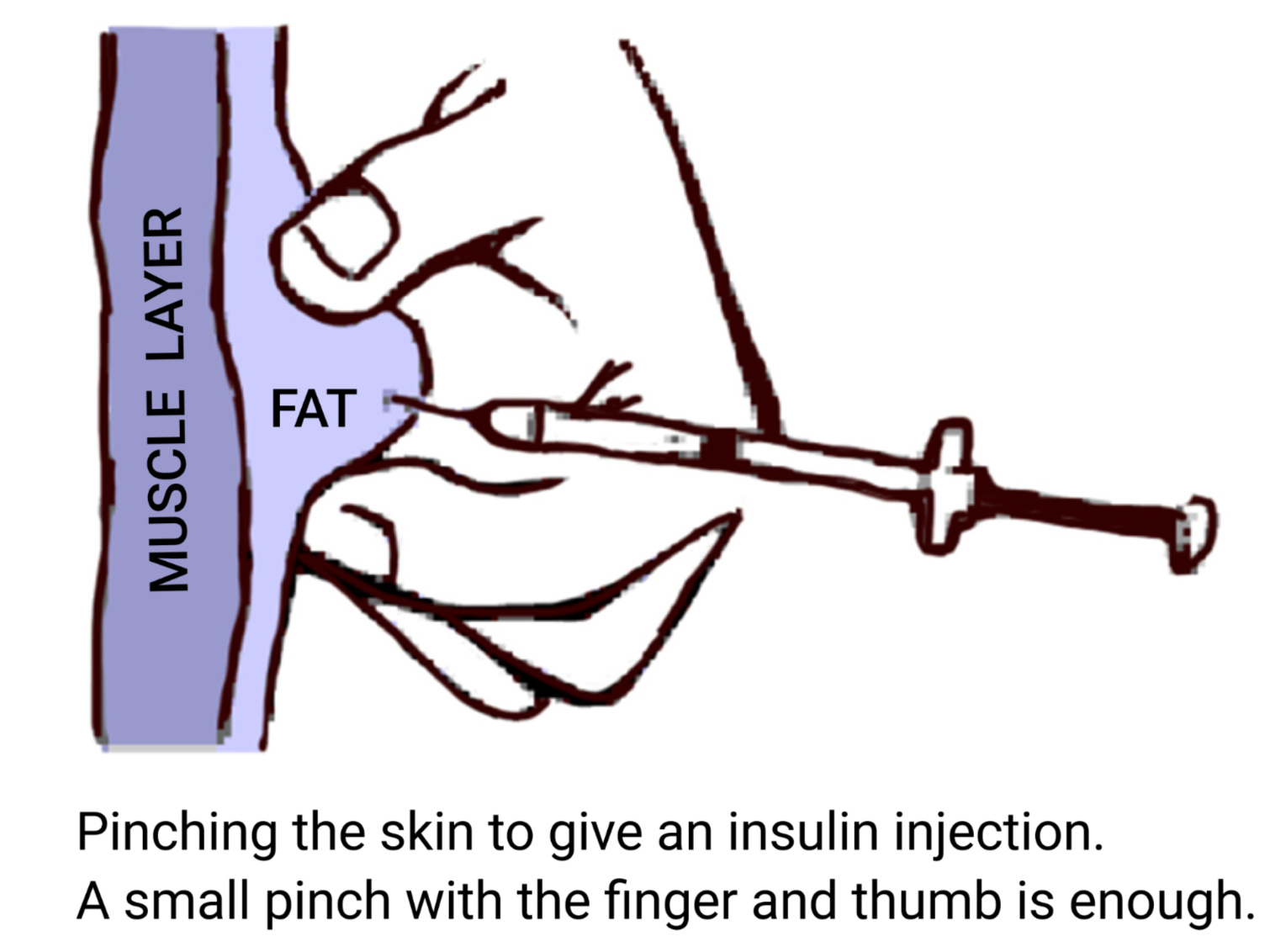
Click on image to enlarge
- Insulin injection by syringe is usually given into deep subcutaneous tissue through a two-finger pinch of skin at an angle of 45–90 degrees.
- The subcutaneous fat layer should be thicker than the needle length.
- There is significant risk of accidental intramuscular injections with more rapid absorption, especially in lean individuals. This can be minimised by using a two-finger pinch technique, an injection angle of 90 degrees and use of 5 mm needles rather than longer needles in all ages.
- Withdraw the needle and release the skin fold on the count of ten.
- Disinfection of the skin is not necessary prior to insulin injections, however, injections should be given through clean, healthy skin.
- Needles should not be used for more than 6 injections.
- Prefilled insulin syringes are recommended for children. Pen devices delivering less than 1 unit should be available for selected patients.
- Thoroughly mix all insulin suspensions before injection by rolling or inverting the vial ten times so that the cloudy suspension mixes thoroughly and uniformly.
Duration of action of standard insulins
| Insulin | Onset of action | Peak action | Effective duration |
| Regular/short-acting | 30–60 minutes | 2–4 hours | 5–8 hours |
| Intermediate-acting | 2–4 hours | 4–12 hours | 12–20 hours |
Choice of insulin regimen
- No insulin injection regimen satisfactorily mimics normal physiology.
The choice of insulin regimen should be individualised and will depend on age, duration of diabetes, lifestyle (dietary patterns, exercise schedules, school, work commitments, etc), targets of glycaemic control, and particularly, individual patient/family preferences. - The choice of an insulin regimen is determined by the patient’s circumstances. Depending on the patient’s scope to undertake insulin therapy, a number of alternatives will allow insulin therapy to be tailored to their lifestyle. Discussion with parents should provide the basis for such important decisions.
- It is not possible to prescribe a single best regimen for preschool and primary school children. Individualise the choice of regimen according to family circumstances.
- Multiple daily injections provide for the best glycaemic control in young people with type 1 diabetes. If manageable, the basal-bolus regimen should be the regimen of choice. A twice daily injection regimen is not recommended, but 3 injections a day is a good alternative.
Questions to be considered when choosing a regimen
What scope does the patient have for insulin therapy?
- Will the patient be able to undertake, financially and culturally, an advanced insulin regimen if necessary?
- Is a responsible person available to give insulin injections at all times of the day or only at certain times?
- How goal-orientated is the patient/caregiver in terms of diabetes control?
What is the patient’s eating pattern?
- What is the typical pattern of meals?
- What type of food do they typically eat at each meal, and how much?
- Is their eating pattern relatively constant, or does it vary?
- Can and will they change their eating habits?
All chosen insulin regimens should be supported by comprehensive education appropriate for the age, maturity and individual needs of the child and family.
Selecting an insulin regimen
Total daily insulin dose
This is individualised and varies according to age, puberty development, stress and individual variability. The usual range is 0.5–1 units/kg/day, but may be higher or lower.
The aim is to select a regimen that allows the achievement of glycaemic control without disabling hypoglycaemia. This also requires a comprehensive support programme for the child and family enabling the implementation of an appropriate diet and other care strategies. These include home blood glucose monitoring and the ability to recognise and manage hypoglycaemic episodes. Where glycaemic control is not achieved despite an adequate support programme, consider referral to a tertiary centre.
Insulin regimens
Consult with a paediatric endocrinologist or paediatrician with experience in diabetes care. Repeated consultations are indicated when glycaemic control targets are not achieved.
Basal-bolus regimen
- Short acting insulin 15–30 minutes before a meal or rapid-acting insulin with main meals e.g. breakfast, lunch and main evening meal; intermediate acting insulin before bed.
- Normally, 30–40% of the total daily dose of insulin is given at bedtime as intermediate-acting insulin. The remaining insulin is given prior to breakfast, lunch and evening meal in the form of short-acting insulin.
|
Basal-bolus regimen Short-acting insulin is indicated in the child (especially < 5 years of age) with erratic eating habits despite adequate education. |
||
| Breakfast | Short-acting insulin | 20% of total daily dose (if able to count carbohydrates: give 1 unit per 15 g) |
| Lunch | Short-acting insulin | 20% of total daily dose |
| Supper | Short-acting insulin | 20% of total daily dose |
| At night (±21h00) | Intermediate-acting insulin (ideally this ought to be a basal insulin acting over 24 hours) | 40% of total daily dose |
Three injections daily regimen
- A mixture of short- and intermediate- acting (premixed 70:30) insulin before breakfast; short acting insulin alone before an afternoon snack or main evening meal; intermediate- acting insulin before bed; or variations of this regimen may be used at times.
- This requires that the caregiver is aware of three different insulin preparations and can differentiate between them.
|
Three injections daily regimen |
||
| Breakfast | Short-acting insulin (30% of morning dose) + Intermediate-acting insulin (70% of morning dose) |
2/3 of total daily dose |
| Supper |
Short-acting insulin (1/3 of evening dose) |
|
| At night (±21h00) |
Intermediate-acting insulin (2/3 of evening dose) |
1/3 of total daily dose |
None of these regimens can be optimised without frequent assessment of blood glucose monitoring.
Achieving a balance between food intake, insulin levels and energy expenditure is an essential pre-requisite for achieving glycaemic control.
Adjustment of insulin dosage for 3 injections daily regimen
The insulin dose should not be changed after a single abnormal blood glucose reading.
Adjust the dose only once a pattern has been established. The dose to be adjusted depends on the time of abnormal glucose readings, as indicated in the table below:
Three injections daily regimen |
||
| Timing of the unsatisfactory blood glucose level | Insulin dose to be increased if glucose too high | Insulin dose be decreased if glucose too low |
| Before breakfast |
21h00 dose: intermediate-acting insulin |
|
| Before lunch |
Breakfast dose: short-acting insulin |
|
| Before supper |
Breakfast dose: intermediate-acting insulin |
|
| At ± 21h00 | Supper dose: short-acting insulin | |
Basal-bolus regimen |
||
| Insulin dose to be increased if glucose too high | Insulin dose to be decreased if glucose too low | |
| Before breakfast |
21h00 dose: intermediate- acting insulin |
|
| 2 hours after breakfast |
Breakfast dose: rapid (or short-acting) insulin |
|
| 2 hours after lunch |
Lunch dose: rapid (or short- acting) insulin |
|
| At ± 21h00 |
Supper dose: Rapid-acting (or short-acting) insulin |
|
REFERRAL
- Management of all children with diabetes should be supervised by a paediatrician with experience in managing diabetes in the young and should involve a multidisciplinary team, i.e. paediatrician, dietician, nurse educator, psychologist, ophthalmologist at a regional hospital.
- Complications.
- Uncontrolled diabetics, such as children with unpredictable blood glucose control, nocturnal or frequent hypoglycaemic events or children who do not reach their therapeutic goals for consideration of analogue insulin.
- Periodic screening of eyes by an ophthalmologist:
- prepubertal onset of diabetes: 5 years after onset and annually thereafter;
- pubertal onset of diabetes: 2 years after onset and annually thereafter.
Standard Treatment Guidelines and Essential Medicines List for South Africa, Hospital Level, Paediatrics, 2023 Edition
Chapter 7: Endocrine, 7.5.1 Type 1 Diabetes Mellitus