Diabetic Hyperglycaemic Emergencies
Diabetic hyperglycaemic emergencies
Introduction
Identification
Severity assessment
Management based on severity
Relevant history, examination
Investigations
Referral criteria
Discharge
Treatment Algorithm
Introduction/ Description
- DKA: Diabetic ketoacidosis is a serious hyperglycaemic complication of diabetes that occurs when the body produces high levels of blood ketones in response to its inability to produce enough insulin.
- HHS: Hyperosmolar hyperglycaemic state is a complication of predominantly type 2 diabetes in which high blood glucose causes severe dehydration and increases in osmolality (usually > 320 mosmol/kg).
- Simple hyperglycaemia: A less serious complication of diabetes that occurs when blood glucose is raised without any production of ketones or increases in osmolality
Identification/recognition/diagnosis of problem
Early symptoms of DKA include polydipsia and polyuria. Malaise, generalised weakness and fatigability, often associated with nausea, vomiting, diffuse abdominal pain, decreased appetite and anorexia are often present on admission. Altered consciousness points to severe disease. Causes include:
- Non-compliance of medication (non-adherence or medication error)
- Sepsis (ENT, respiratory, meningitis, PID, appendicitis, skin, feet)
- New diabetic/ first diagnosis
- Acute coronary syndrome
- Stroke
- Pancreatitis
Differential Diagnosis
- Alcoholic ketoacidosis
- Appendicitis, acute
- Hyperosmolar coma
- Hypophosphatemia
- Hypothermia
- Lactic acidosis
- Metabolic acidosis
- Acute coronary syndrome
- Pancreatitis, acute
- Pneumonia, immunocompromised
- Shock, septic
- Toxicity, salicylate
- Urinary tract infection
Severity assessment (Triage)
| Diabetic ketoacidosis | Hyperosmolar hyperglycaemic state | Simple hyperglycaemia | |||
| Mild | Moderate | Severe | |||
| Glucose | ≥ 14 | ≥ 14 | ≥ 14 | ≥ 30 | ≥ 14 |
| pH | 7.25- 7.3 | 7.0- 7.24 | < 7.0 | > 7.3 | > 7.3 |
| Bicarbonate | 15- 18 | 10- 15 | 10- 15 | > 18 | > 18 |
| U-ketones | Positive | Positive | Positive | ≤ 1 | Absent |
| Mental state | Alert | Alert/ drowsy | Stupor/ coma | Stupor/ coma | Alert |
Management based on severity
Immediate action
Stabilise using ABCs, perform blood glucose 2 hourly, apply oxygen if hypoxic and establish IV access.
Non-drug treatment: Fluid Management
| Systolic BP ≤ 90mmHg | Resuscitate with Saline 0.9% until SBP > 90 mmHg |
| Systolic BP > 90mmHg | 1 L Fluid IV over 1 hour 1 L Fluid IV over 2 hours 1 L Fluid IV over 2 hours 1 L Fluid IV over 4 hours Then 1 L Fluid IV 6 hourly |
- Choice of fluid:
- Saline 0.9% as initial fluid
- If Glucose ≥ 15mmol/l continue Saline 0.9% 1L 6 hourly
- If Glucose < 15 mmol/l change to 5% Dextrose containing fluid (e.g. Rehydration Solution) 1L 6 hourly
- In HHS change to Saline 0.45% only if osmolality and glucose not declining using standard regiment above (should always be done in consultation with the medical team)
- Adjust rate of fluid administration in elderly patients and patients with poor cardiac function or renal compromise.
Drug treatment
- Insulin Administration: start once SBP > 90mmHg
- Rate minder available: 50 Units Actrapid in 200 ml N/S at rate of 24 ml/hr (6 Units/hr)
- No rate minder then: 10 Units SC stat, then 6 Units Actrapid SC hourly
- Hourly glucose checks once insulin started
- Keep at constant rate as above and change fluid depending on glucose until DKA resolved
- Potassium administration: Repeat K+ every 6 hours and adjust replacement as needed
| K+ > 5 mmol/L | No replacement |
| K+ 4.1- 5 mmol/L | 20 mmol (1 amp) in each litre of fluid |
| K+ 3.1- 4 mmol/L | 30 mmol (1 amp) in each litre of fluid |
| K+ < 3 mmol/L | 40 mmol (1 amp) in each litre of fluid |
- Bicarbonate Administration
- No evidence that it improves morbidity/ mortality. Worsens the ketosis and delays clearance of blood ketones. If to be given first ensure patient is fluid resuscitated and then consider:
- If pH < 6.9 then 100 mmol 4 % NaHCO3 in 400 mL Saline 0.9% with 20 mmol KCL over 2 hours
- If pH < 7 then 50 mmol 4 % NaHCO3 in 200 mL Saline 0.9% with 10 mmol KCl over 2 hours
- No evidence that it improves morbidity/ mortality. Worsens the ketosis and delays clearance of blood ketones. If to be given first ensure patient is fluid resuscitated and then consider:
- Antibiotic Administration
- If source of sepsis found then antibiotics administered according to presumed organisms
- If pH < 7 OR patient not responding to treatment then Blood Culture and administer broad spectrum antibiotics
- DVT Prophylaxis
- If patient drowsy/ decreased LOC then give DVT prophylaxis
- Resolution of DKA/ HHS: Glucose < 11; Bicarbonate ≥ 18; pH> 7.3; normalisation of the serum anion gap (less than 12 mEq/L; anion gap = Na+ - (Cl- + HCO3-)); patient has resumed eating and drinking with normal level of consciousness
- Patient will still require a further period of observation prior to discharge to ensure glucose levels stabilise
- Start usual medications as soon as possible following resolution
- In newly diagnosed diabetics start on a sliding scale or appropriate regime and adjust as needed. Provide the first sc dose at least an hour prior to cessation of the infusion in association with a meal.
| Insulin sliding scale for SC use after resolution of DKA/ HHS | |
0 – 3 mmol/L | 50 mL of 50% dextrose IV Stat and call doctor |
3 – 10 mmol/L | Nil |
10.1 – 12 mmol/L | 2 Units Actrapid sc |
12.1 – 14 mmol/L | 4 Units Actrapid sc |
14.1 – 16 mmol/L | 6 Units Actrapid sc |
16.1 – 18 mmol/L | 8 Units Actrapid sc |
18.1 – 20 mmol/L | 10 Units Actrapid sc |
> 20 mmol/L | 10 Units Actrapid sc, check in 30 minutes and repeat dose if still > 20 mmol/L and inform doctor |
Relevant history, Examination
- Examine for precipitants (e.g. infection; arrhythmias; anaemia)
- Measure and Record Vital Signs
- Point of care haemoglobin and glucose
Investigations
- Venous blood gas and U-dipstick
- FBC, renal function
- ECG
- CXR
- Osmolality (if unable to measure an approximation of osmolarity can be calculated where osmolarity = 2 x Na + glucose + urea
Referral criteria
- Confirmed DKA/HHS: admit to ICU or high dependency are under medical team
- Simple hyperglycaemia: admit medicine
Discharge
- If discharging patient, write a comprehensive referral letter back to the clinic, and consider an MOPD appointment for specialist input.
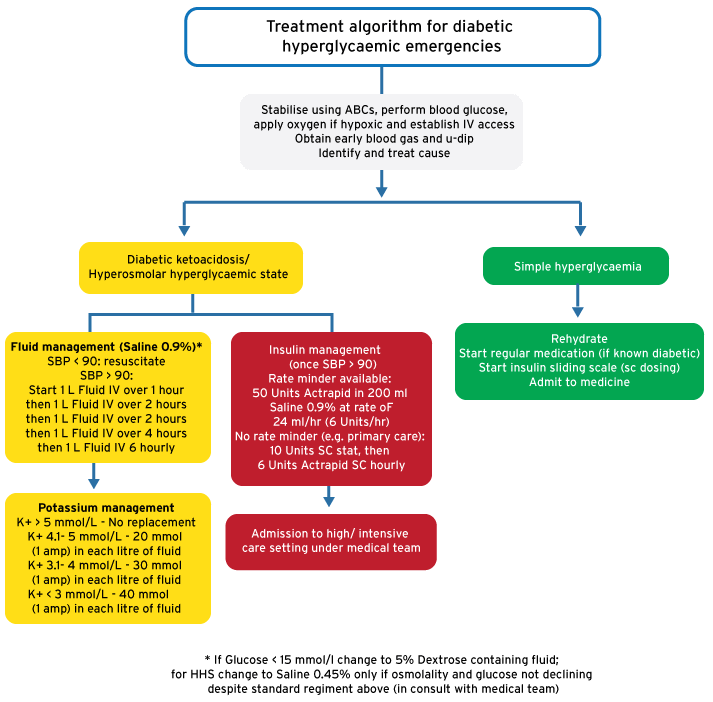
Treatment algorithm for diabetic hyperglycaemic emergencies
| Diabetic ketoacidosis | Hyperosmolar hyperglycaemic state | Simple hyperglycaemia | |||
| Mild | Moderate | Severe | |||
| Glucose | ≥ 14 | ≥ 14 | ≥ 14 | ≥ 30 | ≥ 14 |
| pH | 7.25- 7.3 | 7.0- 7.24 | < 7.0 | > 7.3 | > 7.3 |
| Bicarbonate | 15- 18 | 10- 15 | < 10 | > 18 | ≥ 18 |
| U-ketones | Positive | Positive | Positive | ≤ 1 | Absent |
| Mental state | Alert | Alert/ drowsy | Stupor/ coma | Stupor/ coma | Alert |