Diagnosis and Clinical Characteristics
These are the approved guidelines published by the South African Society of Psychiatrists to provide an overview on treatment and management of commonly diagnosed psychiatric illnesses. The guidelines include consensus recommendations, based on peer contribution and using the international evidence based guidelines that are suitable for the local South African health service.
Please note that parts of this guideline may be out of date, an update will be published as soon as it is available.
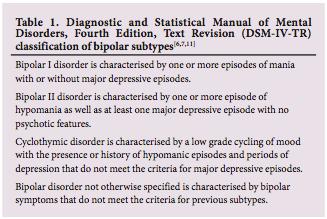
The diagnosis should be made with rigour. As the full spectrum of the disorder does not present itself at one point in time only, the diagnosis should be made over time. Table 1 below summarises the Diagnostic and Statistical Manual of Mental Disorders, Fourth Edition, Text Revision (DSM-IV-TR)[6] classification of bipolar subtypes.[7,8]
The International Society for Bipolar Disorders (ISBD) Diagnostic Guidelines Task Force made the following recommendations for the DSM-V and International Classification of Diseases 11th Revision (ICD-11) for BD.[1] For BD I, the DSM-V criteria for mania should remain similar, but for bipolar depression, the criteria should include a probabilistic approach acknowledging the presence of: (i) atypical depressive symptoms (hyperphagia, hypersomnia, or leaden paralysis); (ii) psychomotor disturbance; (iii) pathological guilt or psychotic features; and (iv) a positive family history of BD.
It was suggested that the rapid-cycling specifier for BD I should be extended to BD II and BD not otherwise specified (NOS) (now known as Other Specified Bipolar and Related Disorder in the DSM-V. The Task Force also suggested modifications to the diagnostic criteria for BD II and BD NOS to improve the identification of bipolar spectrum disorders to include the following: (i) sub-threshold hypomanic episodes, and (ii) other signs of bipolarity without manic or hypomanic episodes (also known as bipolar spectrum disorder). These include:
- Family history (BD, alcohol and substance use, mental illnesses, suicides)
- Depressive symptoms (atypical, psychomotor slowing, psychosis, seasonal)
- Course of illness (early age of onset, short duration of episodes, greater number of episodes).
Separating major depressive disorder (MDD) and BD, particularly BD II, can be a challenge.[2] Several reports have found that BD, in contrast to MDD, is associated with:
- A significantly earlier age of onset
- More recurrences
- Atypical and mixed depression
- A family history of BD or completed suicide.
A BD diagnosis is highly predicted by mixed states, especially BD II, which has been linked with an increased lifetime risk for comorbid psychiatric disorders, more mood episodes, higher rates of treatment contacts, and lower rates of full-time employment compared to pure states.
Once a BD diagnosis has been made, the diagnostic formulation should identify the episode type and the longitudinal course of illness. Valuable clinical tools that inform assessment and assist in monitoring and quantifying treatment response include the following rating scales:
- Bipolar Inventory of Symptoms Scale (BISS)
- Structured Clinical Interview for Mood Spectrum (SCI-MOOD)
- Young Mania Rating Scale (YMRS) formania
- Bipolar Depression Rating Scale (BDRS) for bipolar depression
- Mood Disorders questionnaire.
Once the diagnosis of BD has been confirmed, a comprehensive risk assessment should be completed on an ongoing basis throughout treatment. Ensuring the safety of patients with acute mania is essential, since there is an increased risk of aggression, excessive spending and dis-inhibited behaviour, decreased judgement and insight, and an increased risk of suicidal thoughts immediately after admission to, and immediately following discharge from, hospital.
The risk to others, including to children or other family members, should also be considered. The appropriate venue for treatment, i.e. inpatient or outpatient, voluntary or involuntary, should then be determined.
Table 1.