Diagnosis and Clinical Characteristics
These are the approved guidelines published by the South African Society of Psychiatrists to provide an overview on treatment and management of commonly diagnosed psychiatric illnesses. The guidelines include consensus recommendations, based on peer contribution and using the international evidence based guidelines that are suitable for the local South African health service.
Please note that parts of this guideline may be out of date, an update will be published as soon as it is available.
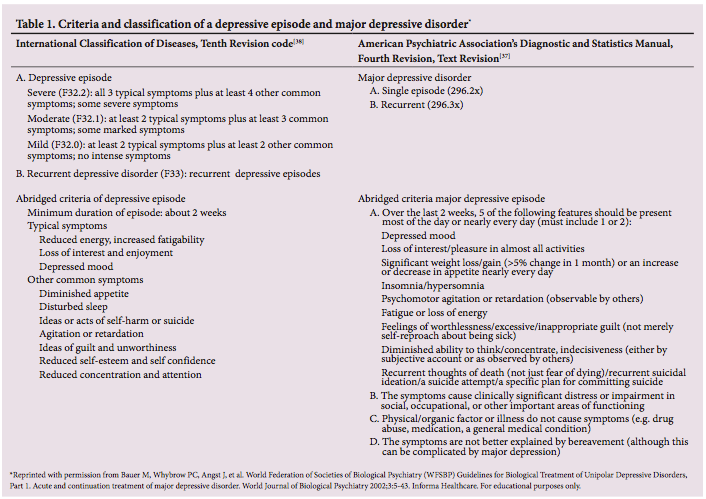
MDD is characterised by single or recurrent major depressive episodes.The essential feature of a major depressive episode is a period of at least 2 weeks of depressed mood with abnormalities of neurovegetative functions (e.g. appetite, weight loss, sleep disturbances), psychomotoractivity (e.g. loss of energy and interests, agitation or retardation), cognition (feelings of worthlessness, hopelessness or in appropriate guilt), as well as anxiety and suicidal ideation.[1]
Table 1 below summarises the diagnostic criteria according to the Diagnostic and Statistical Manual of Mental Disorders, Fourth Edition, Text Revision (DSM-IV-TR)[37] as well as the International Statistical Classification of Diseases and Related Health Problems, Tenth Revision (ICD-10).[38] Depressive symptoms and pathology lie on a spectrum in terms of duration, severity and comorbid pathology.
Course and prognosis
An untreated depressive episode typically lasts about 6 months or longer.[1,19,39] Modern pharmacotherapy alleviates suffering during acute episodes, and placebo-controlled trials show response and remission occurring more quickly in actively treated groups. A 27-year prospective study of 186 uni-polar depressed patients meeting DSM-III criteria for major depression found shorter episodes and cycles with increasing episode number.[19] However, a 10-year prospective study of 258 subjects treated for uni-polar MDD showed that the duration of recurrent mood episodes remained relatively uniform over time and averaged approximately 20 weeks.[39]
MDD is typically a recurrent disorder and 50 - 85% of the patients who have an episode will eventually have another episode.[40,41] There is also increasing evidence that some who experience a major depressive episode will have a lifelong course of illness characterised by recurrent major depressive episodes or the development of chronicity, e.g.recurrent MDD without full inter-episodic recovery, or a chronic major depressive episode, or ‘double depression’ (concurrent major depression and dysthymic disorder).[31,42-44] Between 9% and 24% of patients with the initial diagnosis of a major depressive episode will undergo a change in diagnosis over time, mostly to bipolar disorder.[19,39]
Although the prognosis for a depressive episode is good, with most patients returning to normal functioning once the episode is over, in 20 - 30% of cases depressive symptoms will persist.[40,43,45-47]
Table 1.