Diagnosis, Clinical Characteristics and Course
These are the approved guidelines published by the South African Society of Psychiatrists to provide an overview on treatment and management of commonly diagnosed psychiatric illnesses. The guidelines include consensus recommendations, based on peer contribution and using the international evidence based guidelines that are suitable for the local South African health service.
Please note that parts of this guideline may be out of date, an update will be published as soon as it is available.
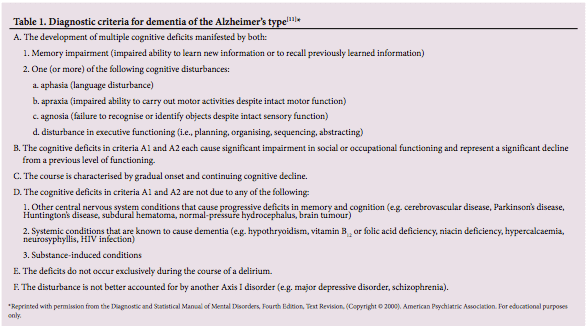
The diagnostic criteria for AD are outlined in Table 1 below.[11]
Clinical features include the following:
- Memory impairment: Poor memory must interfere with daily functioning. Initially, short-term memory is affected, with the later involvement of long-term memory.
- Personality and behavioural changes: Emotions are shallow and easily influenced by environmental factors; irritability and bouts of anger are common. Usually pre-morbid traits become more accentuated. There is a loss of initiative and the person becomes increasingly apathetic and withdrawn. Emotional blunting ensues, and may be mistaken for depression.
- Intellectual impairment: Thinking becomes more concrete. There are word-finding and other language difficulties (dysphasia), the person may no longer recognise familiar faces or objects (agnosia) and may be unable to carry out simple manual tasks such as fixing a plug or dressing themselves (apraxia). A key feature is the instrumental impairment of activities of daily living (e.g. ability to use telephone, shop, handle finances).
- Physical changes: As the disease progresses, the patient appears unduly frail and weak, is stooped in posture with slow, shuffling gait and mild tremor of the hands. There is weight loss, regardless of appetite, increasing bouts of restlessness and confusion, and reduced sphincter control.
Course
This may give an indication of aetiology. Patients with vascular (especially multi-infarct) dementia and to some extent alcohol-induced dementia will present with patchy memory loss and fluctuating disturbances in language and behaviour with a relatively well-preserved personality in the earlier phases, characterised by appropriate social interaction.
- A step-wise deterioration rather than a steady even pattern
- A more abrupt deterioration rather than slow, insidious onset
- Attacks of dizziness, frequent falls and fainting spells, nocturnal confusion
- Bouts of urinary urgency, particularly at night
Table 1.