Diagnosis of axSpA and Screening Tools
Early diagnosis and prompt treatment initiation are essential in the management of axSpA. Delays can result in higher disease burden, progressive structural damage, decreased health-related quality of life (HRQoL) and substantial economic burden, and negative outcomes regarding employability.[6-9] Both underdiagnosis and overdiagnosis of axSpA are prevalent. [10,11] Screening tools for axSpA have
Early diagnosis and prompt treatment initiation are essential in the management of axSpA. Delays can result in higher disease burden, progressive structural damage, decreased health-related quality of life (HRQoL) and substantial economic burden, and negative outcomes regarding employability.[6-9] Both underdiagnosis and overdiagnosis of axSpA are prevalent.[10,11]
Screening tools for axSpA have been developed (Table 1).[12,13] All patients with lower back pain, especially those with symptom onset aged ≤40 years, should be screened for inflammatory features. If present, imaging of sacroiliac joints (SIJ) and HLA-B27 antigen testing should be considered.[14]
| Table 1. Screening approach to chronic back pain. Patients with chronic low back pain (duration ≥3 months) with back pain onset <40 years of age should be referred to a rheumatologist if ≥1 of the following parameters is present | |
| Parameter | Details |
| Inflammatory back pain | Any set of criteria, preferably ASAS definition of inflammatory back pain: four out of the following five parameters: (i) age at onset <40 years; (ii) insidious onset; (iii) improvement with exercise; (iv) no improvement with rest; (v) night pain with improvement upon getting up |
| Peripheral manifestations (arthritis, enthesitis and/or dactylitis) | Past or present, diagnosed by a physician |
| Extra-articular manifestations (psoriasis, inflammatory bowel disease and/or uveitis) | Past or present, diagnosed by a physician |
| Positive family history of SpA | Presence in first-degree or second-degree relatives of any of the following: (i) axSpA; (ii) psoriasis; (iii) acute uveitis; (iv) reactive arthritis; (v) IBD |
| Good response to NSAID | 24 - 48 hours after a full dose of a NSAID the back pain is not present any more or is much better |
| HLA-B27 test | Only 5% of the general population with HLA-B27 positivity have SpA 20 - 33% of persons with chronic back pain and HLA-B27 positivity have SpA Moderate cost: done once only |
| Sacroiliitis on imaging, if available (X-ray or MRI) | Only if imaging is available, not recommended as routine screening parameter |
| Elevated acute phase reactants | CRP serum concentration or erythrocyte sedimentation rate above upper normal limit after exclusion of other causes for elevation |
| ASAS = Assessment of SpondyloArthritis International Society; SpA = spondyloarthritis; axSpA = axial spondyloarthritis; IBD = inflammatory bowel disease; NSAID = non-steroidal antiinflammatory drug; HLA-B27 = human leukocyte antigen B27; MRI = magnetic resonance imaging; CRP = C-reactive protein. | |
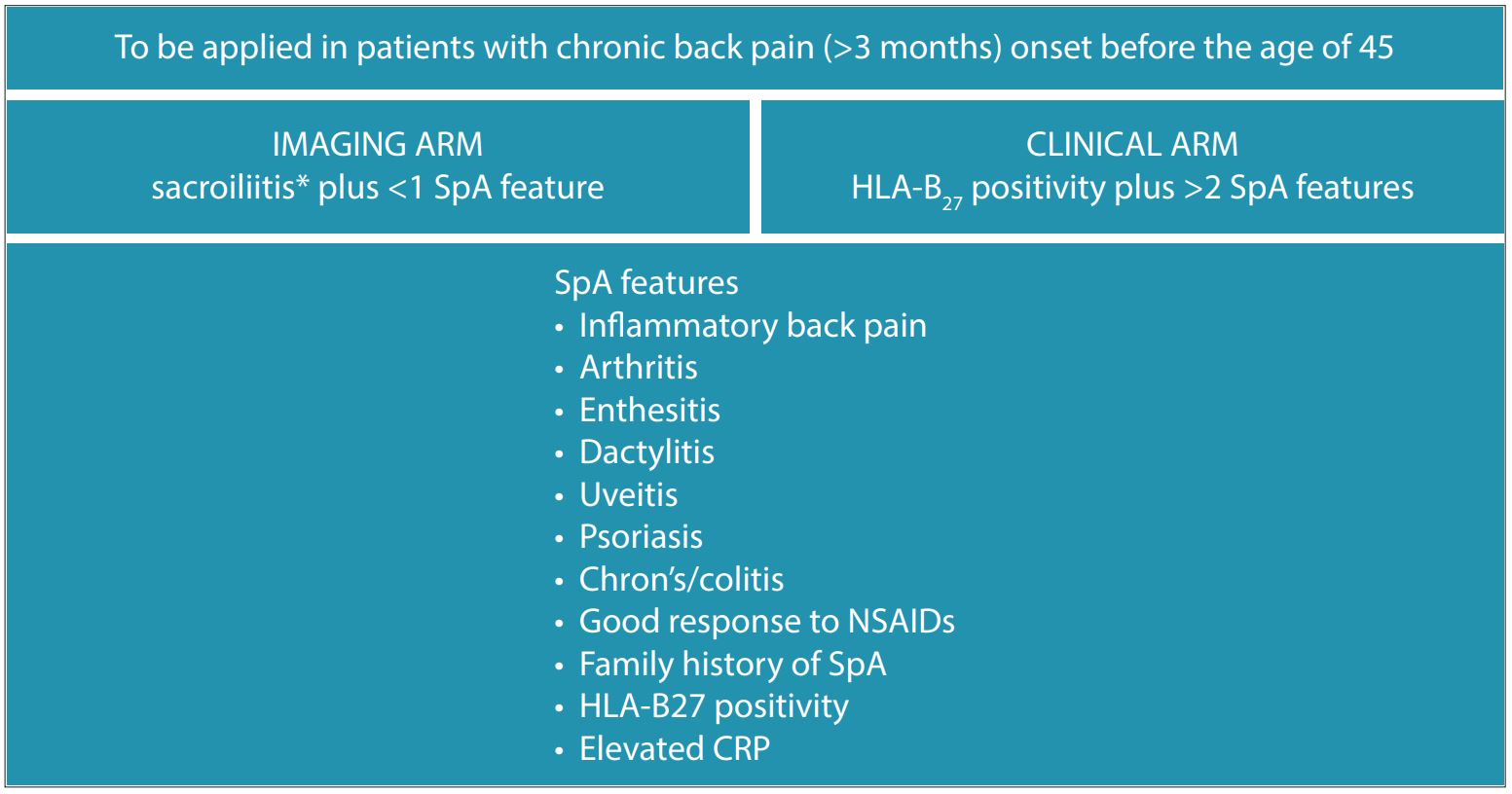
A clinical diagnosis of axSpA, based on the clinical presentation in combination with laboratory and imaging tests, and excluding other potentially more likely diagnoses, is the starting point. The Assessment of SpondyloArthritis International Society (ASAS) has developed classification criteria (Fig. 1) that are highly specific and sensitive.[15,16]
 Click on the image to enlarge
Fig. 1. Assessment of Spondyloarthritis International Society (ASAS) classification criteria for axial spondyloarthritis (reproduced with permission). (SpA = spondyloarthritis; HLA-B27 = human leukocyte antigen B27; NSAIDs = non-steroidal anti-inflammatory drugs; CRP = C-reactive protein.)
*Sacroiliitis may be definite radiographically according to modified New York criteria, or by active inflammation on sacroiliac joint magnetic resonance imaging showing clear presence of bone marrow oedema or osteitis.
Overdiagnosis of axSpA is often related to false positive MRI findings, poor awareness of the differential diagnosis of axSpA and widespread pain syndromes such as fibromyalgia.[17-19] Mechanical causes of sacroiliitis include previous back surgery with malalignment, hypermobility with scoliosis/kyphosis, pregnancy, athletes and participants in extreme sports. Infection, particularly tuberculosis and brucellosis, must be considered.[20]
Maharaj, A. B., et al. (2024). South African Rheumatism and Arthritis Association 2024 guidelines for the management of axial spondyloarthritis. South African Medical Journal, 114(10), e2668.