Diagnosis of RR-TB
Key points Types of laboratory testing and estimated turnaround times Laboratory reflex testing workflow Interpretation of laboratory test results Extended DST request Laboratory testing: Special situations Key points to consider in RR-TB diagnosis in children Key points All persons with signs and symptoms of TB should have a specimen sent for Genotypic testing (e.g. Xpert MTB/RIF Ultra testing)
Types of laboratory testing and estimated turnaround times
Laboratory reflex testing workflow
Interpretation of laboratory test results
Laboratory testing: Special situations
Key points to consider in RR-TB diagnosis in children
Key points
- All persons with signs and symptoms of TB should have a specimen sent for Genotypic testing (e.g. Xpert MTB/RIF Ultra testing) [12].
- Persons who test positive for M. tuberculosis with rifampicin resistance will have DR-TB reflex testing that includes TB microscopy, TB culture, genotypic, second line testing for fluoroquinolones (Xpert XDR cartridge) and phenotypic testing for bedaquiline and linezolid.
- Clinicians should call the laboratory to discuss any discordant results.
- Resistance testing for delamanid and pretomanid should be requested in all patients with > 1 month exposure prior (in addition to bedaquiline and linezolid) when these tests become available.
Types of laboratory testing and estimated turnaround times
| TYPE OF TEST | WHEN DONE | Estimated TAT* | RESULT | |
| Primary diagnosis: Mtb and first-line | Diagnostic investigation using WHO recommended molecular diagnostics | 48 hours | Mtb detected and susceptibility to rifampicin and isoniazid or rifampicin only (test dependent) | |
| Genotypic | XDR cartridge | Mtb detected and rifampicin resistant | 48 hours | Susceptibility to isoniazid, ethionamide, second line injectables and fluoroquinolones. |
| Phenotypic DST for isoniazid (will not be done routinely) | In-lab reflex done when rifampicin resistant and isoniazid susceptible. | Confirm susceptibility to isoniazid if INH will be added to the treatment regimen. | ||
| Second-line phenotypic DST | In-lab reflex done when resistant to rifampicin. | Confirm susceptibility to linezolid and bedaquiline | ||
| If resistant to FLQ or BDQ or LZD laboratories will send samples to NTBRL for pretomanid testing. | Susceptibility to pretomanid. | |||
| Individualized Extended Phenotypic DST (done by the National Institute of Communicable Diseases) | Requested when RR-TB regimen failing, resistant to BDQ or LZD or previous exposure to second-line drugs | Susceptibility to multiple TB drugs, used to construct a rescue regimen | ||
*TAT, Turn around time
Laboratory reflex testing workflow
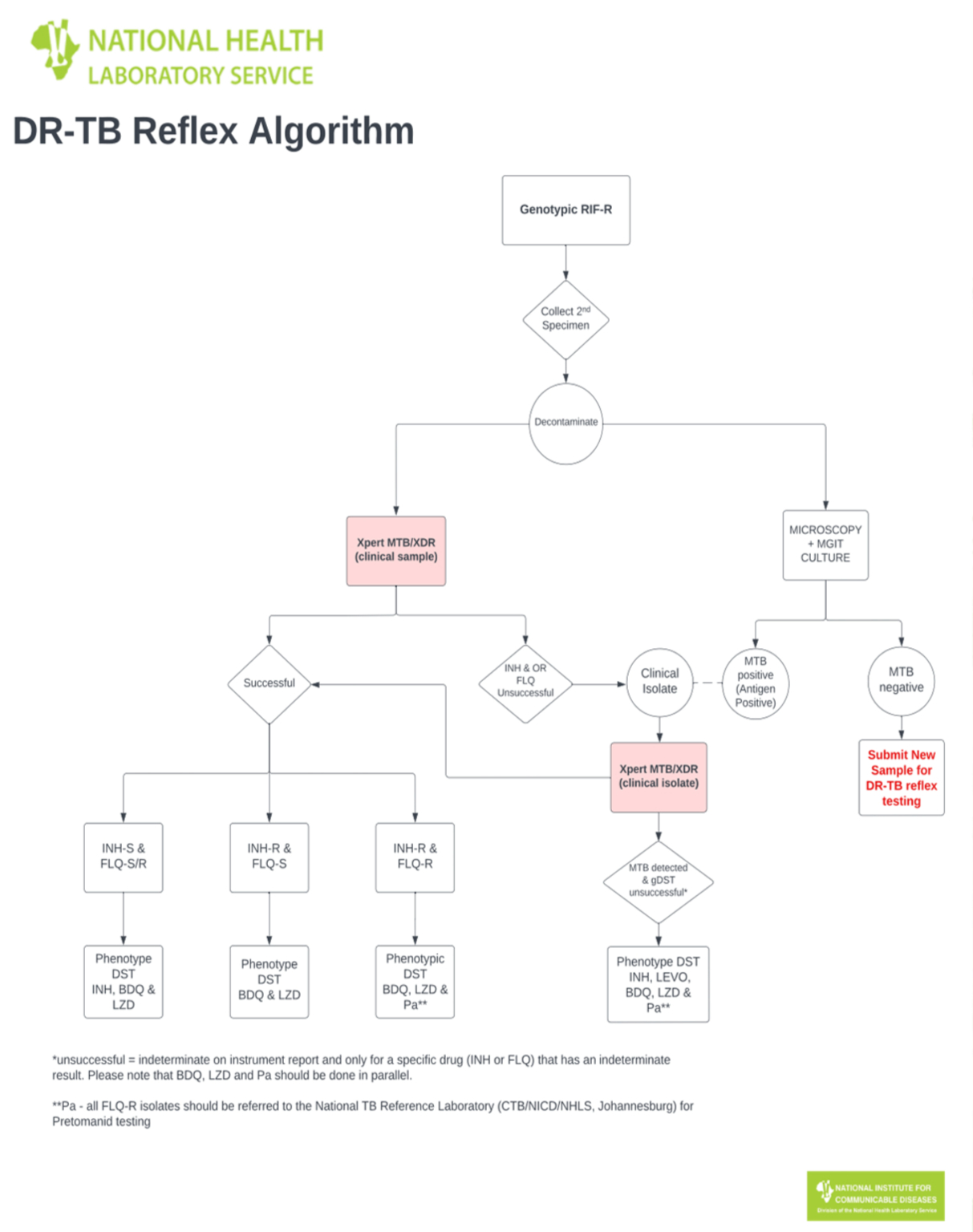
Click on the image to enlarge.
Interpretation of laboratory test results
Patients started on the short regimen based on genotypic (e.g. GeneXpert) rifampicin resistance
| Genotypic Results INH, ETH, SLID and FLQ and phenotypic BDQ, LZD and Pa | Action |
| INH resistant (any combination of inhA and/or katG mutation) or katG | Continue short RR-TB regimen (BPaL-L), modify according to other genotypic and phenotypic susceptibility results. |
| INH susceptible | Continue short RR-TB regimen (BPaL-L), modify according to other genotypic and or phenotypic results. |
| Susceptible to fluoroquinolones | Continue BPaL-L |
| Resistant to fluoroquinolones | Continue BPaL and stop levofloxacin |
| Susceptible or Resistant to injectable | Continue BPaL-L |
| Resistant to ethionamide | Continue BPaL-L |
Short RR-TB regimen = BPaL-L
Extended DST request
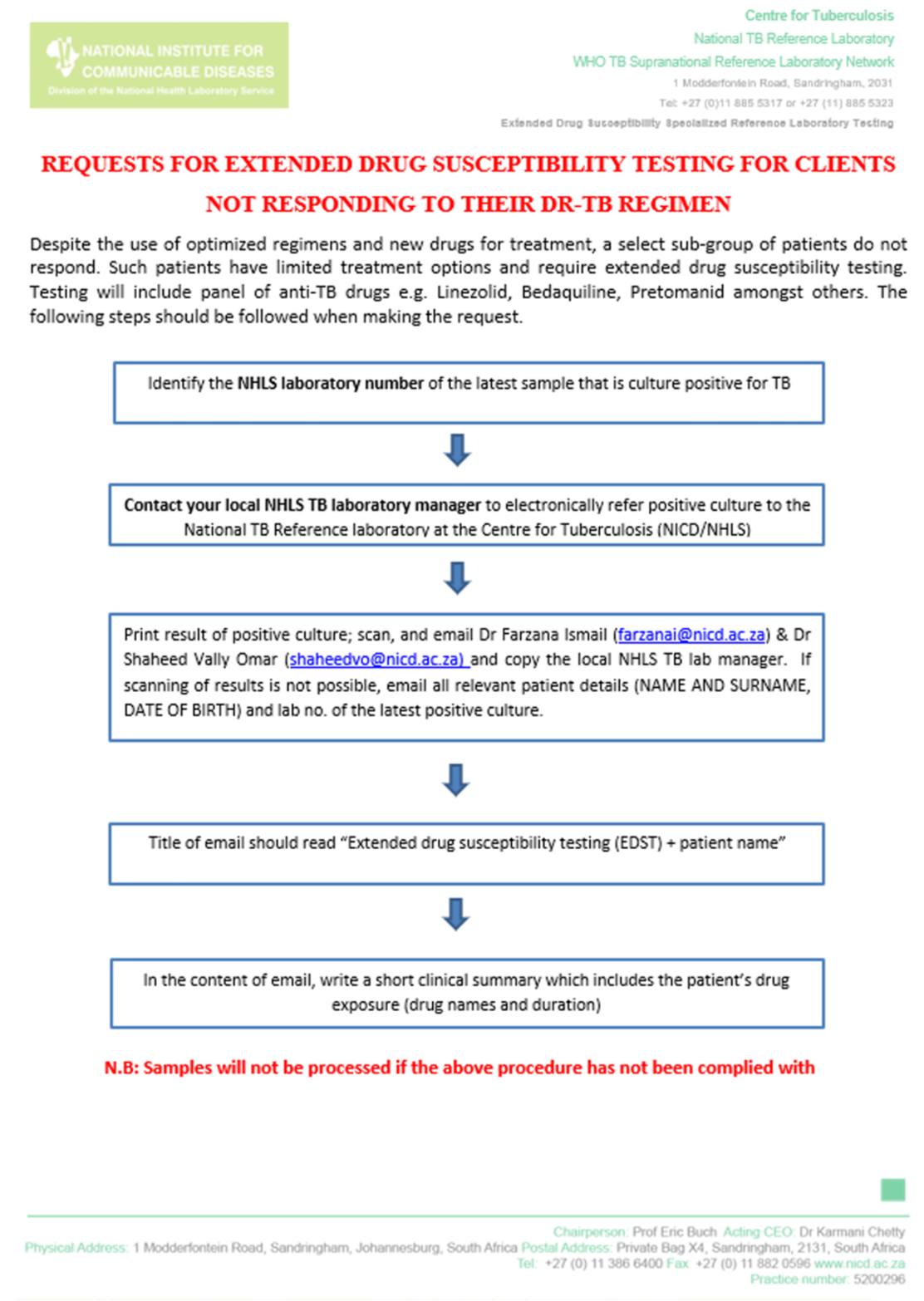
Click on the image to enlarge.
Laboratory testing: Special situations
| Situation | Recommended Actions |
| Treatment of a patient where Genotypic testing (e.g. Xpert MTB/RIF Ultra) is positive and rifampicin resistant, however GeneXpert XDR results are pending |
Assess clinical risk factors and if no exclusion factors start on a short regimen. If no resistance testing results are available, then the patient should continue the short regimen but follow up closely to monitor response both clinically and microbiologically. |
| Discordant results between phenotypic and genotypic tests |
Clinician to phone the laboratory to discuss discordant results. In general, treatment should be based on the “most resistant” scenario; consult with PCAC or NCAC. |
Key points to consider in RR-TB diagnosis in children
- The diagnosis of TB disease in children is often made on patient history, clinical and radiological grounds with consideration of RR-TB disease based on risk factors for RR-TB, such as recent RR-TB exposure or failure of first-line TB treatment with good adherence. However, children with clinically diagnosed TB may also have Xpert MTB/RIF or culture-confirmed RR-TB and may even be the index RR-TB case.
- Microbiological confirmation should always be attempted; at least two good-quality specimens should be collected and sent separately for Xpert MTB/RIF Ultra and mycobacterial culture and DST. Many children will not have microbiological confirmation due to paucibacillary disease or some forms of extra-pulmonary disease.
- For respiratory samples, children aged 5 years and older can usually expectorate sputum; sputum induction can assist children who struggle to produce samples. Children less than 5 years of age may require gastric aspiration or other form of sputum collection (e.g. induced sputum). Induced sputum and gastric aspirates are relatively simple procedures and should be offered in facilities at the primary healthcare level. Stool specimens can be sent for Xpert MTB/RIF Ultra, but not for culture – it is less sensitive than gastric aspirate or induced sputum but gives the opportunity to confirm TB and RIF DST. These results must be actively followed up – culture and DST may take up to 6 weeks for final results.
- Tests to diagnose EPTB, such as appropriate imaging and collection of specimens (such as fine needle aspirates, biopsies, different bodily fluids and CSF) for microbiological confirmation and DST, should be performed, where possible. Peripheral lymph node disease is the most common form of EPTB in children, and fine needle aspiration is minimally invasive and has high yield of microbiological confirmation.
- In children with microbiologically confirmed pulmonary disease, microbiological monitoring (with culture) should be done throughout treatment to assess response to therapy, as for adults.
- Children may be considered to have ‘non-severe’ disease if they are clinically diagnosed with RR-TB disease with: no bacteriological confirmation; unilateral pulmonary TB disease < 1 lobe, non-cavitating TB disease, mediastinal lymphadenopathy with no airway compression or simple pleural effusion on chest radiography; or isolated peripheral lymph node disease.
National Department of Health Clinical Management of Rifampicin-Resistant Tuberculosis, September 2023
Diagnosis of RR-TB