Drugs and Novel Therapies
Warfarin (Vitamin K antagonist) Novel oral anticoagulants Antiplatelet drugs Consensus Grade 18.1 TXA should be administered empirically in critically ill patients with severe trauma within 3 hours of the injury. Yes A 18.2 The dose of TXA in severe trauma is 1g stat and then 1g over 8 hours. Yes A 18.3 TXA should be administered empirically in bleeding obstetric patients. Yes B 18.4 The d
Warfarin (Vitamin K antagonist)
| Consensus | Grade | ||
| 18.1 | TXA should be administered empirically in critically ill patients with severe trauma within 3 hours of the injury. | Yes | A |
| 18.2 | The dose of TXA in severe trauma is 1g stat and then 1g over 8 hours. | Yes | A |
| 18.3 | TXA should be administered empirically in bleeding obstetric patients. | Yes | B |
| 18.4 | The dose of TXA in bleeding obstetric patients is 1g stat, and 1g after 30 min if bleeding persists or recurs within 24 hours. | Yes | B |
| 18.5 | Empiric use of TXA is not recommended in patients with upper gastrointestinal bleeding. | Yes | B |
| 18.6 | TXA is recommended for patients with TBI and GCS 8–13 presenting within 3 hours of injury. | Yes | B |
| 18.7 | Where available POC viscoelastic testing should be used to guide therapy with TXA. | Yes | C |
| 18.8 |
With the use of warfarin: INR to be kept between 2.0 and 2.5 according to indication. Perioperative use: stop 3–5 days before surgery: |
Yes | B |
| 18.9 | Direct acting anticoagulants – stop 48 hours before surgery. If renal impairment then stop earlier: If creatinine clearance >80ml/min/1.73m² >48 hr. If creatinine clearance 50–79ml/min/1.73m² >72 hr. If creatinine clearance <50ml/min/1.73m² >96 hr. |
Yes | B |
| 18.10 | Antiplatelet therapy: Aspirin – don’t stop, unless operating on a non-compressible site. Ticagrelor – stop 3 days before surgery. Clopidogrel – stop 5 days before surgery. Prasugrel – stop 7 days before surgery. If need to continue due to high risk of thrombosis, consider options such as GP IIb/IIIa. |
Yes | B |
| 18.11 | GP IIb/IIIa antagonists – stop at least 4 hours before surgery. (Stop Abciximab earlier as a longer time is required for recovery of platelet function 24–48 hours). | Yes | B |
| 18.12 | LMWH – stop at least12 hours before surgery if used prophylactically, and 24 hours before surgery if used in therapeutic doses. The anticoagulation effect can partially be reversed by protamine sulphate, but not completely. Consider bridging with LMWH/UFH only in patients with a high risk for thrombosis who are on oral anticoagulants. Enoxaparin – stop at least 12 hours before surgery. Fondaparinux – stop 24 hours before surgery. Stop for longer duration in patients with impaired renal function. |
Yes | B |
An increasing number of patients take either anticoagulants or antiplatelet agents. All patients require careful preoperative medication optimisation before surgery. The management of drugs related to antithrombotic therapy in the perioperative setting is a common problem, balancing bleeding risk with thrombosis.
Patients at high risk (> 10% risk of thrombotic events per year) of thrombosis should be considered for bridging anticoagulation, or in the following circumstances:
- venous thromboembolic event within the last 3 months, or
- prosthetic (mechanical) heart valve.
Bridging anticoagulation usually consists of LMWH. The dose and type of the LMWH depends on the patient’s weight, timing of surgery, type of procedure and thrombotic risks.
Warfarin (Vitamin K antagonist)
The INR is used to monitor the effectiveness of warfarin. In most situations, INR is maintained between 2.0 and 3.0. The perioperative management of warfarin is summarised in Figure 2.7 In patients with atrial fibrillation on warfarin, routine use of bridging anticoagulation with LMWH before surgery is not recommended.
For emergency reversal of warfarin, prothrombin complex concentrate (PCC) 50 IU/kg is recommended. IV vitamin K (10mg) may also be given, but this may preclude re-warfarinisation for a number of days. FFP (or FDP) is an alternative if PCC is not available,61 but should not be used as elective prophylaxis in patients taking warfarin.
Novel oral anticoagulants
Novel OACs have more predictable pharmacodynamics and a faster onset of action with a shorter half-life than warfarin. There are currently three drugs on the market (a fourth drug, Edoxaban, is not available in South Africa); these are increasingly used for management of patients with atrial fibrillation; after stroke and transient ischaemic attacks; and prophylaxis/management of venous thromboembolism.67
Their half-life varies, especially in the presence of renal impairment. Currently, there are no specific routine coagulation tests to determine their effectiveness.
Regarding antidotes, the United States Food and Drug Administration and the European Commission have recently approved the first of these, idarucizumab (Praxbind, Boehringer Ingelheim International, Ingelheim am Rhein, Germany), for the emergency reversal of dabigatran; other antidotes are currently undergoing clinical trials. Andexanet the antidote for reversal of Anti Xa inhibitors is not yet approved for use by the EMA (European Medicines Agency).
Dabigatran is a direct thrombin inhibitor. Half-life (14–17 hours) depends on extent of renal impairment (normally cessation duration 48–96 h). For major elective surgery, neuraxial blockade and in patients with renal dysfunction, the drug should be stopped 5 days before surgery. For others, it can be stopped 3 days before surgery.
Rivaroxaban and apixaban (Edoxaban) are direct factor Xa inhibitors. Half-life is 5–13 h and is less dependent on renal function. For major elective surgery, neuraxial blockade and in patients with renal dysfunction, the drug should be stopped 48 hours before surgery.
If surgery is urgent, consider PCC 50 IU/kg, correct other abnormal coagulation tests and check platelets. Bridging anticoagulation is not required except in patients with recent (<3 months) history of pulmonary embolism or deep venous thrombosis. Bridging is required if there has been an acute thrombotic events <4 weeks.7
Antiplatelet drugs
These drugs cause irreversible inhibition of platelets; replenishment of platelets occurs at a rate of 10–15% per day. The restoration of normal platelet function depends on the individual drug and dosage.
Aspirin inhibits the production of thromboxane. It should be continued for most procedures until the day before surgery. In patients at low risk of cardiovascular events having major surgery and those undergoing high-risk procedures such as intracranial surgery, aspirin should be discontinued 5 days before the procedure. Restart if discontinued, when bleeding risk subsided or within 48 hours.
Clopidogrel (1st generation) (stop ≥ 5 days before surgery) is an oral, thienopyridine-class antiplatelet agent, and the active metabolites circulate for up to 18 h after the last dose. Clopidogrel should be stopped 7 days before surgery unless formal platelet function testing is used to check platelet function.7
The drugs prasugrel (2nd generation) (stop 7 days before surgery) and ticlopidine (no indication, exceptional cases only) are also thienopyridine-class antiplatelet drugs similar to clopidogrel, and have the same recommendations as clopidogrel.
Ticagrelor is another drug in the same class (2nd generation) that should be stopped 3 days before surgery.
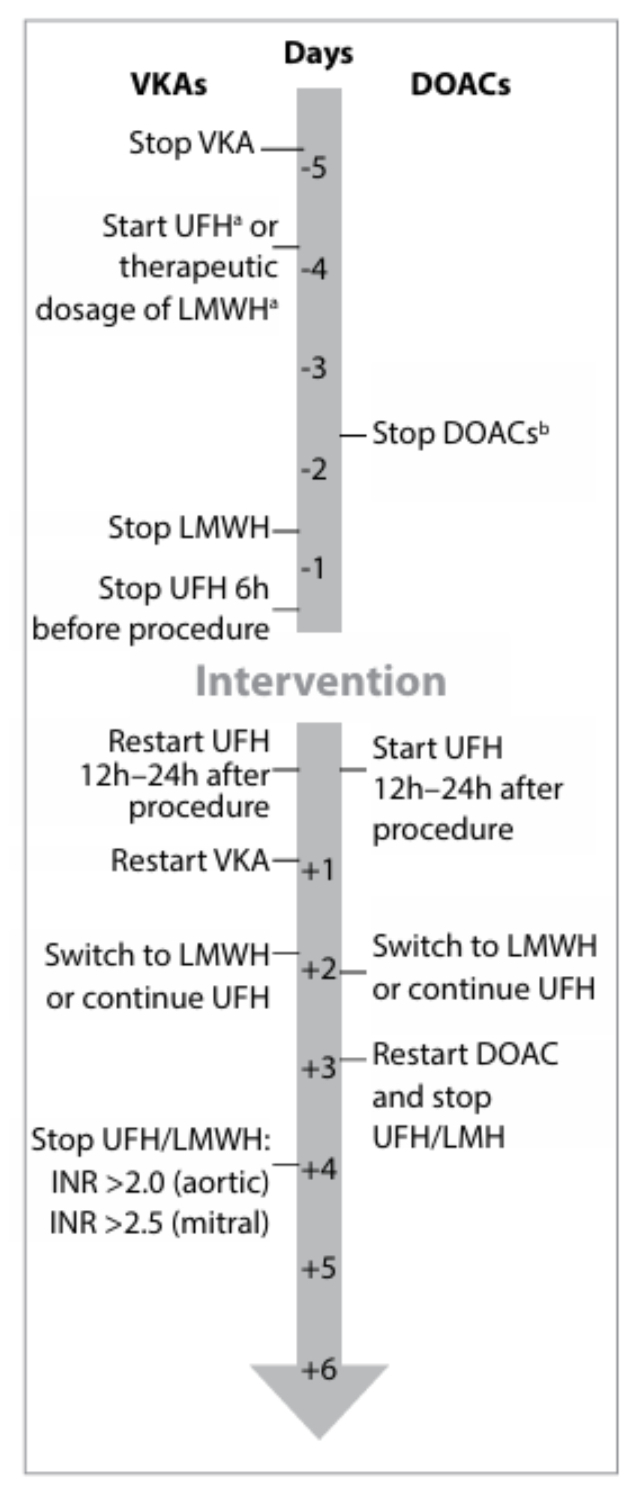
Figure 2: Management of oral anticoagulation in patients with an indication for pre- and/or postoperative bridging. a. Bridging with UFH/LMWH should start when INR values are below specific therapeutic ranges. b. Discontinuation should be prolonged to > 72 h if creatinine clearance is 50–79 ml/min/1.73m2 or ≥ 96 h if creatinine clearance is < 50 ml/min/1.73m2. 7
DOACs – direct oral anticoagulants,
INR – international normalised ratio,
LMWH – low-molecular-weight heparin,
UFH – unfractionated heparin,
VKAs – vitamin K antagonists
Click on the image to enlarge.
Antiplatelet drugs and non-cardiac surgery in patients with coronary stents, mostly DAPT
The management of these drugs in patients with coronary stents in situ depends on the type of stent, time after the coronary event and surgery type (major vs minor). Communication with the cardiology team is important. Elective surgery should be postponed for at least 4–6 weeks after bare metal stent implantation and 6 months after drug-eluting stent implantation. Aspirin may be continued during the perioperative period except in closed space surgery such as intracranial and spinal surgery.
For emergency surgery, management depends on the antiplatelet agent and when the last dose was taken. Platelet transfusion should be reserved as an additional measure for critical bleeding. If deemed appropriate, platelet function analysis can be used, but currently there is no evidence for its routine use.
Cangrelor is an IV, ultra-short half-life, P2Y12 inhibitor (currently not available in South Africa).
Drugs that decrease blood loss
TXA is a synthetic derivative of the amino acid lysine that inhibits plasminogen activation, thus preventing impairment of fibrinolysis. In the last few years, there is increased evidence that its use may reduce bleeding in trauma, cardiac surgery and other major surgery. Seizures have been reported when high doses are given, but there is little evidence of other side-effects.75 The dose is variable, but a 1g bolus is recommended in most instances for the majority of adults, with possibly an additional infusion of 500mg.h-1 also considered.76 A repeat dose has also been used clinically.
Aprotinin is a serine protease inhibitor antifibrinolytic that acts by inactivating free plasmin. The drug was withdrawn from the market in 2007 due to safety issues (BART researchers). Recently, regulators have licensed the drug only for myocardial revascularisation (coronary artery bypass surgery).77
South African Society of Anaesthesiologists (SASA) Guidelines for Patient Blood Management 2020. Confirmed as current version on the SASA website as of November 2024.