E. Antimicrobial Resistance, Prevention and Containment Framework
Supporting the Antimicrobial Resistance Strategy Framework and the Guidelines on Implementation of the Antimicrobial Strategy in South Africa: One Health Approach and Governance, 2018
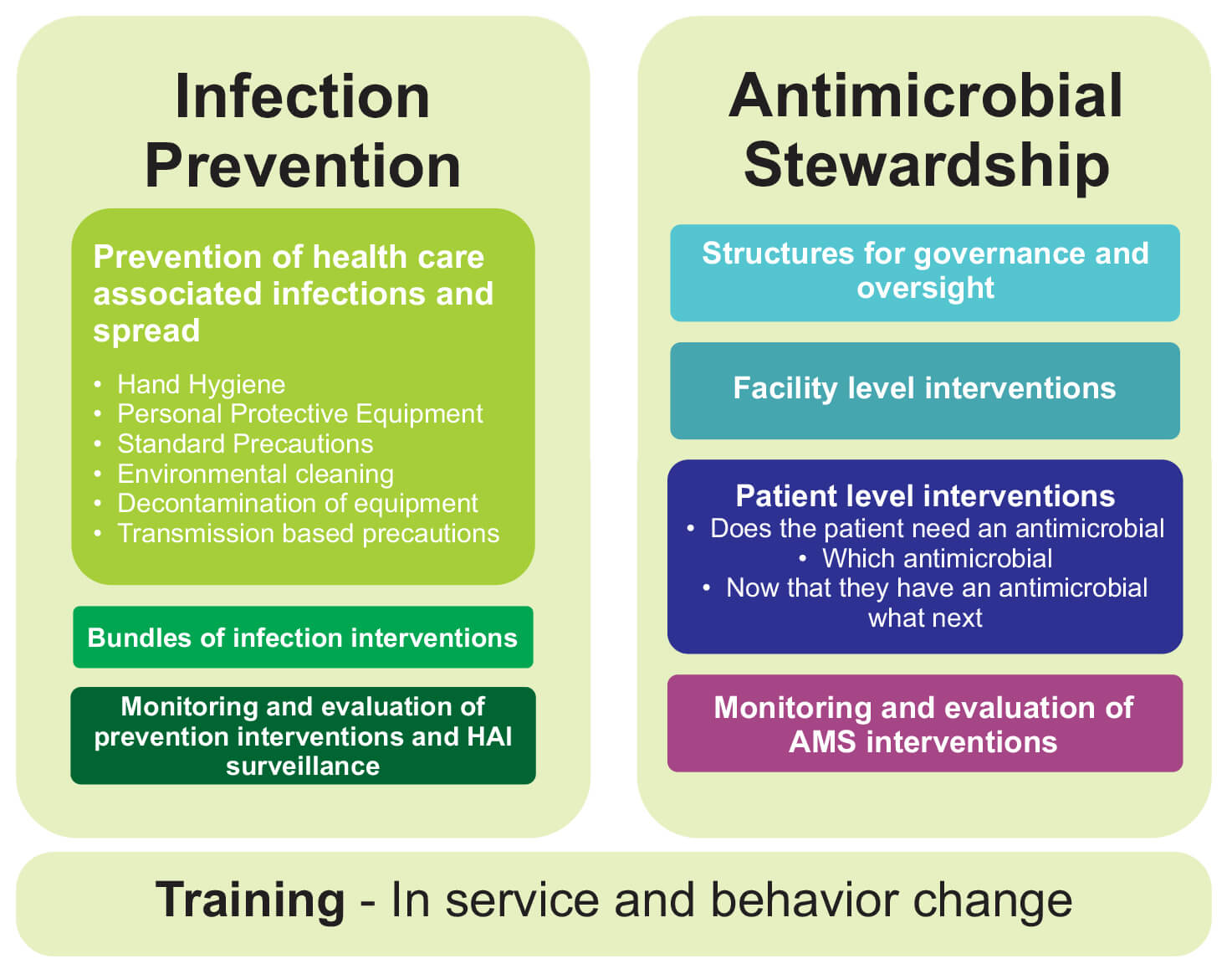
The framework takes a patient-centred approach, following the patient from the time of admission to diagnosis and treatment of hospital-acquired or community-acquired infections and includes the precautions that should be applied to prevent hospital-acquired infections from occurring as well as their spread. It consists of two main components, infection prevention and antimicrobial stewardship (AMS) (see figure below), which are underpinned by training, to improve healthcare professional skills.
Framework for the prevention and containment of AMR in South African hospitals
Click on image to enlarge
The main components of the implementation framework include:
Infection Prevention
- The prevention of healthcare-acquired infections (HAI) from occurring through the use of standard precautions (see definition)
- The application of evidence-based multimodal strategies including infection prevention and control (IPC) bundles to prevent HAIs from occurring
- However, once a HAI is acquired, infection control measures (such as transmission-based precautions) may be required in addition to the standard precautions to ensure that the infection doesn’t spread to other patients or healthcare workers (HCWs)
- Monitoring both the effectiveness and compliance to IPC measures and the impact of multimodal strategies including bundles of care and HAI surveillance is required to determine gaps and put in place corrective measures
- Immunisation of HCWs against relevant communicable diseases such as hepatitis B should be provided
Antimicrobial Stewardship seeks to systematically optimise the appropriate use of antimicrobials to treat community-acquired infections or HAIs by applying evidence-based practices, and consists of four key components:
- Structures to oversee stewardship at the facility and technical expertise in the form of AMS teams to perform stewardship activities at the bedside.
- Facility-level interventions such as local antimicrobial prescribing guidelines, pre-prescription authorisation and prospective audit of antimicrobial use.
- Patient-level interventions which help to identify the organisms responsible for the infection using the appropriate diagnostic tools. Once an infection is diagnosed and it is determined that an antimicrobial is required, it becomes important to ensure that the correct antimicrobial is chosen, administered in the correct dose and for the appropriate period of time.
- A strong monitoring and evaluation system, which monitors for AMR and assesses compliance to AMS and infection prevention interventions.
Underpinning the process is an effective on-going in-service training programme of healthcare professionals to understand AMR, their role in prevention of infections and their containment, how to follow treatment guidelines and ensure that patients are receiving the correct level of care and appropriate treatment every time.