Education
Education is the cornerstone of effective management. Key points include explaining that AR is a chronic disease and that, apart from AIT, there is no curative treatment. Treatment options should be discussed with regard to cost, efficacy, ease of use and side-effect profile. Shared decision-making is of utmost importance. One of the main goals of shared decision-making is long-term adherence to
Education is the cornerstone of effective management. Key points include explaining that AR is a chronic disease and that, apart from AIT, there is no curative treatment. Treatment options should be discussed with regard to cost, efficacy, ease of use and side-effect profile.
Shared decision-making is of utmost importance. One of the main goals of shared decision-making is long-term adherence to treatment,34,35 which is required for the successful treatment of AR.36 This is achieved through discussing the available therapeutic options and agreeing on a treatment plan that best serves the needs of the patient and which ensures compliance with and persistence with the plan.34,35
Daily medication for persistent symptoms or intermittent use for seasonal symptoms should be discussed, as should the correct dosage, frequency and time of dosing.
Poor treatment adherence is an important barrier to treatment success, and questionnaires, such as the Medication Adherence Report Scale, a validated 5-item tool that assesses adherence, can be used in routine clinical practice.28
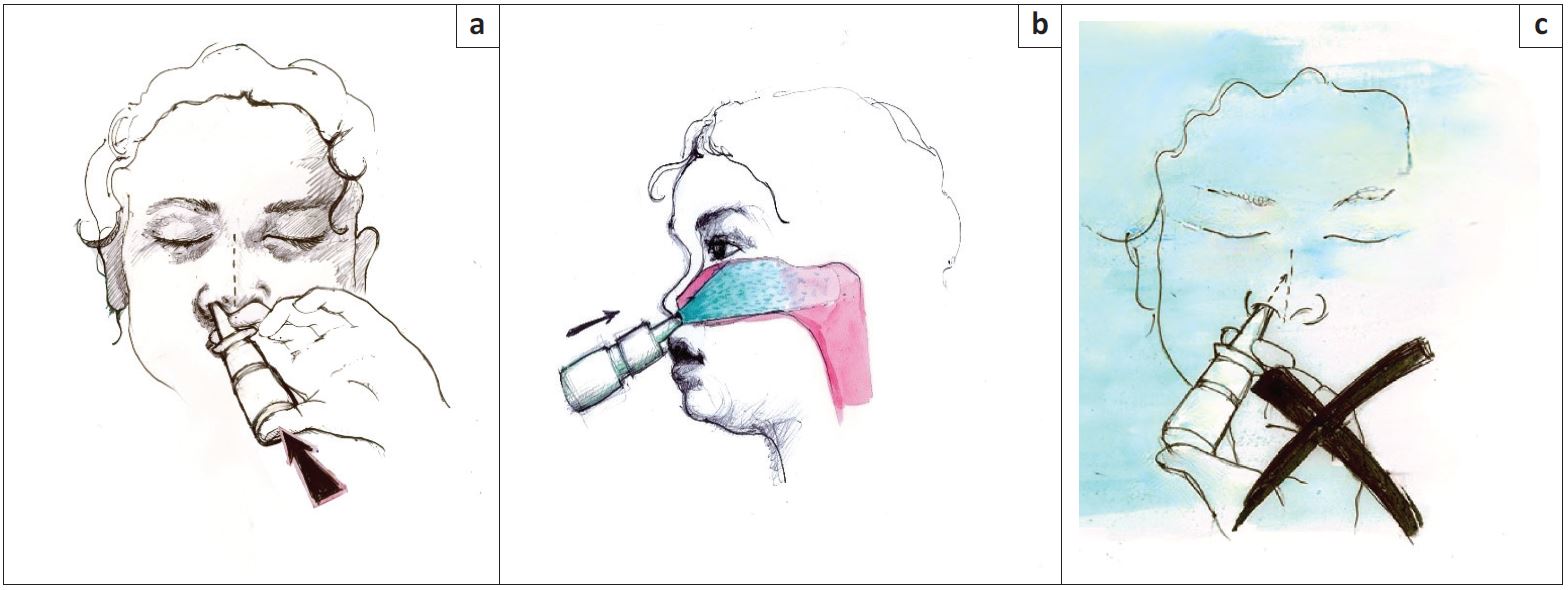
The correct method of using an INCS, by means of a physical demonstration, should be emphasised at the initial visit:
- After shaking and removing the lid, the nasal spray should be aimed towards the turbinates, which are on the lateral wall of the nasal passage.
- Ideally, the head should be tilted slightly forwards and, while closing the opposite nostril, one puff should be administered towards the outer side wall of the nose, aiming towards the ear and the back of the head, avoiding the nasal septum (Figure 3).
- Repeat the process in the other nostril.
- After each puff, the patient should try not to sniff, but rather pinch the nose between the thumb and index finger, holding the head neutrally forwards for a count of 10.
- Afterwards, the nose may be wiped, without blowing.
Written educational material containing this information may be helpful to cement the key points.
 Click on the image to enlarge
Source: Images by Dr Nicole Shaer, used with permission
FIGURE 3: Technique for using nasal sprays. (a) Correct technique, (b) direction of spray using correct technique and (c) incorrect technique.
Click here to access the PDF.
Richards GA, McDonald M, Gray CL, et al. Allergic rhinitis: Review of the diagnosis and management: South African Allergic Rhinitis Working Group. S Afr Fam Pract. 2023;65(1), a5806. https://doi.org/10.4102/safp.v65i1.5806