GuidelinesOther guideline
Elbow Dislocation
The elbow is second only to the shoulder as the major joint most frequently dislocated.
Clinical
Examination
Management
Reduction and Disposition
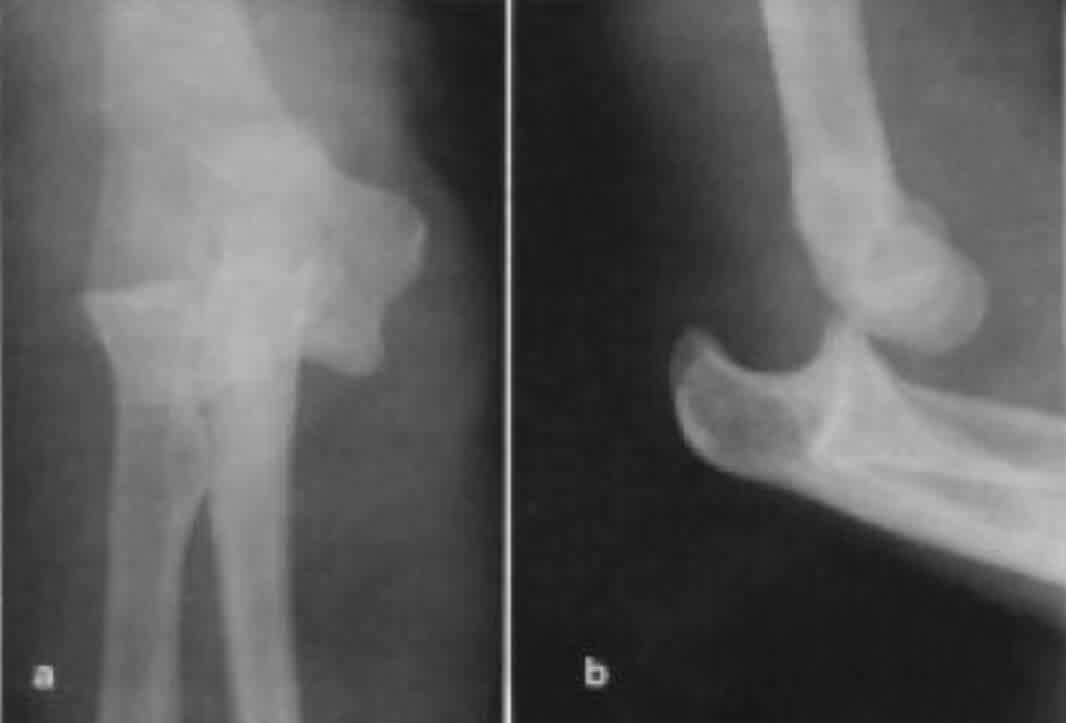
The elbow is second only to the shoulder as the major joint most frequently dislocated. Most dislocations are posterior, although the elbow may also dislocate medially, laterally, or anteriorly.
Clinical
The classic mechanism of injury is a fall onto the outstretched hand with the elbow extended.
- Patients will have a marked deformity on the injured side and a prominent olecranon.
- The elbow is held in about 45º of flexion. (Elbow is “locked”)
- Large joint haematoma.
Examination
- Frequent neurovascular examinations are crucial. The median nerve and brachial artery are at particular risk. Brachial artery injury is noted in 5%-13% cases.
- Nerve and vascular injury after reduction have been reported.
Management
- Treatment is prompt reduction.
- If the neurovascular status of the extremity is compromised, immediately reduce the elbow.
- Reduction of a posterior dislocation is accomplished by stabilisation of the humerus and gentle traction of the wrist with flexion of the elbow if the joint does not easily reduce.
- In most cases, elbow reduction is uneventful. Most patients will require conscious sedation or intra-articular anesthesia. Obtain post-reduction films and range the elbow through flexion and extension to ensure stability.
- Immobilise the elbow in 90º of flexion (Back slab and collar and cuff).
- Admission for most patients to ensure stability of the reduction and neurovascular status check of arm.
- Most patients who dislocate their elbow without comorbid fractures have an excellent long-term prognosis.
- O'Driscoll SW. Elbow dislocations. In: Morrey BF, ed. The Elbow and Its Disorders. 3rd ed. Philadelphia, Pa: WB Saunders; 2000:409-17.
- Rockwood CA Jr, Green DP, Bucholz RW, eds. Rockwood and Green's Fractures in Adults. 4th ed. Philadelphia, Pa: Lippincott Williams & Wilkins; 1996:971-85.
- Kuhn MA, Ross G. Acute elbow dislocations. Orthop Clin North Am. Apr 2008;39(2):155-61.
- Ross G. Acute elbow dislocation: on-site treatment. Phys Sportsmed. Feb 1999;27(2):121-2.