Emergency Procedural Sedation
Emergency Procedural Sedation
Introduction
Definition
Levels of procedural sedation
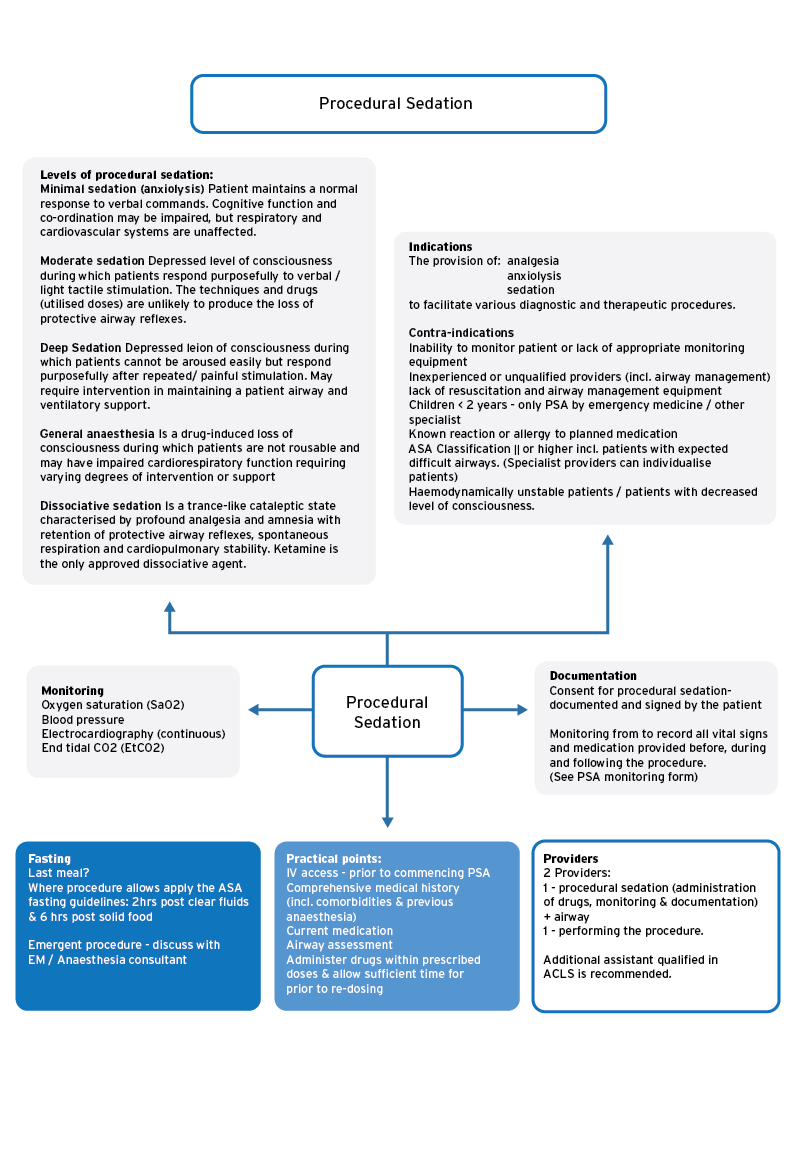
Introduction
Procedural sedation is utilised in the Emergency Centre (EC) to humanely facilitate painful, unpleasant or anxiety-inducing procedures (esp. children.)
Definition
Procedural sedation is a technique of administering drugs (sedative, dissociative, analgesia or combination) to allow patients to tolerate procedures while maintaining cardiorespiratory physiology and airway protective reflexes. Procedural sedation can be applied to adults and children in the EC.
Levels of procedural sedation:
Minimal sedation (anxiolysis)
Is a drug-induced state during which the patient maintains a normal response to verbal commands. Cognitive function and co-ordination may be impaired, but respiratory and cardiovascular systems are unaffected.
Moderate sedation
Is a drug-induced depression of consciousness during which patients respond purposefully to verbal / light tactile stimulation. The techniques and drugs (utilised doses) are unlikely to produce the loss of protective airway reflexes.
Deep sedation
Is a drug-induced depression of consciousness during which patients cannot be aroused easily but respond purposefully after repeated / painful stimulation. These patients may require intervention in maintaining a patent airway and ventilatory support.
General anaesthesia
Is a state of drug-induced loss of consciousness during which patients are not rousable and may have impaired cardiorespiratory function requiring varying degrees of intervention or support.
Dissociative sedation
Is a trance-like cataleptic state characterised by profound analgesia and amnesia with retention of protective airway reflexes, spontaneous respiration and cardiopulmonary stability. Ketamine is the only approved dissociative agent.
| Minimal Sedation | Moderate Sedation | Deep Sedation | Dissociative Anaesthesia | General Anaesthesia | |
| Responsiveness | Respond to verbal stimuli | Responds purposefully to verbal / tactile stimuli | Purposeful response only repeated / painful stimuli | Responds to tactile / verbal stimuli | Unrousable (including painful stimuli) |
| Airway | Unaffected | No intervention | Intervention may be required | Unaffected | Intervention require |
| Spontaneous Breathing | Unaffected | Adequate | Possible inadequate | Unaffected | Frequently inadequate |
| CVS function | Unaffected | Maintained | Maintained | Unaffected | Impairment possible |
Indications:
The provision of analgesia, anxiolysis and sedation to facilitate various unpleasant (painful,) diagnostic and therapeutic procedures in emergency medicine. Other disciplines also utilising procedural sedation include cardiology, dentistry, gastroenterology, radiology, dermatology and plastic surgery.
Contra-indications
- Inability to monitor patient or lack of appropriate monitoring equipment.
- Inexperienced or unqualified providers (incl. airway management)
- lack of resuscitation and airway management equipment
- Children < 2 years should only receive procedural sedation from qualified emergency medicine or other qualified specialist.
- Known reaction or allergy to planned medication.
- ASA Classification II or higher incl. patients with expected difficult airways. (Specialist providers can individualise patients)
- Haemodynamically unstable patients or patients with decreased level of consciousness.
Monitoring
The monitoring required includes oxygen saturation (SaO2), blood pressure, electrocardiography (continuous) and end tidal CO2 (EtCO2).
Providers
2 Providers are required, 1 to provide procedural sedation (administration of drugs, monitoring & documentation) and attend to the airway if management are required and 1 specifically performing the procedure. It is advised that an assistant also qualified in advanced life support be available to assist the providers during the procedural sedation and procedure.
The procedural sedation provider should be competent to rescue a patient from the intended level of procedural sedation and one level beyond ie. If deep sedation is planned the provider should be competent to rescue a patient from general anaesthesia.
Documentation
The patient has to consent to procedural sedation being administered and this consent should be documented and signed by the patient or a consent form completed in this regard separate from the procedure itself.
All vital signs and medication provided should be recorded during and following the procedure. See attached monitoring form. Additionally the patients should receive a patient information sheet detailing what to expect and when to return to the emergency centre following procedural sedation.
Practical points:
Good IV access is required prior to commencing procedural sedation.
Comprehensive medical history including comorbidities and previous anaesthesia is required and to be documented. This includes current medication which could interact with drugs to be administered.
Airway assessment prior to commencing procedural sedation in view of airway intervention if necessary
Administer drugs within the prescribed doses and allow sufficient time for effect prior to re-dosing
Fasting
Obtain a history of time of last meal
Where the procedure allows apply the ASA fasting guidelines of 2 hours post clear fluids and 6 hours post solid foods.
Where procedure is emergent and cannot be delayed risk vs benefit has to be considered. Exercise caution in regards to the airway and have a specialist perform the sedation where possible.
Drugs:
The table below details drugs used in procedural sedation. The use of combination of two or more drugs during procedural sedation should be considered carefully and in these situations procedural sedation should be performed by specialists in EM and other qualified disciplines. Table below includes most frequent drugs utilised only. This is not a comprehensive list – please review the pharmacology of the drugs mentioned in other texts
| Sedative | Characteristics | Adult dose | Paeds dose | Onset of action | Duration of action | Precautions & Side-effects |
| Midazolam | Anxiolytic Amnesia Anticonvulsant | IV: 0.05 – 0.1 mg/kg Max single bolus 2mg IM: | IV: 0.05 – 0.1 mg/kg | 2-5 min | 60-90 min | CNS & Resp depression ↓ dose in elderly / debilitated |
| Ketamine | Analgesia Dissociative agent NMDA antagonist | IV: 1-2 mg/kg | IV: 0.5-1 mg/kg IM: 4 mg/kg Oral: 4-5 mg/kg | 30-60 seconds (IV) | 5 – 15 min (IV) | Different dosages packaging Beware CVS high risk pt’s |
| Propofol | Sedative Nil analgesia | IV: 0.5-1 mg/kg (add 0.5 mg/kg bolusses) | IV: 0.5-1 mg/kg | < 1 min | 5-10 min | Hypotension ↓ dose in elderly / debilitated Pain on injection Cross react w egg allergic pt’s |
| Etomidate | Sedative Nil analgesia | IV: 0.1-0.2 mg/kg | Only > 10 yrs | < 1 min | 5-10 min | Myoclonus Nausea & vomiting Adrenal suppression (Sepsis relative contraindication) |
| Morphine | Analgesia Mild sedative (adjunct agent) | V: 0.05-0.1 mg/kg | IV: 0.05-0.1 mg/kg slow | 1 min | 2-4 hrs | Slow IV administration ↓ dose in elderly / debilitated / combination with other drugs Resp depression |
| Fentanyl | Analgesia Sedative | IV: 1-2 ug/kg slow | IV: 1 ug/kg | 1 min | 30 min | Hypersensitivity Chest wall rigidity Respiratory / CNS depression |
| Reversal Agents | ||||||
| Naloxone | Reversal of opoids | IV: 0.4-2 mg (repeat 2-3 min) | 0.01-0.1 mg/kg | 1-2 min | 45 min | Beware hypersensitivity |
| Flumazenil | Reversal Benzodiazepines | IV: 0.2 mg over 15 sec, repeat 0.2 mg bolus 1 min intervals (max 1mg) | 1-2 min | 1 hour | Precipitate seizures (susceptible pt’s) T1/2 shorter than benzo Hypersensitivity | |
Drafted Nov 2014, Review Nov 2016
References:
- Guidelines for procedural sedation and analgesia for diagnostic and therapeutic procedures in adults: 2010. S Afr J Anaesthesiol Analg 2010;16(4)(Supplement 1):S1-S37
- Guidelines for procedural sedation and analgesia for diagnostic and therapeutic procedures in children: 2010 S Afr J Anaesthesiol Analg 2010:16(5)(Supplement 1):S1-S37
- EMSSA, Wallis LA, Stander M. Procedural sedation in the emergency centre. S Afr Med J 2010; 100:195-201.