Endotracheal Intubation
National Neonatal Resuscitation Guidelines
Assembling and checking the equipment
Common problems with intubation
Management of the infant with meconium stained liquor
In this section you should learn:
- How to prepare the equipment required for intubation and choose appropriately sized ET tubes.
- The indications for ET intubation. The technique of ET intubation.
Assembling and Checking the Equipment
Additional equipment needed for advanced neonatal resuscitation
- Laryngoscope with straight blades for preterm (size 0) and term (size 1) infants
- Extra bulb, blades and batteries for the laryngoscope
- Magill’s forceps
- Endotracheal tubes sizes 2.5 to 4
- KY lubricating jelly
- Introducer (stylet)
- Suction pump, tubing and suction catheters sizes 5F to 10F
- Self- inflating ventilation bag with face mask and suitable ET tube connection
- Oxygen supply and tubing
- Meconium aspirator Scissors
- Tape for securing ET tube
- Air supply and air/oxygen blender (if possible)
- Pulse oximeter if available
- Cardiac monitor with ECG leads if available
Drugs:
- Adrenaline (Epinephrine) (1:1 000) 1ml ampoules
- Normal saline – 5ml and 10ml ampoules
- Sterile water – 5ml or 10ml ampoules
- Sodium Bicarbonate 8.5% diluted with an equal volume of water i.e. 4.25% (or use the 4% solution if available)
- Narcan (naloxone) Adult 0.4mg/ml
The correct size blades and endotracheal (ET) tubes must be available. Make sure that the laryngoscope bulb is properly attached and is working. ET tubes should be radio-opaque, of a uniform diameter, without a shoulder, have a natural curve and have a mark to indicate the depth of insertion. An introducer (stylet) passed through the ET tube, but not beyond the end of the tube, makes intubation easier.
Indications for ET intubation
Most babies do not need to be intubated and will be successfully resuscitated by bag and mask ventilation only.
Note: Babies do not die from failure to INTUBATE but rather from failure to VENTILATE and OXYGENATE.
The oral route for intubation is preferred for resuscitation. Babies who need to be intubated for resuscitation have a depressed level of consciousness and do not need sedation.
The timing of intubation depends on the skill and experience of the resuscitator and may be done at several points during the resuscitation.
Indications for ET intubation
- Clearing the airway of meconium when someone experienced in intubation is present
- Ineffective or prolonged bag and mask ventilation.
- When chest compressions are given, especially if there is only one person doing the resuscitation
- If chest compressions fail to result in an increased heart rate
- To give medications via the trachea
- Special circumstances e.g. diaphragmatic hernia, very low birth weight babies
- The need for ongoing mechanical ventilation
Technique of ET intubation
Oral intubation is preferred for resuscitation. Position the baby’s head in the neutral position or slightly flexed. Do not hyper-extend the baby’s head, as this will obscure the view of the vocal cords. Hold the laryngoscope in the left hand and pass the blade into the mouth. Always keep the tip of the blade in the midline so that the tip is placed either in the vallecula or just over the epiglottis. Gently lift the blade in the direction of the handle so that the vocal cords are seen.
Do not tilt the blade upwards, using the upper gums/lip as a fulcrum, as this may injure the baby and does not help with visualisation of the cords. Gentle cricoid pressure may help. It may be necessary to suction secretions from the pharynx in order to see the cords properly. Hold the ET tube, with the introducer in place (if preferred), in the right hand and gently pass the tip through the cords. Magill’s forceps may be used to grasp the end of the ET tube and pass it through the vocal cords.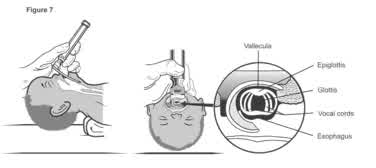
The table below gives a quick guide to the correct size of ET tube and level of insertion. Some tubes have a black line at the tip, which should just pass through the cords. The depth to which the tube should be inserted can also be calculated by:
- Insertion depth at lip (cm) = weight (kg) + 6
| Weight (grams) | Tube size | Level of insertion at lip (cm) |
| <1000 | 2.5 | 6.5 to 7 |
| 1000 to 2000 | 3.0 | 7 to 8 |
| 2000 to 3000 | 3.5 | 8 to 9 |
| 3000 to 4500 | 3.5 to 4 | 9 to 10.5 |
Record the level to which the tube is inserted and secure the tube at that level. Movement of the head can result in accidental extubation or the ET tube passing into the right main bronchus.
Allow 20 seconds for an attempt at intubation. If you fail to intubate the baby, start bag and mask ventilation and chest compressions again until the baby’s colour and heart rate have improved.
If you cannot intubate the baby after 2 to 3 attempts, continue bag and mask ventilation and seek help.
If the tube is in the correct position:
- You will not hear the baby cry.
- There should be good chest movement with equal air entry over the chest and no air entry over the stomach.
- There will be a prompt improvement in heart rate.
- There should be fogging of the inside of the ET tube when the baby breathes out.
- Routine use of detection of exhaled carbon dioxide and/or flow/volume monitoring are not recommended.
Common problems with intubation
You will not see the vocal cords properly because:
- The laryngoscope blade is pushed in too far, into the oesophagus. The blade should be pulled back (withdrawn) until the cords are seen.
- The laryngoscope blade is not pushed in far enough and the base of the tongue is hiding the view of the cords. The blade should be removed and inserted again, taking care to get the tongue out of the way.
- The laryngoscope blade has been pushed in to one side and once again the tongue is hiding the view of the vocal cords. The blade should be removed and reinserted in the midline.
- The tongue is not lifted up enough - try gentle cricoid pressure.
- Secretions obscure your view of the cords. Use suction to clear the secretions.
- The baby’s neck is overextended - reposition the baby’s head in the neutral position.
The baby may fail to improve after endotracheal intubation due to:
- The ET tube being positioned in the oesophagus.
- The ET tube being pushed too far down, into the right main bronchus.
- The ET tube is blocked – either by secretions or has kinked at some point
- A cause unrelated to the ET tube e.g. pneumothorax, stomach splinting the diaphragm.
- Equipment failure (see Bag and Mask ventilation) e.g. oxygen supply run-out
DOPES mnemonic:
Displaced / dislodged tube
Obstructed tube
Pneumothorax
Equipment failure
Stomach distension
Management of the infant with meconium stained liquor
Meconium stained liquor is a common occurrence and is particularly associated with postdates babies. It was previously recommended that in all cases of meconium stained liquor, the baby’s mouth, nose and pharynx should be suctioned with a large bore suction catheter as soon as the baby’s head is delivered, but there is no evidence that this prevents meconium aspiration and this is not longer practised.
If the baby has poor respiration, decreased muscle tone or a heart rate <100 bpm and requires bagging and there is someone experienced in endotracheal intubation, do direct laryngoscopy to suction residual meconium from the hypopharynx and intubate and suction the trachea. Suction catheters passed through the ET tube may be too small to clear the airway of meconium. Connect a meconium aspirator between the ET tube and the suction catheter, to allow direct suction on the ET tube. You may need to repeat the intubation and suction several times to clear the airway.
If the baby’s heart rate drops, you should stop suctioning and continue with resuscitation. However, there is insufficient evidence that this prevents meconium aspiration and this step should be omitted if someone experienced in endotracheal intubation is not present. Any baby born through meconium stained liquor who develops respiratory distress or apnoea, should have the airway cleared of meconium before positive pressure ventilation is started.
If you are unable to intubate, clear as much meconium from the mouth as you can and proceed with resuscitation (bag and mask ventilation).
Intubation and suction of a vigorous baby with meconium stained liquor does not improve outcome and may cause complications.