Enterocolitis, Necrotising
Description Diagnostic criteria General and supportive measures Medicine treatment Surgical treatment Referral ICD-10 code: P77 DESCRIPTION Neonate presenting with the consequences of bowel wall injury or necrosis. Risk factors include: prematurity, hypotension/shock, sepsis, early formula feedings, high feeding volumes, perinatal asphyxia (hypoxia), patent ductus arteriosus, and polycythae
Description
Diagnostic criteria
General and supportive measures
Medicine treatment
Surgical treatment
Referral
ICD-10 code: P77
DESCRIPTION
Neonate presenting with the consequences of bowel wall injury or necrosis.
Risk factors include:
- prematurity,
- hypotension/shock,
- sepsis,
- early formula feedings,
- high feeding volumes,
- perinatal asphyxia (hypoxia),
- patent ductus arteriosus, and
- polycythaemia.
DIAGNOSTIC CRITERIA
- Early signs are often non-specific, i.e.:
- feeding intolerance,
- significant gastric aspirates,
- vomiting,
- body temperature instability,
- apnoea and lethargy.
- Non-specific signs may progress to more specific signs including:
- abdominal distention with ileus,
- bloody stools,
- peritonitis,
- red-purple discolouration of the abdominal wall with abdominal wall cellulitis, and
- bowel perforation.
- X-ray of abdomen may show:
- distended loops of intestines,
- bowel-wall thickening (oedema),
- pneumatosis intestinalis,
- hepatic portal venous gas, and
- free intraperitoneal air due to perforation.
- Blood samples for culture and sensitivity testing before starting antibiotic therapy.
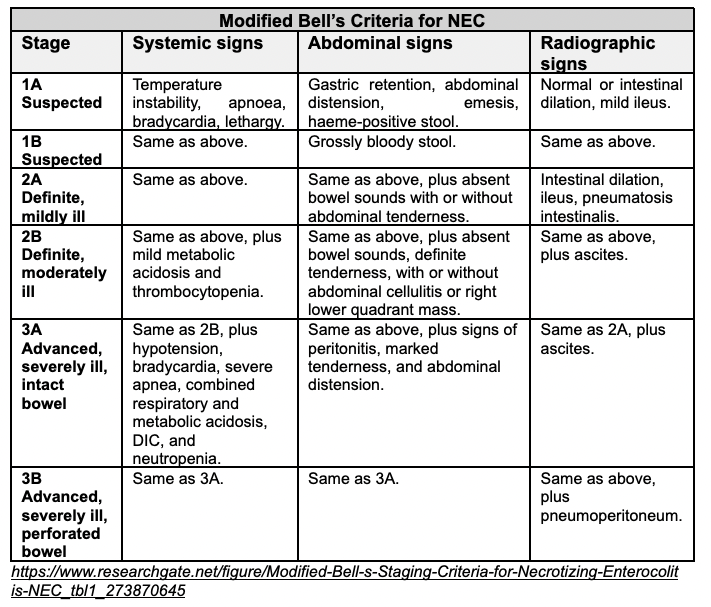
Click on the table to enlarge
GENERAL AND SUPPORTIVE MEASURES
- Admit to a neonatal high-care unit or intensive care unit.
- Nurse in a neutral thermal environment.
- Insert an oro/nasogastric tube and apply free drainage.
- Suspected cases should be nil-per-mouth for 72 hours.
- Confirmed cases should be nil-per-mouth for at least 7 days.
- Provide adequate parenteral nutrition as soon as diagnosis is confirmed.
- Provide cardiovascular and ventilatory support, if necessary.
MEDICINE TREATMENT
Depending on age, weight and hydration status:
- Neonatal maintenance solution, IV.
Add volume of gastric aspirates to daily maintenance fluid volume.
If coagulopathy or septic shock:
- Plasma (lyophilised or fresh frozen), IV, 20 mL/kg over 2 hours.
See:
Respiratory Distress in the Newborn for figure 1: Blood cell transfusion thresholds for preterm neonates
If anaemia is present according to thresholds in figure 1
- Packed red cells, IV, 10 mL/kg over 3 – 4 hours in haemodynamically stable patients. More rapid transfusions may be appropriate in bleeding and haemodynamically unstable patients.
Until blood pressure is stabilised:
- Dopamine, IV, 5–15 μg/kg/minute.
Empiric antibiotic therapy
- Ampicillin, IV, 50 mg/kg/dose for 7 days.
| Gestational Age | Postnatal Age | Dose |
| ≤ 34 weeks | ≤ 7 days | 50 mg/kg/dose every 12 hours |
| 8 to 28 days | 75 mg/kg/dose every 12 hours | |
| >34 weeks | ≤ 28 days | 50mg/kg/dose every 8 hours |
PLUS
- Gentamicin, IV, 5 mg/kg once daily for 7 days.
Where available, gentamicin doses should be adjusted on the basis of therapeutic drug levels.
- Trough levels (taken immediately prior to next dose), target plasma level < 1 mg/L.
- Peak levels (measured 1 hour after commencement of IV infusion or IM/IV bolus dose), target plasma level > 8 mg/L.
PLUS
- Metronidazole, IV, for 7 days.
- Loading dose: 15 mg/kg over 60 minutes.
- Post natal age < 4 weeks: 7.5 mg/kg/dose 12 hourly.
- Postnatal age ≥ 4 weeks: 7.5 mg/kg/dose 8 hourly.
Reassess choice of antibiotics when the culture and sensitivity results become available.
Adjust antibiotic regimen according to local susceptibility patterns and suspicion of nosocomial infection, where possible in consultation with a microbiologist or infectious diseases specialist.
SURGICAL TREATMENT
Surgical intervention is required when there is progressive deterioration of the clinical condition despite maximal medical support and/or bowel necrosis with/without bowel perforation.
- Prior to transport to a tertiary hospital for definitive surgery, insert/place a peritoneal drain in babies presenting with severe abdominal distension, due to free air and/or fluid in the peritoneal cavity, compromising respiration and/or blood pressure.
- Perform the procedure in a theatre, intensive care or high care unit where facilities for monitoring vital signs, resuscitation, ventilation and temperature control of the environment are available.
- Obtain consent to perform the surgical procedure.
Method of inserting/placing a peritoneal drain
- The procedure is sterile; the doctor should be gowned and gloved.
- Clean and drape the abdomen.
- Administer an appropriate analgesic (e.g. ketamine, IV) immediately before the start of the procedure.
- Identify a site in either one of the fossae iliaca, ensuring that it is lateral to the inferior epigastric artery.
- At the intended surgical incision site, inject:
- Lidocaine (lignocaine) 1%, SC, 0.5 mL.
- Make a small skin incision over the ‘bubble’ of lidocaine (lignocaine) (no. 11 blade).
- Use a mosquito forceps or clamp to dissect down to the peritoneum, pierce the latter with a gentle stab using the closed forceps and slightly stretch the peritoneal puncture site with the forceps.
- Note what drains from the peritoneal cavity and send a sample for microscopy and culture.
- Insert a pencil drain of ~5 mm width with the mosquito clamps or forceps into the peritoneal cavity through the peritoneal stab wound. About 1.5–2 cm of the pencil drain should be inside the peritoneal cavity.
- Fix the drain to the skin with a size 4–0 stitch (e.g. PDS).
- Cover the drain with a gauze pad or urine collecting bag.
REFERRAL
- All confirmed cases for specialist care.
- Deterioration of clinical condition, despite adequate treatment.
- Signs and symptoms of intestinal perforation and peritonitis requiring surgical intervention.
- Recurrent apnoea episodes and/or signs of respiratory failure, requiring respiratory support.
Standard Treatment Guidelines And Essential Medicines List For South Africa, Hospital Level, Paediatrics, 2023 Edition
Chapter 19: Prematurity And Neonatal Conditions, 19.3 Prematurity/preterm Neonate, 19.3.1 Enterocolitis, Necrotising (NEC)