Epilepsy
Standard Treatment Guidelines and Essential Medicines List for South Africa, Hospital Level, Adults 2019 Edition
Please click on the link below to access the most up-to-date version of this guideline. The content on this page is currently being updated to align with the latest publication. Always check the version number at the bottom of the screen to confirm which version you are using.
Epilepsy in adolescents and adults
G40.0-9
DESCRIPTION
Epilepsy is a disease of the brain defined by any of the following conditions:
- At least two unprovoked (or reflex) seizures occurring >24 hours apart, or
- One unprovoked (or reflex) seizure if there is a high risk (60% or more) of having recurrent seizures within the next 10 years (i.e., if the person is vulnerable to having another unprovoked seizure, e.g. because of structural damage such as from a stroke) or
- Diagnosis of an epilepsy syndrome.
Note:
An “unprovoked” epileptic seizure is a seizure which does not have evidence of an identifiable temporary or reversible factor acting on a healthy brain (e.g., hypoglycaemia, alcohol withdrawal, concussion).
A “reflex” epileptic seizure is a seizure which occurs in response to a stimulus such as flashing lights. Such epileptic seizures indicate the person’s brain is predisposed to having seizures and therefore warrant a diagnosis of epilepsy.
Epilepsy may be diagnosed after a single unprovoked seizure in people with an increased risk of recurrence for example in people with previous [MR1] [JR2] [MR3] conditions such as TB meningitis, neurocysticercosis, stroke, brain tumour or traumatic brain injury. Note that the single unprovoked seizure is not caused by the immediate insult to the brain but occurs spontaneously (i.e., is unprovoked) because of the long-term sequelae of the initial insult. The damaged brain is thus at high risk of a recurrent unprovoked epileptic seizure.
Epileptic syndromes confer a diagnosis of epilepsy, even if the risk of recurrent epileptic seizures is low for a particular individual.
Epilepsy is considered to be resolved and no longer needing maintenance treatment in individuals who either:
− had an age-dependent epilepsy syndrome, but are now past the applicable age, OR
− have remained seizure-free for the last 10 years and weaned off ASM for at least the last 5 years.
Epilepsy is associated with many psychological, social and legal problems, and cultural misperceptions which should be explored and addressed at the time of diagnosis and throughout the course of the illness.
Epilepsy types
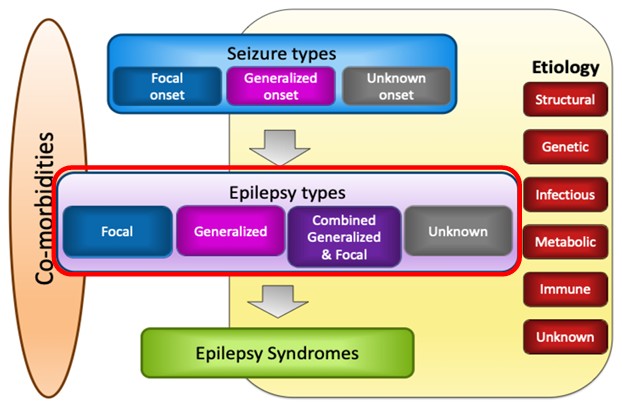
As shown in Figure 3, epilepsies are classified by the International League Against Epilepsy (ILAE) according to:
- Type of seizures experienced, e.g., focal, generalised, combined generalised and focal, or unknown.
AND
- Aetiology, which may be:
- Structural (e.g., cerebral or vascular malformations, stroke, traumatic brain injury, brain tumours).
- Genetic (the epilepsy is a direct result of chromosomal or gene abnormalities, e.g., Down syndrome, Fragile X syndrome, Dravet syndrome).
- Infectious (e.g., post-infectious sequelae of TB meningitis).
- Metabolic (e.g., inborn errors of metabolism).
- Immune (rare conditions involving neuroreceptor antibodies).
- Unknown.
Focal epilepsy
- Characterised by unprovoked focal seizures, which may or may not evolve to bilateral tonic-clonic seizures.
- The diagnosis is made clinically and requires a detailed description of how the seizure started. In people presenting with generalised tonic-clonic seizures, it is important to ask about any warning symptoms or ‘aura’ experienced by the person before losing consciousness.
- Typical interictal and/or ictal EEG findings may be present, and neuroimaging may reveal a focal brain lesion, supporting the diagnosis, but may also be normal.
Click on the image to enlarge.
Figure 3. International League Against Epilepsy classification of seizure types
(Source: Scheffer IE, Berkovic S, Capovilla G, Connolly MB, French J, Guilhoto L. ILAE classification of epilepsies: Position paper of the ILAE Commission for Classification and Terminology. Epilepsia. 2017, 58 (4): 512-521)
LoE:IVbxxxviii
Generalised epilepsy
- Characterised by unprovoked generalized seizures, including tonic-clonic, tonic, myoclonic, and absence seizures.
- Typical interictal and/or ictal EEG findings may be present.
Combined generalised and focal epilepsy
- Diagnosed in people with more than one type of seizure, e.g. unprovoked focal seizures and unprovoked generalised seizures.
- This may occur in people with Dravet syndrome or Lennox-Gastaut syndrome.
Unknown epilepsy
- This classification is used when it is not possible to determine whether the epilepsy is focal, generalised, or combined generalised and focal epilepsy from the available history, clinical, and investigative findings.
For seizure types, see: Epileptic seizures. For more information and educational videos on epilepsy types, see https://www.epilepsydiagnosis.org/epilepsy/epilepsy-classification-groupoverview.html
Investigations:
- Neuroimaging (a CT Brain or MRI if available) should be conducted:
- in new focal onset seizures to exclude a focal brain lesion.
- if the epilepsy features change in an individual (i.e., new symptoms appear, noting that most people will experience the same march of symptoms with each seizure).
- if epileptic seizures recur despite adherence to treatment and the diagnosis is unclear.
- EEG is indicated for recurrent or syndromic seizures where a diagnosis cannot be made on clinical grounds alone. Delay an EEG for at least one week after the convulsive episode.
- EEG is not indicated for simple febrile seizures.
- If the seizure presentation is atypical, a 12-lead ECG should be considered to identify prolonged QT interval syndromes. Syncope with exercise, syncope in response to loud noise, fright, or extreme emotional stress, syncope whilst supine, a family history of sudden death in a young person e.g. <40 years old, or sensorineural deafness are associated with some types of long QT syndrome.
EPILEPSY IN ADOLESCENTS AND ADULTS
G40.0-9
DESCRIPTION
See: Epilepsy.
DIAGNOSTIC CRITERIA
- The diagnosis of epilepsy is usually made clinically.
- Take an adequate history and get an accurate witness description of the seizures to define the type of epilepsy.
- Juvenile myoclonic epilepsy and absence seizures specifically should be considered and identified, as some first line medicines may be less efficacious or may even worsen seizure frequency or severity.
- Patients with new onset epilepsy should have a CT scan (essential in immunocompromised patients), and other investigations as clinically indicated.
Special considerations
Women and girls of child-bearing potential and pregnancy
- Antiseizure medicines during pregnancy can cause structural or physical malformations and neurodevelopmental harms that may impact learning and education.
- The risk of antiseizure medicine to the unborn child needs to be balanced against the risk of uncontrolled seizures to both the mother and unborn child.
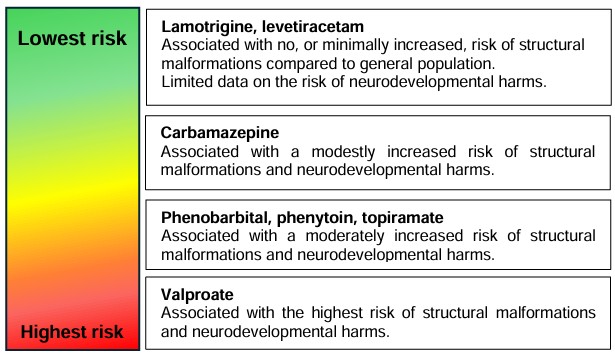
- The risk associated with each antiseizure medicine during pregnancy differs (see Figure 4).
| It is crucial to treat epilepsy during pregnancy to prevent seizures, which pose significant risks to both the mother and the foetus/infant. |
- Women and girls of child-bearing potential with epilepsy should be counselled regarding contraception and the need to plan pregnancy.
NOTE:
There are important drug-drug interactions between hormonal contraceptives (except DMPA) and several anticonvulsant medicines (e.g. carbamazepine, phenobarbital, phenytoin).
- Progestin-only injectable contraceptives or IUCDs are the preferred contraceptive methods for women of child-bearing potential on ASMs. See Chapter: Family planning.
- In pregnant women, women of child-bearing potential (i.e. women < 55 years of age), and young girls who are likely to need to continue treatment into their child-bearing years, initiate treatment with a lower risk ASM.
- Lamotrigine and levetiracetam are the safer ASM to use.
- Large amounts of data consistently show no increased risk of major congenital malformations associated with the use of lamotrigine or levetiracetam at usual doses.
- Since lamotrigine requires slow dose titration, initiation of lamotrigine is best suited to low-risk patients who have infrequent seizures, and no previous history of seizures requiring hospitalisation or status epilepticus.
- Levetiracetam may be used if there is a poor response or adverse effects to lamotrigine, or in high-risk patients with frequent seizures, a previous history of hospitalization for seizures or status epilepticus.
- Valproate must not be used in pregnant women, women of child-bearing potential and young girls who are likely to need to continue treatment into their child-bearing years.
- In women who take valproate while pregnant, around 1 in 9 babies (11%) will have a major birth defect and about 3–4 children in every 10 may have neurodevelopmental problems and these disorders can be seriously debilitating and permanent (e.g., delayed leaning to walk and talk, lower intelligence, poor speech and language skills, memory problems, autism or autism spectrum disorders, attention deficit hyperactivity disorder).
- In situations where valproate is deemed the only option in a female patient after all other treatment options have been ruled out, health professionals (prescribers and dispensers) are required to:
- Regularly review treatment
- Provide counselling on the risks of valproate use in pregnancy
- Ensure that the woman has completed and signed an acknowledgment of risk form annually: https://www.sahpra.org.za/wp-content/uploads/2025/05/GLF-CEM-PV-S01_v2-Valproate-Annual-Risk-Acknowledgement-Form-ARF.pdf
- Provide supplemental folic acid, oral, 5 mg daily.
- Women and girls with epilepsy who discover they are pregnant should not abruptly stop their ASM due to the risk of seizures.
- Women and girls who become pregnant while on valproate should be transitioned off valproate and onto levetiracetam, as early as possible during pregnancy, to decrease the risk of neurodevelopmental harms, provided their seizures are not refractory to other ASM.
- During pregnancy women may experience an increased number of seizures.
- This may be due to sleep deprivation, increased emotional stress and changes in ASM plasma concentrations.
- ASM plasma concentrations may decrease during pregnancy due to decreased absorption from nausea and vomiting, increased volume of distribution and increased clearance.
- There is increased hepatic metabolism of lamotrigine and increased renal clearance of levetiracetam in pregnancy, which return to normal post-partum; increase the dose if necessary, according to clinical response.
Click on the image to enlarge.
Figure 4. Risk of congenital structural malformations and neurodevelopment harms associated with various antiseizures medicines.
Increasing risk refers to increasing number of pregnancies or children affected.
(Adapted from Pennell PB. Neurotherapeutics. 2016 and Medicines & Healthcare products Regulatory Agency safety leaflet).
LoE:IVbxxxix
|
CAUTION - ASM and pregnancy Children born to women taking valproate are at significant risk of birth defects (11%) and persistent developmental disorders (40%). Valproate is contra-indicated and should be avoided in pregnancy and women of child-bearing potential. |
Children and adolescents transitioning to adult care
- Children and adolescents whose seizures are controlled on levetiracetam should be continued on levetiracetam in adulthood.
Adults on ART
- Lamotrigine is the preferred ASM in people with HIV on ART because of fewer medicine interactions.
- Phenytoin, phenobarbital and carbamazepine are enzyme inducing ASMs. Due to potential drug interactions with ARVs, switch these medicines to lamotrigine.
- Where concurrent use of dolutegravir and carbamazepine, phenytoin, or phenobarbital is unavoidable, double dolutegravir dose to 50 mg 12 hourly.
- Metabolism of lamotrigine is induced by lopinavir/ritonavir and atazanavir/ritonavir. The dose of lamotrigine may need to be increased when patients are switched to, or initiated on, lopinavir/ritonavir or atazanavir/ritonavir.
GENERAL AND SUPPORTIVE MEASURES
- Patients should record dates and, if possible, times of seizures in a seizure diary. Review seizure diary at each consultation for assessment of therapy.
- Patients with epilepsy should be issued a disease identification bracelet, necklace or card.
- Patients with uncontrolled seizures should avoid driving, swimming, working at heights and operating machinery until they have been seizure free for at least one year. Refer to an occupational therapist for rehabilitation and a workplace assessment. The patient should sign in the medical notes that they have received workplace and lifestyle advice.
- Provide counselling and advice on:
- the adverse effect of alcohol on seizures,
- sleep hygiene,
- the effect of missing a dose of medication,
- discontinuing the medication without advice of a doctor.
MEDICINE TREATMENT
Acute treatment
- Manage acute seizure and status epilepticus as per seizures/status epilepticus (see: Epileptic seizures, and Status epilepticus).
Maintenance Treatment
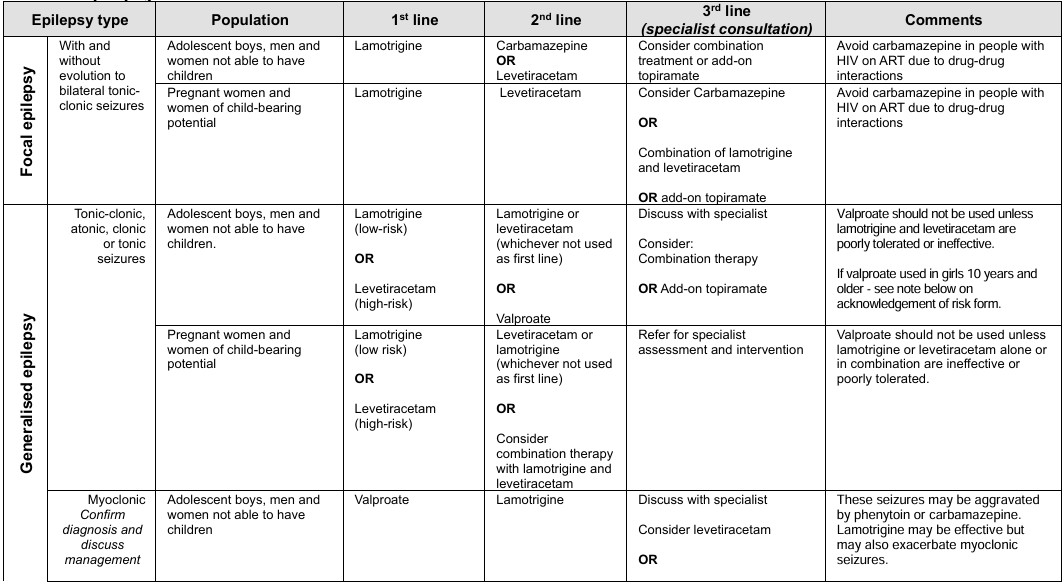
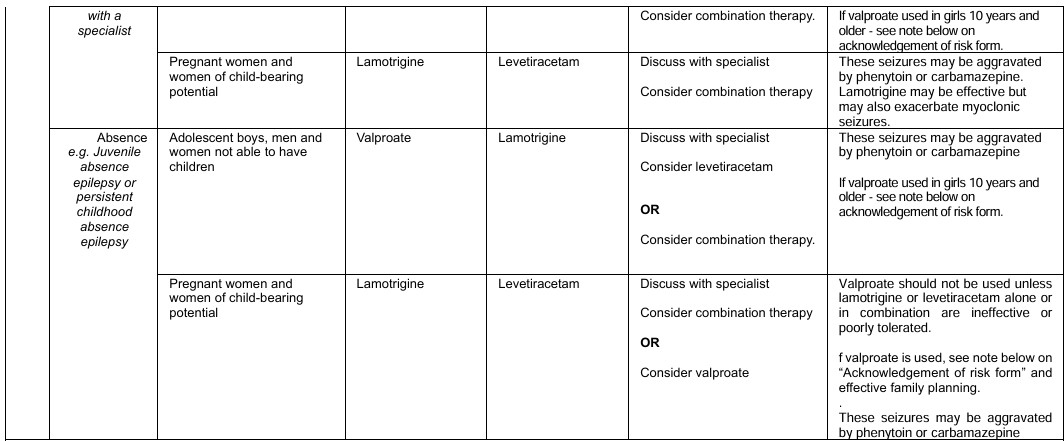
- Refer to Table 2 below for guidance around the choice of medicine by seizure type.
- HIV status, child-bearing potential and pregnancy are important determinants of medicine choice.
- The antiseizure treatment strategy should also be individualised based on use of other medicines, comorbidities, as well as response to medication, and adverse effects.
- The goal of medicine treatment is to prevent recurrent seizures and optimise quality of life.
- As a general rule, a single ASM (monotherapy) is best. Progressively increase the dose of the ASM until the seizures are controlled or clinically important side effects occur.
- Recommended drug doses are general guides and will be effective in most patients. However, some patients may need much higher or lower doses. Doses should be increased at 2-weekly intervals only.
- If the initial ASM fails to achieve satisfactory control (no seizures) at optimal dosages, or causes unacceptable adverse effects, then a trial of a second ASM medicine may be commenced.
- Initiate second medicine, titrate to therapeutic dose; then gradually reduce and stop the first ASM over 6–8 weeks or longer if necessary (See notes below for individual medicines).
- Failure of second-line monotherapy, after exclusion of alcohol use/misuse and poor adherence, may require add-on therapy. Add on therapy may be initiated by a medical officer in consultation with a specialist.
|
Medicine interactions Phenytoin, phenobarbital and carbamazepine are potent enzyme inducing agents and should be used with caution with other medicines metabolised by the liver, especially warfarin, antiretrovirals, progestin subdermal implants and oral contraceptives. LoE:IVbxli |
- Therapeutic drug monitoring is not necessary in stable patients, but should be performed in the following situations:
- To confirm ASM toxicity in a symptomatic patient
- In patients with poor seizure control
- To confirm suspected poor adherence despite self-reported good adherence
- Phenytoin is not recommended in Table 2, however may be continued in adults whose seizures are well-controlled on phenytoin. Therapeutic drug monitoring should be conducted in patients receiving higher than usual doses of phenytoin.
- Long term use of phenytoin and carbamazepine are associated with potential risks. Continued use of these ASM requires careful consideration of the balance between benefits and risks in individual patients.
Table 2: Epilepsy treatment in adolescents and adults
Click on the image to enlarge.
Combined generalised and focal epilepsy
OR
Unknown/unclassified
Discuss clinical presentation and management with a specialist in all cases.
*Assess level of risk (high vs low) based on clinical judgement and discuss with a specialist if unsure. In general, high-risk patients are those with frequent seizures, a previous history of hospitalization for seizures, or previous history of status epilepticus. Low-risk patients are those with infrequent seizures, no previous hospitalization for seizures, and no history of status epilepticus.
NOTE:
- Lamotrigine is the preferred first line treatment for all adult patients, including women of child-bearing potential, pregnant women, and people living with HIV.
- Lamotrigine requires slow dose up-titration and may not be suitable in people at high-risk of seizures. High-risk patients are those with frequent seizures, a previous history of hospitalization for seizures, or previous history of status epilepticus. Low-risk patients are those with infrequent seizures, no previous hospitalization for seizures, and no history of status epilepticus.
- If valproate is used, acknowledgment of risk must be obtained annually, even if not of child-bearing potential. Girls aged 10 years and older should receive effective family planning and consider a long-acting form of contraception. https://www.sahpra.org.za/wp-content/uploads/2025/05/GLF-CEM-PV-S01_v2-Valproate-Annual-Risk-Acknowledgement-Form-ARF.pdf
LoE:IVbxlii
Medicine Treatment
- Lamotrigine, oral (Doctor initiated).
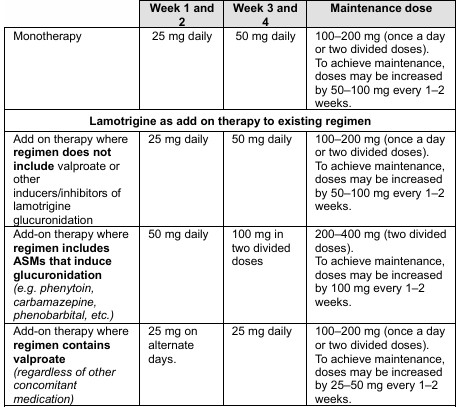
- Dose-titrate using table below.
Table 3: Dosing table for lamotrigine as monotherapy or add-on therapy
Note:
- If therapy is interrupted for more than a week, restart the titration protocol.
- Metabolism of lamotrigine is induced by lopinavir/ritonavir and atazanavir/ritonavir. The dose of lamotrigine may need to be increased when people with HIV are switched to or initiate lopinavir/ritonavir or atazanavir/ritonavir.
- Metabolism of lamotrigine is induced during pregnancy. The dose of lamotrigine may need to be increased during pregnancy.
LoE:IVbxliii
|
CAUTION - LAMOTRIGINE Lamotrigine may cause Stevens-Johnson Syndrome. |
- Carbamazepine, oral
- Start with 100 mg 12 hourly.
- Increase by 100–200 mg/day at weekly intervals according to seizure control and adverse events.
- Usual maximal dose: 600 mg 12 hourly.
LoE:IIIbxlv
- Levetiracetam, oral
- Initially 250 mg 12 hourly, increasing to a therapeutic dose of 500 mg 12 hourly.
- Dose can be adjusted upwards in increments of 500 mg 12 hourly every 2 to 4 weeks to a maximum of 1500 mg 12 hourly (3000 mg per day).
- Valproate, oral
- Usual starting dose: 200–300 mg 12 hourly.
- Increase, as required, every 3 days to 2 weeks (depending on the seizure frequency) to a maximum dose of 1200 mg 12 hourly.
- Phenytoin, oral, 4.5–5 mg/kg (lean body mass) daily, at night. Only consider continuing phenytoin in patients already well controlled on phenytoin, and in whom phenytoin is well tolerated.
- Usual starting and maintenance dose in adults: 300 mg once daily.
- Dose increases above 300 mg should be done in no more than 50 mg increments at intervals no shorter than 2 weeks.
- Doses > 300 mg/day of phenytoin are potentially toxic and could lead to permanent cerebellar damage. Caution and frequent monitoring of drug levels are essential at doses > 300 mg daily.
LoE:IVb
Poorly controlled epilepsy
- Ensure diagnosis of epilepsy and seizure type is confirmed, and exclude imitators of epileptic seizures.
- Ask the patient, and if possible, a family member or primary care giver, about the following, as these factors can influence decisions regarding medicine therapy:
- Has the patient been adherent in taking the medication regularly for at least 2 weeks or more before the seizure? Ask about medicine dosage and frequency.
- If non-adherence has been established, ask for reasons contributing to non-adherence and offer guidance.
- Has the patient recently used some other medicine and/or herbal remedy (i.e., look for drug interactions, substance abuse or traditional medicine use).
- Is there a chance that alcohol is involved?
- If ≥ 1 of the above are present, address the problem/s but leave ASM therapy unchanged (unless dose adjustment is necessary because of a drug interaction). Reassess the patient within 2 weeks.
REFERRAL
- People with epilepsy who have not responded to two trials of ASM monotherapy at therapeutic drug concentrations and require consideration of combination therapy.
- Epilepsy with unexplained neurological symptoms or signs.
Information on the seizures that should accompany each referral case:
- Number and frequency of seizures per month (or year).
- Date and time of most recent seizures.
- Detailed description of the seizures, including:
- Presence of an aura or warning signs
- what happens during the seizure? (give a step-by-step account)
- is the person conscious during the seizure?
- how long do the seizures last on average?
- what does the patient experience after the seizure?
- how long does this experience last?
- Is there a family history of seizures?
- What is the initial date of diagnosis?
- Is there evidence of alcohol use?
- Is there another medical condition, e.g. diabetes, HIV and what medication is used?
- What is the name and dosage of the ASM used to date?
- Does the person return regularly for repeat of medication?
Standard Treatment Guidelines and Essential Medicines List for South Africa, Adult Hospital Level, 2020-4_Version 2.0_6 June 2025
Chapter 14 Neurological Disorders_14.6 Epilepsy
Drugs mentioned
ICD-10 codes
- G40.0Localization-related (focal)(partial) idiopathic epilepsy and epileptic syndromes with seizures of localized onset
- G40.1Localization-related (focal)(partial) symptomatic epilepsy and epileptic syndromes with simple partial seizures
- G40.2Localization-related (focal)(partial) symptomatic epilepsy and epileptic syndromes with complex partial seizures
- G40.3Generalized idiopathic epilepsy and epileptic syndromes
- G40.4Other generalized epilepsy and epileptic syndromes
- G40.5Special epileptic syndromes
- G40.6Grand mal seizures, unspecified (with or without petit mal)
- G40.7Petit mal, unspecified, without grand mal seizures
- G40.8Other epilepsy
- G40.9Epilepsy, unspecified