Epilepsy
Epilepsy
G40.0-9
DESCRIPTION
Epilepsy is a disease of the brain defined by any of the following conditions:
- At least two unprovoked (or reflex) seizures occurring >24 hours apart, or
- One unprovoked (or reflex) seizure if there is a high risk (60% or more) of having recurrent seizures within the next 10 years (i.e., if the person is vulnerable to having another unprovoked seizure, e.g. because of structural damage such as from a stroke) or
- Diagnosis of an epilepsy syndrome.
Note:
An “unprovoked” epileptic seizure is a seizure which does not have evidence of an identifiable temporary or reversible factor acting on a healthy brain (e.g., hypoglycaemia, alcohol withdrawal, concussion).
A “reflex” epileptic seizure is a seizure which occurs in response to a stimulus such as flashing lights. Such epileptic seizures indicate the person’s brain is predisposed to having seizures and therefore warrant a diagnosis of epilepsy.
Epilepsy may be diagnosed after a single unprovoked seizure in people with an increased risk of recurrence for example in people with previous conditions such as TB meningitis, neurocysticercosis, stroke, brain tumour or traumatic brain injury. Note that the single unprovoked seizure is not caused by the immediate insult to the brain but occurs spontaneously (i.e., is unprovoked) because of the long-term sequelae of the initial insult. The damaged brain is thus at high risk of a recurrent unprovoked epileptic seizure.
Epileptic syndromes confer a diagnosis of epilepsy, even if the risk of recurrent epileptic seizures is low for a particular individual.
Epilepsy is considered to be resolved and no longer needing maintenance treatment in individuals who either:
− had an age-dependent epilepsy syndrome, but are now past the applicable age, OR
− have remained seizure-free for the last 10 years and weaned off ASM for at least 5 years.
Epilepsy is associated with many psychological, social and legal problems, as well as cultural misperceptions which should be explored and addressed at the time of diagnosis, and throughout the course of the illness.
Epilepsy types
As shown in Figure 1 below, epilepsies are classified by the International League Against Epilepsy (ILAE) according to:
- Type of seizures experienced, e.g., focal, generalised, combined generalised and focal, or unknown.
AND
- Aetiology, which may be:
− Structural (e.g., cerebral or vascular malformations, stroke, traumatic brain injury, brain tumours).
− Genetic (the epilepsy is a direct result of chromosomal or gene abnormalities, e.g., Down syndrome, Fragile X syndrome, Dravet syndrome).
− Infectious (e.g., post-infectious sequelae of TB meningitis).
− Metabolic (e.g., inborn errors of metabolism).
− Immune (rare conditions involving neuroreceptor antibodies).
− Unknown.
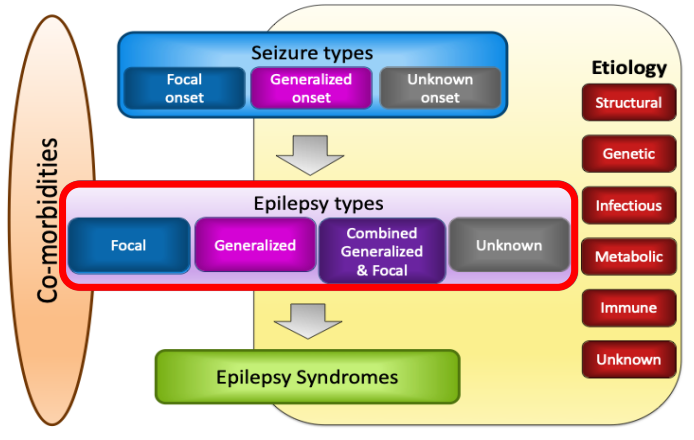
Click on the image to enlarge.
Figure 1. International League Against Epilepsy classification of seizure types
(Source: Scheffer IE, Berkovic S, Capovilla G, Connolly MB, French J, Guilhoto L. ILAE classification of epilepsies: Position paper of the ILAE Commission for Classification and Terminology. Epilepsia. 2017, 58 (4): 512-521)
LoE:IVb26
Focal epilepsy
Characterised by unprovoked focal seizures, which may or may not evolve to bilateral tonic-clonic seizures. The diagnosis is made clinically and requires a detailed description of how the seizure started. In people presenting with generalised tonic-clonic seizures, it is important to ask about any warning symptoms or ‘aura’ experienced by the person before losing consciousness. Typical interictal and/or ictal EEG findings may be present, and neuroimaging may reveal a focal brain lesion, supporting the diagnosis, but may also be normal.
Generalised epilepsy
Characterised by unprovoked generalised seizures, including tonic-clonic, tonic, myoclonic, and absence seizures. Typical interictal and/or ictal EEG findings may be present.
Combined generalised and focal epilepsy
Diagnosed in people with more than one type of seizure, e.g. unprovoked focal seizures and unprovoked generalised seizures. This may occur in people with Dravet syndrome or Lennox-Gastaut syndrome.
Unknown epilepsy
This classification is used when it is not possible to determine whether the epilepsy is focal, generalised, or combined generalised and focal epilepsy from the available history, clinical, and investigative findings.
For seizure types, see Epileptic seizures.
For more information and educational videos on epilepsy types, see https://www.epilepsydiagnosis.org/epilepsy/epilepsy-classification-groupoverview.html
Investigations:
- Neuroimaging (a CT Brain or MRI if available) should be conducted:
− in new focal onset seizures to exclude a focal brain lesion.
− if the epilepsy features change in an individual (i.e., new symptoms appear, noting that most people will experience the same march of symptoms with each seizure).
− if epileptic seizures recur despite adherence to treatment and the diagnosis is unclear. - EEG is indicated for recurrent or syndromic seizures where a diagnosis cannot be made on clinical grounds alone. Delay an EEG for at least one week after the convulsive episode.
- EEG is not indicated for simple febrile seizures.
- If the seizure presentation is atypical, a 12-lead ECG should be considered to identify prolonged QT interval syndromes. Syncope with exercise, syncope in response to loud noise, fright, or extreme emotional stress, syncope whilst supine, a family history of sudden death in a young person, e.g., <40 years old, or sensorineural deafness are associated with some types of long QT syndrome.
Standard Treatment Guidelines and Essential Medicines List for South Africa, Primary Healthcare, 2020-4_Version 1.0_26 May 2025
Chapter 15: Central Nervous System Conditions_15.7 Epilepsy
ICD-10 codes
- G40.0Localization-related (focal)(partial) idiopathic epilepsy and epileptic syndromes with seizures of localized onset
- G40.1Localization-related (focal)(partial) symptomatic epilepsy and epileptic syndromes with simple partial seizures
- G40.2Localization-related (focal)(partial) symptomatic epilepsy and epileptic syndromes with complex partial seizures
- G40.3Generalized idiopathic epilepsy and epileptic syndromes
- G40.4Other generalized epilepsy and epileptic syndromes
- G40.5Special epileptic syndromes
- G40.6Grand mal seizures, unspecified (with or without petit mal)
- G40.7Petit mal, unspecified, without grand mal seizures
- G40.8Other epilepsy
- G40.9Epilepsy, unspecified