Epileptic Seizures
Description Diagnosis Seizure types G40.6-7; G41.0-2; G41.8-9; R56.8 DESCRIPTION An epileptic seizure is a change in movement, attention or level of awareness that is sustained or repetitive and occurs because of abnormal and excessive neuronal discharge within the brain. LoE:IVb 7 Epileptic seizures should be differentiated from: Collapse, e.g. syncope, anoxic seizures, transient ischaemic attac
G40.6-7; G41.0-2; G41.8-9; R56.8
DESCRIPTION
An epileptic seizure is a change in movement, attention or level of awareness that is sustained or repetitive and occurs because of abnormal and excessive neuronal discharge within the brain.
LoE:IVb7
Epileptic seizures should be differentiated from:
- Collapse, e.g. syncope, anoxic seizures, transient ischaemic attack, cardiac arrhythmias;
- Movement disorders, e.g., paroxysmal dyskinesias, tic disorders;
- Mental health conditions, e.g., functional/dissociative seizures (also called psychogenic non-epileptic seizures), rage reactions, panic attacks, daydreaming/ inattention;
- Sleep-related conditions, e.g., parasomnias, narcolepsy;
- Migraine associated disorders, e.g., migraine with visual aura
See https://www.epilepsydiagnosis.org/epilepsy-imitators.html for a full list of conditions which may look like an epileptic seizure.
LoE:IVb8
Not all persons who have an epileptic seizure have epilepsy. Specific criteria must be met to diagnose epilepsy (See Epilepsy)
DIAGNOSIS
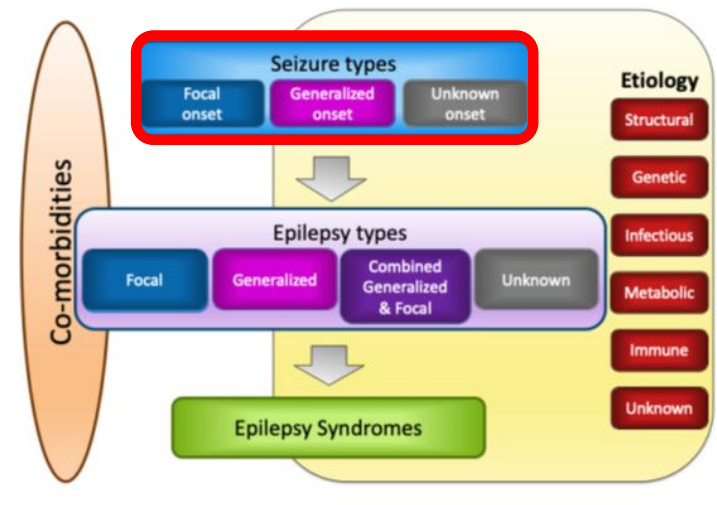
Epileptic seizures are diagnosed clinically, through eye-witness accounts, videos, careful observation by the healthcare professional, and a history from the patient of the symptoms, signs and behaviours experienced prior to and during the seizure. Epileptic seizures are classified by the International League Against Epilepsy (ILAE) into three types: focal, generalised, and unknown (see Figure 1). The evolution of the seizure (how it starts and progresses clinically) directs investigations to determine the cause of the seizure and related management.
LoE:IVb9
SEIZURE TYPES
Focal seizures:
The epileptic activity arises from a specific focus, or networks limited to one hemisphere of the brain.
Focal seizures may present with motor signs (e.g., rhythmic jerking of one limb; automatisms such as lip-smacking) or with non-motor signs (e.g., olfactory, tactile, or visual hallucinations, or intense emotions such as fear). This depends on the site of origin, which may be the frontal lobe, temporal lobe, parietal lobe or occipital lobe. A focal brain lesion should always be excluded in new focal seizures.
Focal seizures are classified according to the degree of impaired consciousness and whether there is progression to a tonic-clonic seizure. Consciousness is evaluated by assessing the levels of awareness (of themselves and their surroundings) and responsiveness (to other people or stimuli) of the person during the seizure. Any impairment in consciousness means that the person’s safety and the safety of others must be protected during the seizure.
Click on the image to enlarge.
Figure 1. International League Against Epilepsy classification of seizure types
(Taken From: Scheffer IE, Berkovic S, Capovilla G, Connolly MB, French J, Guilhoto L. ILAE classification of epilepsies: Position paper of the ILAE Commission for Classification and Terminology. Epilepsia. 2017, 58 (4): 512-521).
LoE:IVb10
- Focal preserved consciousness seizures (previously termed ‘simple partial seizures’): the person is fully aware of themselves and their surroundings and fully responsive to others throughout the seizure.
- Focal impaired consciousness seizures: (previously termed ‘complex partial seizures’), the person has impaired awareness or responsiveness at any time during the seizure.
- Focal unknown state of consciousness seizures: used when the state of consciousness is not known (e.g. unclear information).
- Focal-to-bilateral tonic-clonic seizure: the epileptic seizure progresses to both brain hemispheres. Bilateral tonic-clonic seizures are differentiated from generalised tonic-clonic seizures by a history of preceding focal signs (either sensory or motor) occurring before complete loss of consciousness and the development of tonic-clonic movements. The terms ‘aura’ or ‘warning signs’ may be used by people for the focal signs of the seizure.
Generalised seizures
The epileptic activity arises within and rapidly spreads to involve networks in both hemispheres of the brain. Generalised seizures are almost always associated with impaired or loss of consciousness.
Generalised seizures are classified as:
- Generalised motor seizures, which include:
− Generalised tonic-clonic seizures, with loss of consciousness and bilateral tonic-clonic limb movements.
− Generalised seizures other than tonic-clonic, including seizures with varying degrees of impaired consciousness and bilateral tonic movements (stiffening, sometimes with vibratory movements) of limbs or eyes, bilateral atonic movements (sudden loss of muscle tone) of head, trunk or limbs, bilateral jerks (brief shock-like muscle contractions), as in myoclonic seizures. - Absence seizures (previously termed ‘petit-mal seizures’), which usually occur in association with an epilepsy syndrome (See Epilepsy). Absence seizures may be:
− ‘typical’ with abrupt loss of consciousness lasting 5-30 seconds and clonic movements of face and/or automatisms, or
− ‘atypical’ with a less abrupt onset of impaired consciousness, longer seizure duration and loss of muscle tone of head, trunk and limbs. Atypical absence seizures are rare and can be challenging to differentiate from focal sensory seizures.
LoE:IVb11
Unknown:
The category of ‘unknown onset’ is used when there is not enough information, or the clinical presentation is too unclear, to distinguish between focal or generalised seizures. For more detail and educational videos on seizure types, see https://www.epilepsydiagnosis.org/seizure/seizure-classificationgroupoverview.html
Standard Treatment Guidelines and Essential Medicines List for South Africa, Primary Healthcare, 2020-4_Version 1.0_26 May 2025
Chapter 15: Central Nervous System Conditions_15.4 Epileptic Seizures
ICD-10 codes
- G40.6Grand mal seizures, unspecified (with or without petit mal)
- G40.7Petit mal, unspecified, without grand mal seizures
- G41.0Grand mal status epilepticus
- G41.1Petit mal status epilepticus
- G41.2Complex partial status epilepticus
- G41.8Other status epilepticus
- G41.9Status epilepticus, unspecified
- R56.8Other and unspecified convulsions