Epileptic Seizures and Status Epilepticus in Children <13 Years of Age
Description General measures Medicine treatment Referral DESCRIPTION Central nervous system infections are a common cause of epileptic seizures in children < 13 years of age in South Africa. The most common seizures in children are febrile seizures (See Febrile seizures ) but the history, examination and investigations must aim at excluding the following conditions: Perinatal conditions Infect
DESCRIPTION
Central nervous system infections are a common cause of epileptic seizures in children < 13 years of age in South Africa. The most common seizures in children are febrile seizures (See Febrile seizures) but the history, examination and investigations must aim at excluding the following conditions:
| Perinatal conditions | Infections | Poisoning |
|
- congenital infection - hypoxic-ischaemic damage - trauma - cerebral haemorrhage or thrombosis |
- meningitis - encephalitis - brain abscess - neurocysticercosis |
- medicine toxicity, e.g., isoniazid, antihistamines, antiseizure medicines - substance abuse, e.g., solvents, amphetamines - environmental and other toxins e.g., pesticides (organophosphates), essential oils - substance withdrawal, e.g. benzodiazepines. |
| Metabolic abnormalities | Systemic disorders | Primary cerebral causes |
|
- hypoglycaemia - hypocalcaemia - hypomagnesaemia - hyponatraemia - hypernatraemia - inborn errors of metabolism |
- vasculitis - hypertensive encephalopathy - uraemia (renal failure) - hyperammonaemia (liver failure) |
- cerebral malformation - genetic/familial (syndromic) - tumour - idiopathic/ unknown |
Special considerations by age group
Neonates:
Neonatal seizures are usually provoked, most commonly by hypoxic ischaemic encephalopathy (HIE). They rarely lead to a subsequent diagnosis of epilepsy. For management, refer to Seizures, neonatal.
Infants and children up to 2 years of age:
- The most frequent cause of epileptic seizures that present in infancy are febrile seizures (See Febrile seizures).
- Infants under 6 months of age cannot manifest generalised tonic-clonic seizures.
- Most provoked seizures presenting in this age group appear to be focal even when a generalised brain pathology is present.
- Infants and children under 2 years may not have typical signs of meningitis, i.e. neck stiffness or Kernig sign. Meningitis should be excluded in all children with a fever and seizure.
- Infants and children are at risk of metabolic derangement which may be from common triggers (e.g., dehydration) or rare causes (e.g., inborn errors of metabolism).
- Neuroimaging is often very useful, especially to exclude structural aetiologies (e.g., intracranial bleeds).
Children 2 to 12 years of age:
Older children are often able to present with clearer descriptions of seizure onset, i.e. a focal onset seizure is more likely to be specifically driven by an underlying focal cause (potentially a structural pathology):
- Ask for focality – point to the side of movement or change
- Change in behaviour before convulsive seizure evident
- Altered consciousness
- Type of seizure is related to the underlying aetiology
GENERAL MEASURES
On arrival/ while fitting:
- Ensure the environment is safe. Remove all sharp objects and hot liquids.
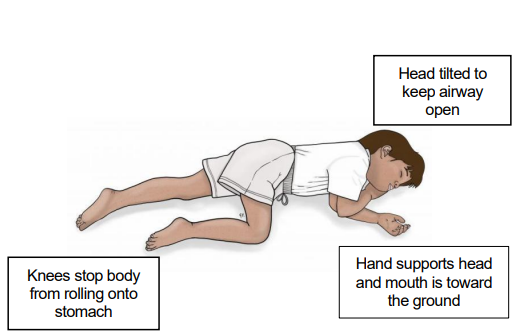
- Place the child in a recovery position to prevent aspiration of secretions or vomitus, on the floor if necessary.
- Do not place anything (spoon or spatula, etc.) in the patient's mouth.
- Ensure the airway is not obstructed.
Click on the image on enlarge.
Adapted from https://www.kidshealth.org.nz/emergencies/emergencies-cpr
LoE:IVb12
- Administer oxygen via face mask or nasal cannula to maintain SaO2 ≥ 95%.
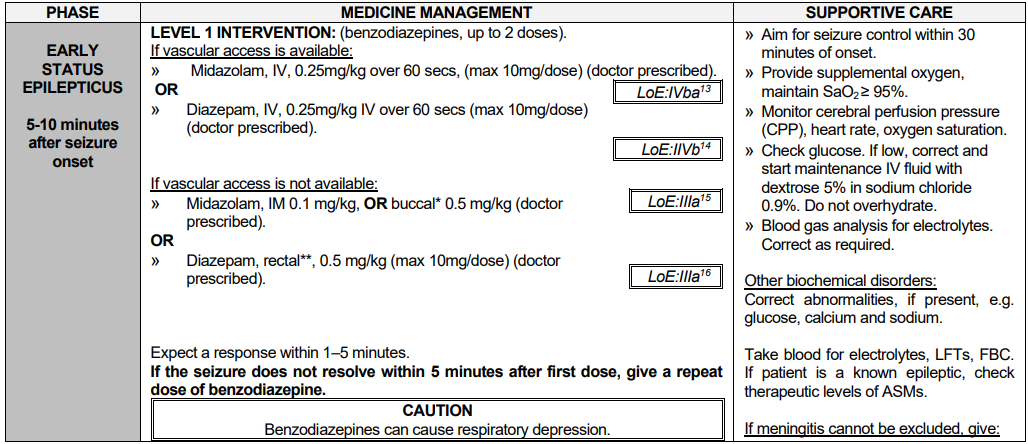
- Obtain eyewitness account of when the seizure started and associated impaired consciousness: If seizure duration is ≥ 5 minutes, commence urgent medicine treatment for convulsive status epilepticus (refer to table below on medicine management and supportive care of status epilepticus in children < 13 years).
- Examine for fever, dehydration, meningism, hypoglycaemia, evidence of toxin or poison ingestion, head, neck or other trauma, obvious focal neurology and other possible causes of the seizure.
- Establish vascular (IV or IO) access, if possible. See Paediatric Hospital Level STGs and EML, Emergencies and Trauma, Intra-osseous infusion in emergencies.
- Once threat of falling no longer present, move to bed (with cot sides up), if needed.
- Monitor vital signs every 15 minutes.
- Keep nil per mouth.
- Ensure the family/caregiver/escort is attended to; social worker or auxiliary staff member should obtain all contact details and provide counselling as needed.
MEDICINE TREATMENT
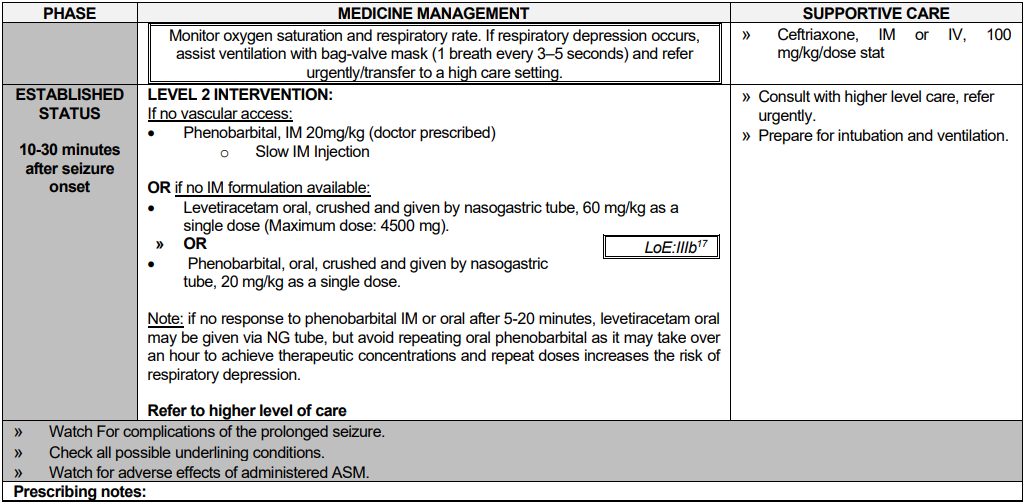
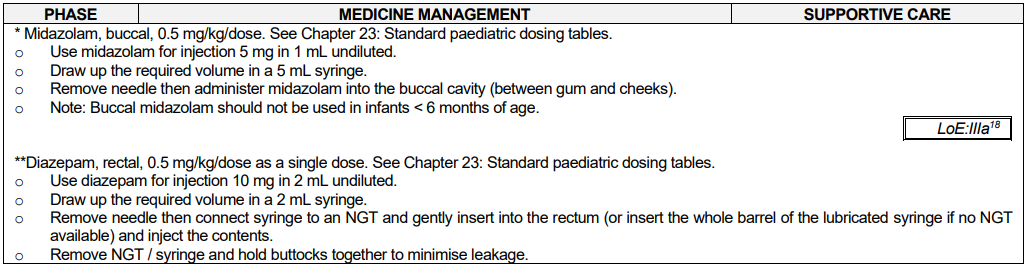
The aim is to control the seizure within 30 minutes of its onset, prevent complications of status epilepticus with supportive care, and identify and correct underlying causes. Follow standard resuscitation protocols, such as the ABCDE approach.
Table 1: MEDICINE MANAGEMENT AND SUPPORTIVE CARE OF STATUS EPILEPTICUS IN CHILDREN < 13 YEARS OF AGE
Click on the image to enlarge.
Click on the image to enlarge.
Click on the image to enlarge.
Link in image above: Standard paediatric dosing tables
After The Seizure
Post-ictal phase
- Keep nil per mouth and haemodynamically stable until child has regained consciousness.
- Determine the seizure type (focal or generalised) and cause of the seizure. Further investigations are driven by clinical signs and seizure onset, e.g.:
− History of toxin exposure
− Evidence of neuro-infection
− History of trauma
− Focal onset (e.g., a warning experience prior to generalised tonic-clonic movements) and/or focal neurology warrants neuroimaging. - If meningitis cannot be excluded, commence antibiotic therapy within one hour of arrival. See Acute meningitis.
Pre-discharge
- Consider whether the criteria for a diagnosis of epilepsy are met (see Epilepsy). Initiate appropriate ASM for type of epilepsy and develop an emergency care plan for recurrent seizures.
- If not epilepsy, start weaning any ASMs.
- Counsel the caregiver on the current state of the child, the reason for the seizure, management given and likely sequelae of the seizure. Offer only as much information as the caregiver can receive at that time.
- Set up a follow up appointment to re-evaluate the diagnosis, educational and social needs, and to reinforce educational counselling about the child’s condition.
Active follow-up
- Ensure underlying medical conditions are appropriately managed.
- Reduce and stop any residual ASMs if not epilepsy.
- Assess neurodevelopmental conditions, educational and social needs. Refer as necessary
- If epilepsy is the cause of the seizure, check seizure control and if emergency care plan is understood.
REFERRAL
- All children with status epilepticus.
- All children < 2 years.
- Children over ≥ 2 years, except for those with simple febrile seizures (see Section 15.6: Febrile seizures).
Follow up social worker or rehabilitation services required.
Standard Treatment Guidelines and Essential Medicines List for South Africa, Primary Healthcare, 2020-4_Version 1.0_26 May 2025
Chapter 15: Central Nervous System Conditions_15.5 Status Epilepticus_15.5.1 Epileptic Seizures and Status Epilepticus in Children <13 Years of Age