Evaluating the Child with a First Non-Febrile (Afebrile) Seizure
Guideline on the management of the child with a first non-febrile / afebrile seizure
Authors: Dr Jo Wilmshurst & Dr Sally Ackerman
Section Editor: Dr Baljit Cheema
Summary Algorithm
History/examination
Indications for referral to Paediatric OPD
Indications for admission and referral to paediatrics
Advice for caregivers
Indications for neuroimaging
Indications for EEG
Indications for lab investigations
Summary Algorithm
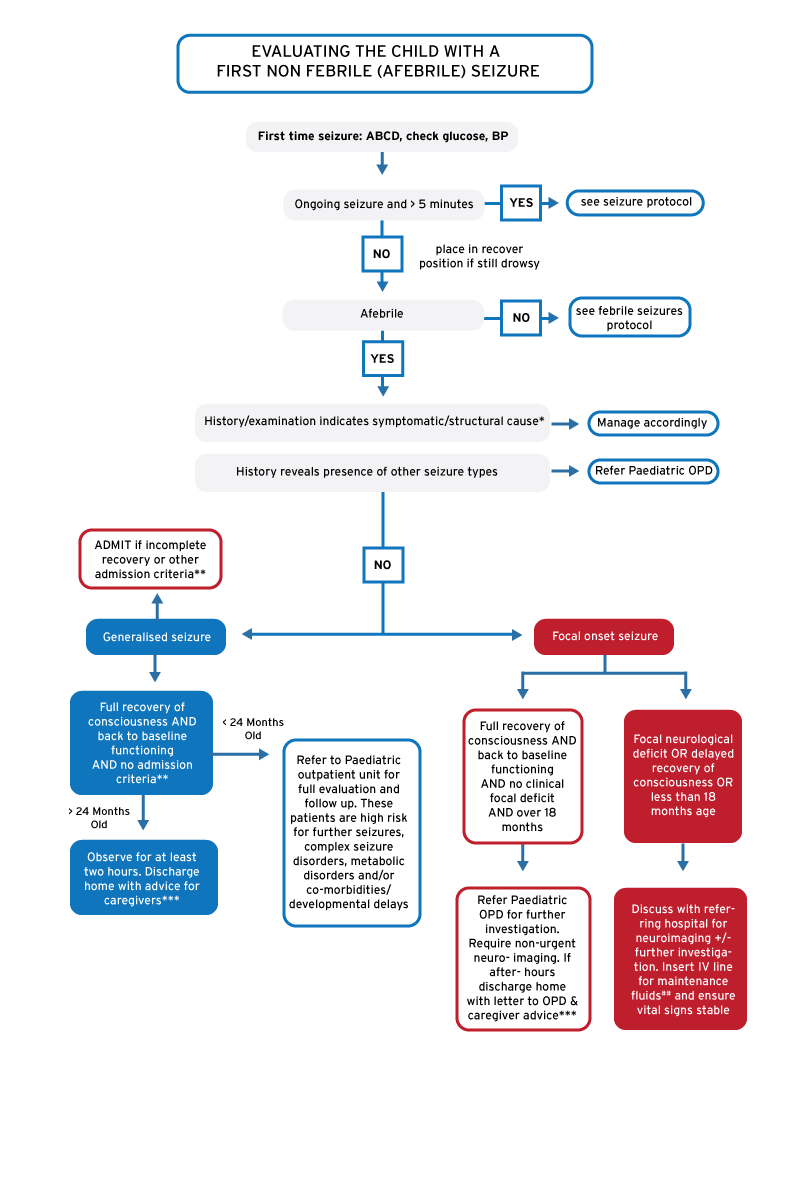
Click on image to enlarge
Note: If seizure onset was unwitnessed, follow the flow chart for generalised seizures.
If in doubt, or concerns regarding high risk for further seizures discuss with local paediatric team or referral centre team as appropriate.
Note: Children over the age of two years who have had only one seizure and have none of the indications for admission** or indications for imaging 1 or EEG2 below do not require referral for out-patient EEG or neuroimaging.
ADDITIONAL NOTES:
History/examination:
1. Obtain as detailed a history as possible regarding the event at the time of presentation.
Targeted history in order to ascertain the following:
- Was the event a seizure? Be aware of seizure mimickers including breath holding spells, syncope etc.
- Was the event the first epileptic seizure? Enquire about prior seizures; these may have looked different to the current event and therefore go unrecognised e.g. absences, myoclonic jerks, drop attacks.
- The specific circumstances and characteristics of the seizure – occurrence day or night, specific questioning to reveal focal onset, duration and whether there were any provoking factors – e.g. head injury, flashing lights. Note that sleep deprivation may reduce threshold for seizures but is not considered a provoking factor.
2. Search for a cause (history and examination)
- Includes: hypoglycaemia, electrolyte disturbances (diarrhoea/vomiting), malignant hypertension (various causes), possible substance ingestion including accidental/intentional ingestion of prescription or recreational drugs and toxins, head trauma (accidental or non-accidental). Note that infection may be present without fever.
- Past medical history or examination may reveal a structural cause requiring acute intervention E.g.: stroke, granuloma, space occupying lesion, cyanotic cardiac lesion -> REFER PAEDIATRICS & MANAGE ACCORDINGLY
- PMH or examination may reveal a structural cause with a high risk of recurrence but not requiring acute/ emergency intervention e.g. a pre-existing brain abnormality or prior static insult such as birth asphyxia/ prior meningitis -> REFER PAEDIATRIC OPD
- PMH may reveal other factors with a high risk of recurrence (e.g. previous febrile seizures or a first degree relative with childhood onset epilepsy) - > REFER PAEDIATRIC OPD
All children presenting with an afebrile seizure must have their glucose checked as soon as possible following presentation and their blood pressure measured during the acute presentation
Indications for referral to Paediatric OPD (if the child has fully recovered and has NO indications for admission)
- If there is a history of more than one seizure – REFER TO PAEDIATRIC OPD
- If there is a history of more than one seizure type OR one or more afebrile seizures AND <24 months age then REFER TO PAEDIATRIC OPD URGENTLY or if available PAEDIATRIC NEUROLOGY SERVICE
Indications for admission and referral to paediatrics
- Impaired consciousness more than 1 hour post seizure (consider impact of medications used to terminate seizure)
- New neurological signs
- Clinical signs of raised intracranial pressure
- Systemically or generally unwell e.g. irritability, listlessness
- Meningism
- Prolonged (>15 minutes) or recurrent (within 24 hours) seizures
- Signs of possible aspiration e.g. Respiratory distress/clinical pneumonia without prior symptoms/oxygen requirement
- Clinical indicators requiring neuroimaging 1
- Clinical indicators requiring urgent EEG2
- Clinical indicators requiring lab investigation3
- History of neuro-regression (motor or language/cognitive)
- Less than 24 months age or focal seizures at any age – low threshold for admission and referral particularly if impractical/unlikely to return to Paediatric OPD for further evaluation/workup
- High caregiver anxiety/ caregiver not willing to take home or difficulty returning to hospital
Advice for caregivers
- Return if following discharge one or more of the following:
- altered level of consciousness
- persistent headache or vomiting
- further seizure/s (NB: some parents mistakenly think they do not need to return for further seizures as the child has already been seen. Therefore emphasise that they must return for review as further seizures may require further investigation or treatment)
- other motor/cognitive decline
- Reinforce basic seizure management i.e.: recovery position, never attempt to put anything into the child’s mouth, wipe away any secretions only, do not delay seeking help if seizure persists > 5 minutes; parents should access nearest medical centre for emergency treatment
- Reinforce precautions: The child should not be left unsupervised in or near open water even if they are able to swim (this includes bathwater) for at least the first 3 months post seizure
1Indications for neuroimaging
- Urgent in any child with a post ictal focal deficit which does not resolve fully within 30 minutes or who has not returned to baseline within several hours after the seizure (effects of medication used to abort seizure need to be taken into consideration)
- Non urgent: (Refer Paediatric out patients)
- seizure of focal onset with or without secondary generalisation in whom there is no persistent focal deficit (see above)
- any child with significant developmental delay (motor impairment or cognitive disability) of unknown cause and not previously investigated
- children under age 24 months without any of above indications for urgent imaging
2Indications for EEG (AAN guidelines(2) recommend a non-urgent EEG for all children after a first non-febrile seizure however in resource limited settings the following are the minimum recommended indications for an EEG)
Urgent EEG:
- A child with continuing altered level of consciousness in whom sub-clinical status epilepticus cannot be ruled out
- Infantile spasms or suspected infantile spasms (admit and refer urgently to paediatrics)
Non-urgent EEG (refer via Paediatric out-patients/Paediatrician to ensure ongoing care):
- A child with recurrent seizures (includes a new non-febrile seizure on a background of previous febrile seizures
- A child with a history of more than one type of seizure
- Language regression between ages 2 – 7 years, suspicious of Landau Kleffner syndrome with or without accompanying seizures
- Children under age 24 months
3Indications for lab investigations (not indicated for children older than 6 months if seizure clearly unprovoked and no other clinical indicators for bloods or CSF)
- A history of diarrhoea or vomiting
- History suggestive of possible electrolyte disturbances (e.g.: renal, liver, cardiac patient, relevant medication)
- Toxicology screen if history suggestive
- CSF should be performed in children under 6 months age OR in those with meningeal signs or other signs suggestive of intracranial infection OR in the child with fever under 18 months age
- NOTE: CSF should only be performed provided there are no contra-indications
##IV Fluids:
1/2 Darrows Dextrose is recommended as maintenance fluid therapy while awaiting transfer if serum electrolytes not known: Note: Avoid overzealous fluid administration unless specifically replacing losses
For children who have had prolonged seizures or remain neurologically obtunded discuss with paediatric team and/or referral centre
Abbreviations: AAN: American Academy of Neurology
References:
- Baumer JH. Evidence based guideline for post-seizure management in children presenting acutely to secondary care. Arch Dis Child 2004; 89: 278–280.
- Hirtz D, Ashwal S, Berg A, Bettis D, Camfield C, Camfield P. Practice parameter: Evaluating a first non-febrile seizure in children. Neurology 2000; 55.
- Wiebe S, Tellez-Zenteno J, Shapiro M. An evidence – based approach to the first
- seizure. Epilepsia 2008; 49(Supp.1): 50-57.