GuidelinesOther guideline
Examination of an Individual Allegedly under the Influence of Alcohol
Alcohol
Legislation relating to alcohol and driving
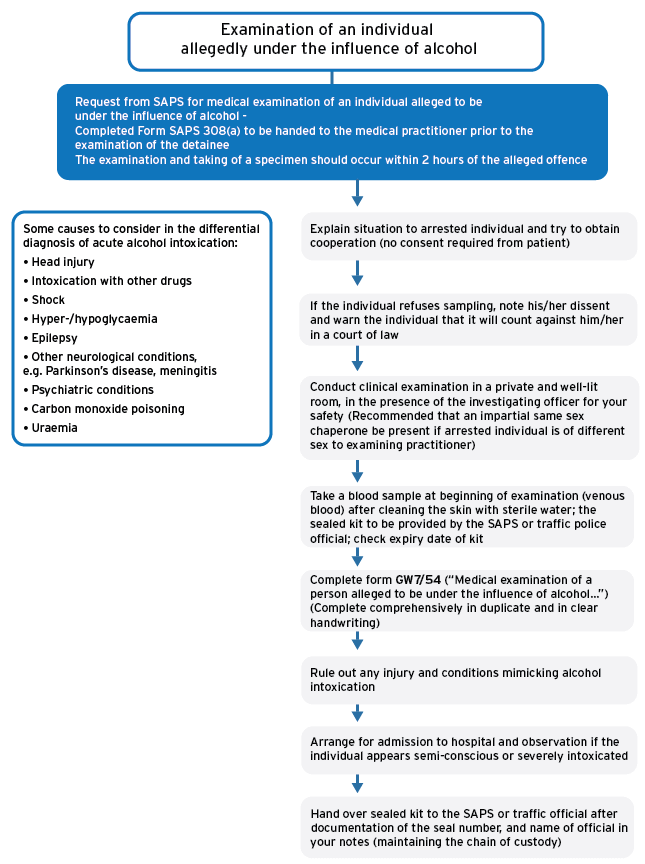
Management and examination
- A written request, in the form of a SAPS 308(a) form, should be provided to the medical examiner by the police or traffic officer prior to the medical examination of a person arrested for allegedly being under the influence of alcohol. A sealed blood alcohol kit is to be provided by the police or traffic officer – check the expiry date of the kit, and take careful note of the seal number(s) in your documentation. Note the expiry date on the GW7/54 form.
- The clinical examination and taking of a specimen should be done within 2 hours of the alleged offence. The clinical examination is performed to determine whether the arrested person’s abilities to drive a vehicle is impaired and to exclude other factors which may be the cause for the impairment (e.g. other drugs, hypoglycaemia).
- The consent of the detainee is not necessary, however it is important to explain the procedure to the detainee and to try to obtain his or her cooperation. Remember that your safety comes first, and you should never put your own safety and the safety of your staff at risk. Call for back-up and assistance if necessary in the case of an aggressive and uncooperative patient, and remember that in some cases, even after employing “reasonable force” to obtain a specimen, it may be impossible. Note the patient’s dissent and un-cooperativeness in your report and warn the detainee that it will count against him/her in a court of law.
- The examination should be conducted in a private and well-lit room, and your findings should be recorded, in duplicate on a “GW 7/54” form – keep a copy of this form and the SAPS 308(a) form in the patient’s folder.
- Remember that the skin should only be cleaned with a non-alcohol cleansing agent, and approximately 7ml of peripheral venous blood should be collected, using the equipment provided in the blood alcohol kit. Complete the label of the blood alcohol kit, and document the date, police station, CAS number, name of investigating officer receiving the blood specimen, and your details.
- It is very important to exclude underlying pathology, and to arrange further medical referral, treatment or admission if indicated.
Legislation relating to alcohol and driving
- The National Road Traffic Act, No. 93 of 1996
- Provides that:
- Ordinary drivers with blood alcohol levels in excess of 0.05g/100ml and professional drivers with blood alcohol levels in excess of 0.02g/100m will be guilty of an offence if found driving a vehicle or occupying the driver’s seat of a motor vehicle of which the engine is running while on a public road.
- Breath alcohol levels may not exceed 0.24mg/1000ml for ordinary drivers and 0.1mg/1000ml for professional drivers.
- The specimen of blood should be taken within 2 hours of the alleged offence.
- No person detained for blood alcohol testing is allowed to consume any substance containing alcohol, unless prescribed by a doctor.
- A person detained for breath alcohol testing may not smoke, until his/her breath has been tested.
- A person may not refuse to have his/her blood or breath tested.
The Criminal Procedures Act, No.51 of 1977
Section 37 provides for the following:
- A medical officer of a prison, a district surgeon, a registered practitioner or a registered nurse may obtain a blood sample from a person arrested, or charged with, or convicted of a crime, if requested by a police official to do so.
- Where a medical practitioner is attached to a hospital believes that a patient admitted for medical attention is under the influence of alcohol, he or she may obtain a blood sample, which may be relevant at a later criminal proceeding.