Examining an Unwell Diver
Examining an Unwell Diver
Approach algorithm
Where you scuba diving within the last 24 hours?
When did your symptoms FIRST present in relation to the dive?
How many dives have you made within the last 24 hours?
Diving Profile
Were you exposed to altitude within the last two days
Examination
Treatment
Approach to the Unwell Diver - Algorithm
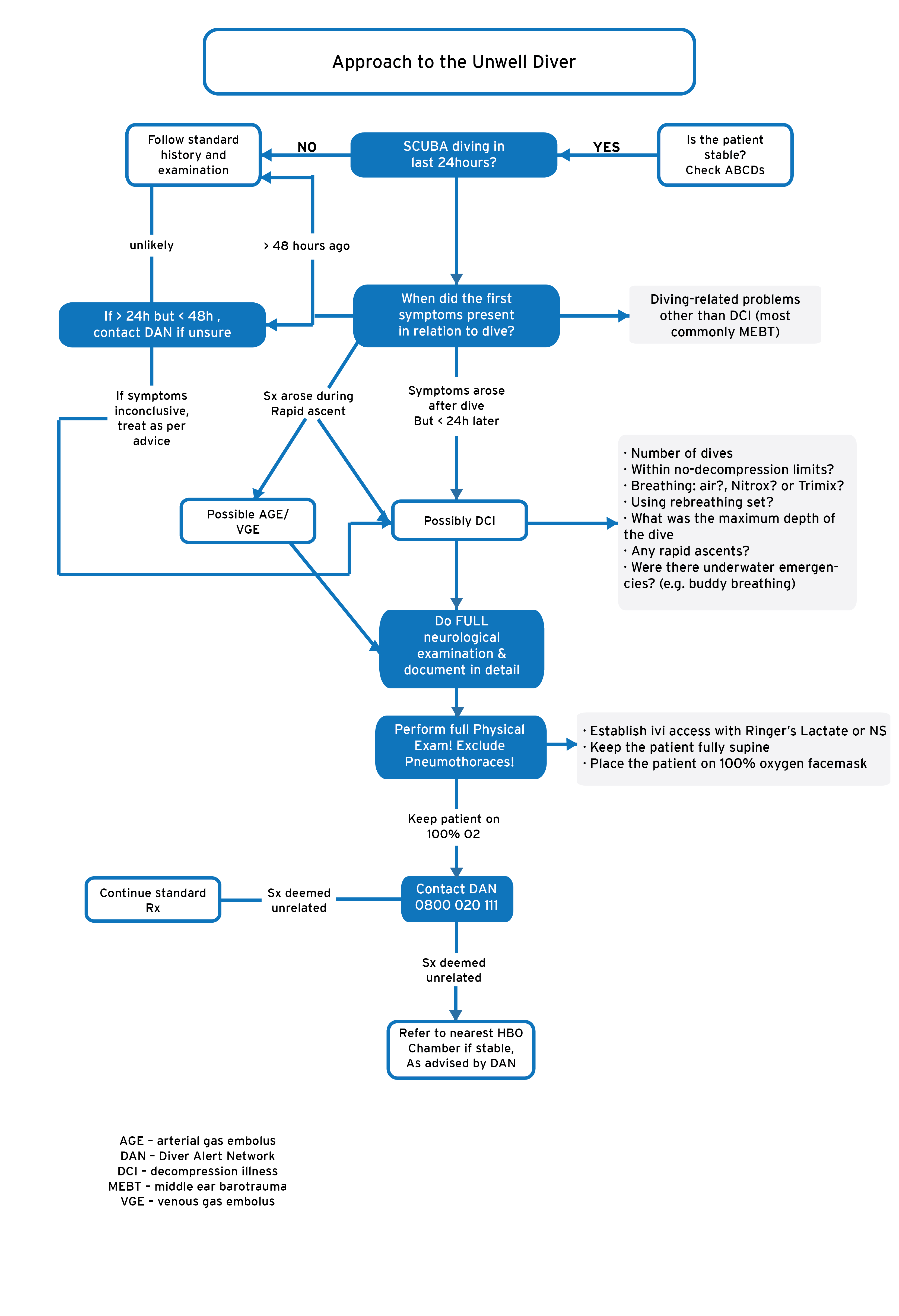
The taking of a diving history and the examination of a diver requires special skills. Even if you are a diver yourself, you may not have treated diving illnesses on a regular basis. At all times, consider consulting with the Divers Alert Network physicians (0800 020 111), who are experts in this field, dealing with more than 500 calls per year and at least one decompression illness (DCI) case per week.
Asking a patient whether or not they were diving in the 24 to 36 hours before they presented with an illness should be as routine as asking about an occupational history in any patient, especially if they present with unusual or bizarre neurological or orthopaedic complaints that do not fit the history or with a mottled skin rash.
Same as in general orthopaedics and trauma, many a pain is associated with a minor injury, in which case a more serious decompression sickness might be missed.
The following scenario presupposes a patient not requiring immediate ACLS intervention. If the patient has no pulse or has stopped breathing, follow the standard ABCDE protocol!
History of current illness:
Where you scuba diving within the last 24 hours?
An answer of yes to this question establishes that a directly related diving malady may exist.
When did your symptoms FIRST present in relation to the dive?
A temporal relationship of symptoms to diving is a strong indicator of diving-related illness. Symptoms presenting before ANY diving (see point 3) makes diving-related illness unlikely. Symptoms presenting during the dive may indicate diving-related illness other than DCI. Symptoms presenting during decompression stops (see below) is indicative of possible DCI. Symptoms presenting within 1 hour after a diver indicates serious DCI (even if the patient is currently stable, rapid deterioration is possible). Symptoms presenting within 4 hours after a dive is very likely to be DCI, but less serious. Symptoms presenting within 24 hours after a dive could still be DCI, but not likely serious. After a period of 24 hours it is unlikely that symptoms would deteriorate rapidly.
The symptoms are possibly related to the diving!
Now determine a DIVING HISTORY:
How many dives have you made within the last 24 hours?
Make sure that the person you are asking understands this important question. Sometime the victim thinks 24 hours as only being that day. If the day is Sunday ask about Saturday, and if he dove on Saturday, ask about Friday until you get to a day without diving. The victim may have been repetitive diving for several days
Diving Profile:
Where you within the no-decompression limits on all dives?
An answer of yes to this question does not rule out decompression sickness. Check the diver's log book (if he kept one) and determine if the dive profiles were worked properly, and determine if he pushed the tables in any way.
If not, did you make all required decompression stops?
Sometimes the answer will be yes but the diver did not stay at the stop for the required time. If he had to make a decompression stop it is clearly established that decompression sickness may exist. Any time a diver makes a REQUIRED stop a bell should ring.
Which breathing gases did you use during the dives?
Most scuba dives are performed while breathing compressed air, but many divers use other gas mixes, e.g. nitrox (a mixture of nitrogen and oxygen); heliox (a mixture of helium and oxygen); or trimix (a mixture of nitrogen, helium and oxygen). These different gas mixes all have different decompression requirements.
What was the maximum depth obtained during the dives?
The maximum depth should be obtained for all dives performed in the diving series. Therefore, obtain the maximum depth every day going back to when the victim was a new diver. Again he may be on a continuous repetitive dive profile. If this is the case then the diver may be making deeper dives than previous dives. Again the bell should ring. This is a strong history for decompression sickness.
Was any sort of rapid ascent made during the dive?
This includes any training dives. Just because an Instructor was present, does not mean an accident will not occur. Ascent training can be dangerous and air embolism has occurred while doing it. Lift bag operations have turned into rapid ascents, though the diver does not think so.
Did you or your buddy run out of air and make an emergency ascent or buddy breathing ascent?
An emergency ascent to some people means a ''blow and go'' ascent, however any time a dive is aborted for any reason it must be considered an emergency ascent. Blow and go ascents lend themselves to possible Arterial Gas Embolism (AGE) while aborted dives lend themselves to omitted decompression. Assisted or buoyant ascents are also emergency ascents. Buoyant ascents can lead to AGE and Venous Gas Embolism (VGE) due to the rapid rate of ascent. A buddy breathing ascent is one in which the divers share the same second stage. Using a safe second or alternate air source is not buddy breathing. The passing of the regulator back and forth can lead to breath holding and AGE. Also omitted decompression could be involved due to an out of air situation. If the ascent was made with an alternate air source and both divers did not panic or race to the surface than omitted decompression also could be there.
Did you drop your weights at any time?
This indicates that a situation arose to which the diver thought he was too heavy and had to ditch his weight belt. This indicates a problem dive and further investigation is indicated. If he was on the surface, it may not be dive related, but underwater it could lead to buoyant ascents.
Were you exposed to altitude within the last two days?
Do not over look this important question. In today's world of fast air service the victim could have been diving in Mozambique or Dar es Salaam for the last four days, flew home yesterday, and is now making a recreational dive at home. Driving over mountain passes or any other exposure to altitude will also increase the risk of DCI.
Examination
Next do a thorough full NEUROLOGICAL EVALUATION. The sooner it is done the better base line as to progression or regression can be determined. First determine the level of consciousness (GCS), then determine if the patient is orientated to TIME, PLACE, and PERSON. The victim should be completely orientated to all three. Test the higher cerebral functions (serial sevens, short term and long term memory), then cranial nerves, motor function (movement and power), sensation (touch, pain, temperature) and deep tendon reflexes. When doing the motor and sensory exam, start at the head and work to the toes or start at the toes and work towards the head. No matter where you start do not skip around.
It is not uncommon to find neurological signs that do not fit normal neurological distributions (since these are dependent on where the decompression bubbles are). Girdle pain (around the waist like a belt, in a dermatomal distribution) is a sign of serious illness that could progress rapidly to paralyses. Lastly, do a thorough examination of balance and coordination (gait evaluation, heel-to-toe walking, Rhomberg test, dysdiadokinesis, finger-nose and heel-shin slide). Then follow with a full head-to-toe general and systems examination to rule out any other possible injuries or conditions. Of particular concern are the cardiovascular, respiratory and ENT examinations.
Treatment
Treatment guidance, as well as assistance to identify appropriate treatment facilities, can be obtained from the DAN consultants (0800 020 111). Not all victims demand immediate recompression. Sometimes the delay may be permissible as during transportation. As soon as it has been determined that the victim is suffering from a diving malady, place him on 100% oxygen administered through a non-rebreather mask (or highest concentration mask available!). Have the victim lay down, and elevate his feet, as in the shock position. If the victim is unconscious he should be put on his left side, to prevent aspiration should vomiting arise. Keep the victim warm and watch for formation of life threatening symptoms.
Remember: like any other patient, the diver may also be suffering from the consequences of trauma or medical conditions! Strokes, heart attacks, wildlife envenomation, contusions, etc. can occur in the diver.
Always think of other causes and rule out common reasons for the presenting symptoms.
Always consider the possibility of a pneumothorax!
Only transfer for hyperbaric treatment once a patient is stable. Any life sustaining interventions and/ or operations will need to precede HBO therapy.
Intravenous access should be established and Ringer’s Lactate (or alternatively another crystalloid) should be administered. This should not contain any glucose, unless hypoglycaemia is present. When transporting to the chamber, keep him lying down. Do not put the patient head down or head up.
This lends itself to cerebral oedema and the patient aspirating his stomach contents (if head down) or cerebral gas embolism (if head up). Watch for signs of deterioration.
Always have the victim breathing 100% oxygen (with no air breaks) until the patient reaches a recompression facility or for as long as advised by the DAN physician. If symptoms are relieved or improve during transportation, chamber treatment should be conducted as if they were still present.
NB: Most medical practitioners are not trained as Diving Medical Examiners.
When seeing a patient who wants to determine if he/ she is fit to dive, especially if they have pre-existing medical conditions or are on medications, refer them to your nearest DME (www.sauhma.co.za -> DME Listing)
With thanks to the South African Underwater and Hyperbaric Medicine Society (www.sauhma.co.za) for allowing the adaptation of some of their protocols.