Exchange Transfusion Technique
Management guidelines for students, interns and registrars on a variety of routine and emergency situations in our neonatal service at Tygerberg Children’s Hospital. Published in 2014.
Special investigations at commencement of procedure
After completion of the exchange
Special investigations after exchange transfusion
See also Bilirubin Assessment and exchange transfusion
Notify the consultant of any bilirubin values within the exchange range.
Warn blood bank early of a potential exchange transfusion so that fresh blood can be ordered timeously.
Obtain parental consent for the procedure.
The procedure
The baby should be placed under an overhead warming pan.
Immobilise the baby.
Attach an oxygen saturation monitor.
Aseptic technique with gloves, mask, cap, sterile theatre gown and sterile drapes, etc. should be used.
An umbilical venous catheter (size FG 5 or 8) to be inserted.
Confirm the catheter tip in correctly placed by means of X-Ray. X-Ray and/or interpretation there of should not delay the exchange transfusion.
The requisite blood should be collected from the blood bank only once the umbilical line is in situ.
Use fresh blood <120 hrs old
Volume blood = 180 ml/Kg
Blood should be pre-warmed to 36-37°C by means of a blood warming apparatus during the procedure.
An experienced assistant must be available to assist with monitoring of the neonate (e.g. temperature, heart rate, saturation) and diligently record precise volumes of neonatal and donor blood exchanged.
IF FRESH BLOOD IS NOT AVAILABLE: Ask the blood bank to suspend packed red blood cells in 5% albumin and supply for exchange. No time delays are acceptable.
Exchange transfusion procedure should occur in volume increments of:
- 4 ml blood / Kg body-weight or
- 5 ml blood if <1500 g body-weight
- 10 ml blood if 1500-2500 g body-weight
- 15 ml blood if >2500 g body-weight
Order of exchange transfusion (see sketch):
- Extract infants blood with syringe.
- Discard
- Pull up the required volume of donor blood.
- Slowly inject into baby.
- A saturation monitor and skin temperature probe throughout should monitor infants.
- Keep NPO throughout the procedure.
Special investigations at commencement of the procedure
- If no specific cause for the jaundice has been elucidated (e.g. ABO or Rh incompatibility) the following must be requested with the first 10 - 15 ml of infant blood:
- Blood group, Rh and Coombs
- Full blood count, reticulocyte, white cell counts and peripheral blood smear
- Glucose-6 Phosphate-dehydrogenase
- Syphilis serology (if not already requested)
- CRP if sepsis is clinically suspected
- Other investigations as indicated.
After completion of the exchange
- Maintain the umbilical catheter with an infusion (Neonatalyte).
- Confirm catheter tip position (ideally in the IVC just above the diaphragm) if this has not been done already.Prophylactic antibiotics are not routinely indicated.
- Oral feeds may be recommended unless contra-indicated.
- Continue with phototherapy.
Special investigations after exchange transfusion
These should be performed 1 hour after the procedure:
- Acid base status and electrolytes
- Blood glucose
- Bilirubin
Bilirubin should be repeated at least 6 hourly until stable.
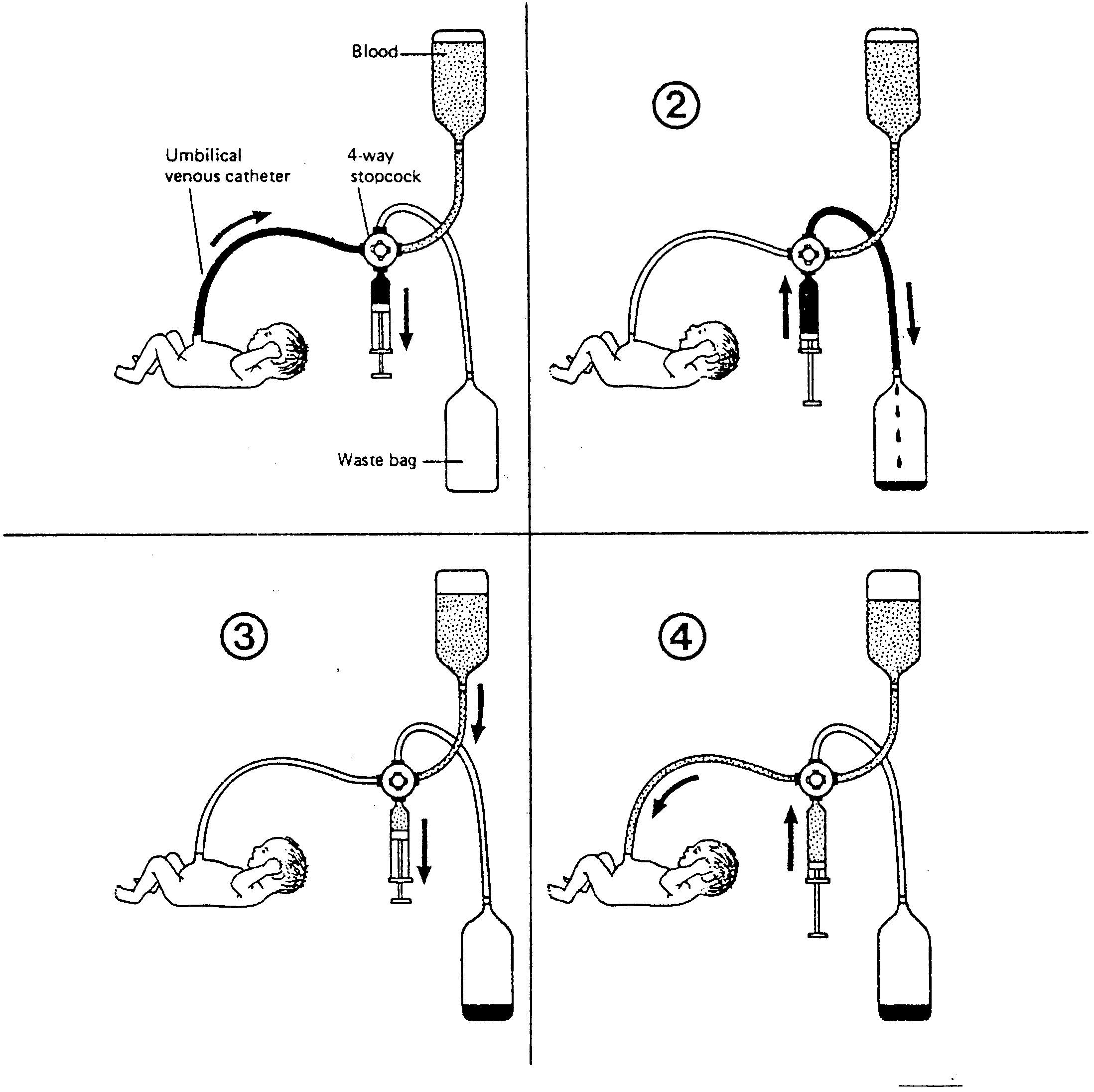
Textbook of Neonatology. NRC Roberton, Churchill Livingstone