External Oral Signs Symptoms: Acutely Swollen Face
External oral signs symptoms: Acutely swollen face
Acutely swollen mouth: Non painful
Acutely swollen mouth: Painful
Extra-oral trauma
Acutely swollen mouth: Non-painful
- Allergies - What have they been eating
- Medications – Angioedema (ACE inhibitor). Has the patient been using an ACE-inhibitor. The presenting signs will in most cases be the swelling of just the whole of the top lip. This will resolve with time and is worrisome for the patient. The patient should consult with their doctor to assess the use of an alternative anti-hypertensive medication.
- Bell’s Palsy – A trigger episode (such as trauma but usually unknown) may cause transient paralysis of the facial nerve (usually) on one side, resulting in a drooping effect of the affected muscles. It may last only days but may also be present for weeks to months, with some patients experiencing slight changes for longer periods which may be permanent. A course of steroids may be prescribed for 10 – 14 days. Patients may be concerned about this being the manifestation of a stroke.
- Dislocated temperomandibular joint — The patient may give history of previous such episodes and may be helpful in working with you in reducing the dislocation. If the dislocation is on the left side then support the patient’s head with your left arm and place your right thumb into the mouth on top of the back (molar) teeth and press down and back at the same time. If not successful then consider an oral sedative before trying again. Otherwise refer to maxillofacial surgeon.
Acutely swollen mouth: Painful
- Tooth abscesses (intra-oral):
- An abscess which is draining requires no antibiotics as it is a localised infection.
- Usually located in the sulcus, adjacent to carious tooth
- Children should be referred to a dental practitioner for pulp treatment or extraction of the tooth in question.
- Due to the chances of developing resistance, indiscriminate prescription of antibiotics (especially in children) should be avoided.
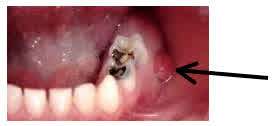
- Cellulitis:
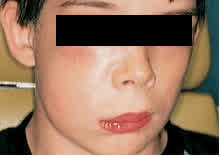
- Cellulitis manifests when inflammatory exudate from a non-vital tooth drains to the facial planes.
- Management should include drainage through either extraction or direct opening of the root canals (refer to dental surgeon for further treatment)
- This should also be supplemented with antibiotics if the body temperature is elevated and lymphadenopathy is diagnosed (See table)
- In severe cases it might be necessary to hospitalise the child in order to effect adequate treatment/ drainage—referral to a maxillo-facial surgeon might be warranted in such a case.
Presentation in upper jaw: swelling in zygoma area which can include lower eyelid as well as ala of the nose eliminating the naso-labial fold. Venous network connection with the intracranial cavernous sinus means that this is a potential pathway for spread of infection. Start with Metronidazole and Amoxicllin (see table below) regimen. This situation requires urgent attention from a dentist or maxillofacial surgeon.
Presentation in lower jaw: Sub-mandibular swelling could obstruct the airways (Ludwig’s Angina) and be life-threatening. Ludwig’s Angina is a deep neck abscess caused by tooth decay and subsequent infection at the apex of the tooth resulting in infection spreading into the tissue planes of the neck’. Start the Metronidazole / Amoxicillin regimen – patient might have to be admitted and antibiotics administered intravenously. Urgent attention by maxillofacial surgeon required. Be prepared to perform tracheotomy if breathing becomes impaired as a result of pressure on airway by swollen tissues.
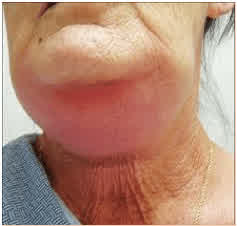
Ludwig’s Angina with severe deep soft tissue swelling that can fatally obstruct the airways.
Source: healthwiseeverythinghealth.blogspot.com
Management of cellulitis in adults:
- Metronidazole 200mg or 400mg tds for 7 days and
- Amoxicillin (1g stat and 500mg tds for 5 days)
Management of cellulitis in children
- Penicillin or Macrolide + Metronidazole
Summarized/ adapted from the MIMS (Dr. N. Mohamed)
| Examples | Dose for cellulitis management | |
| Penicillins | Amoxil suspension Caps (250/ 500mg) | 125mg/5ml or 250mg/5ml Upto 12 yrs (<40kg): 125mg/5mlÞ 5ml tds(5-7 days) 12 yrs+ (> 40kg): 250mg/5ml Þ 5ml tds (5-7 days) |
| Augmentin Suspension (soft tissue infections) | Amoxicillin component=125mg/5ml or 250mg/5ml Upto 12 yrs (<40kg): 125mg/5mlÞ 5ml tds(5-7 days) 12 yrs+ (> 40kg): 250mg/5ml Þ 5ml tds (5-7 days) | |
| Not allergic to Penicillin | Ranceph suspension | 125mg/5ml or 250mg/5ml (25 to 50 mg/kg) Upto 12 yrs (<40kg): 125mg/5mlÞ 5ml qid(5-7 days) 12 yrs+ (> 40kg): 250mg/5ml Þ 5ml qid (5-7 days) |
| Allergic to Penicillin (Macrolides) | Erymycin suspension | Upto 12 yrs (<40kg): 125mg/5mlÞ 5ml qid (5-7 days) 12 yrs+ (> 40kg): 250mg/5ml Þ 5ml qid (5-7 days) |
| Clarihexal suspension Klarithran suspension | Upto 12 yrs (<40kg): 125mg/5mlÞ 5ml bd (5-7 days) 12 yrs+ (> 40kg): 250mg/5ml Þ 5ml bd (5-7 days) | |
| Clindamysin-Fresenius suspension Caps | 150mg caps Mild infection: 8-12mg/kg/day Moderate infection: 13-16mg/kg/day Severe infection:17-25mg/kg/day | |
| Flagyl (Metronidazole) | Suspension (7.5mg/kg; 8 hourly) Tabs (200/ 400mg) | (200mg/ 5ml) 1-3 yrs: 50mg tds (3 days) 3-7 yrs: 100mg bd (3 days) 7-10 yrs: 100mg tds (3 days) |
Extra-oral trauma
- Facial fractures-- External signs and symptoms:
- Pain / tenderness
- Swelling
- Ecchymoses
- Lacerations: Intraoral, auditory canal, conjunctivae, facial skin
- Raccoon eyes and leakage of cerebrospinal fluid from the nose and ears indicate a fracture of the base of the skull
- Trauma to the chin and mental area warrants careful examination of the head of the mandibular condyles.
- Palpate orbital rims, zygomatic arches, nose, frontal bones, mandibular borders (look for step deformities and crepitations)
- Assess facial asymmetry, deformity
- Impaired jaw movement-- Jaw movements should be checked for normal range of movements, pain and the presence of deviation. If jaw movements are abnormal, a jaw fracture must be considered and evaluated radio-graphically. Does the patient have difficulty opening their mouth, or difficulty in speaking or chewing?
- Diplopia / reduced visual acuity-- check size of pupils for size, equality, light reaction, squint or nistagmus
- Epistaxis
- Obstructed breathing
- Facial paralysis or numbness of the lip/ chin
NB! Eliminate the possibility of child abuse.Also remember that some conditions can often be mistaken for abuse.
Medical conditions such as bleeding disorders must always be excluded by laboratory tests.
The clinician should also be mindful of the fact that conditions such as chronic eczema could be mistaken for bruising.
(See Child abuse vs trauma (orofacial manifestations) + recognizing and reporting of suspected cases of abuse )
Radiographic surveys for facial fractures: | |
Structure | Best view |
| Mandible | |
| Condyle, coronoid process | Lateral oblique |
| Ramus, body | Water’s |
| Condyle and neck of condyle | Reverse Towne |
| Symphysis | Occlusal |
| Symphysis, body, ramus | Panoramic |
| Maxilla and Zygoma | Water’s and Lateral |
| Frontal and orbital floor | Caldwell |
| Nasal | Water’s. Lateral (Coned down) |
References:
Douglass AB & Douglass JM (2003). Am Fam Physician. Common dental emergencies. Feb 1; 67(3):511-517.
Parthiscar A & Har-El G (2001). The annals of Otology, Rhinology and Laryngology. Deep neck abscess: a retrospective review of 210 cases. 110(11):1051-1054.
Fundamentals of Pediatric Dentistry (3rd Edition). RJ Mathewson, RE Primosch. Pg 287 + 297+ 301.
Dentistry for the child and adolescent (6th Edition). RE McDonald, DR Avery. Pg 503—563.
The management of traumatised anterior teeth of children. JA Hargreaves, JW Craig, HL Needleman.
Flores MT, Andersson L, Andreasen JO et al. (2007). Guidelines for the management of traumatic dental injuries II (b). Avulsion of permanent teeth. Dental Traumatology 23: 130-- 136.
Flores MT, Malmgren B, Andersson L, et al. (2007). Guidelines for the management of traumatic dental injuries III (c). Primary teeth. Dental Traumatology 23: 196-- 202.
McIntyre JD, Lee JY, Trope M, Vann WF (2007). Management of avulsed permanent incisors: a comprehensive update. Paediatric Dentistry 29 (1): 56—63.