Feeding and Growth: Breastfed and Non-Breastfed Infants (Birth up to 2 months)
IMCI - Young Infant (Birth up to 2 months)
BREASTFED INFANTS
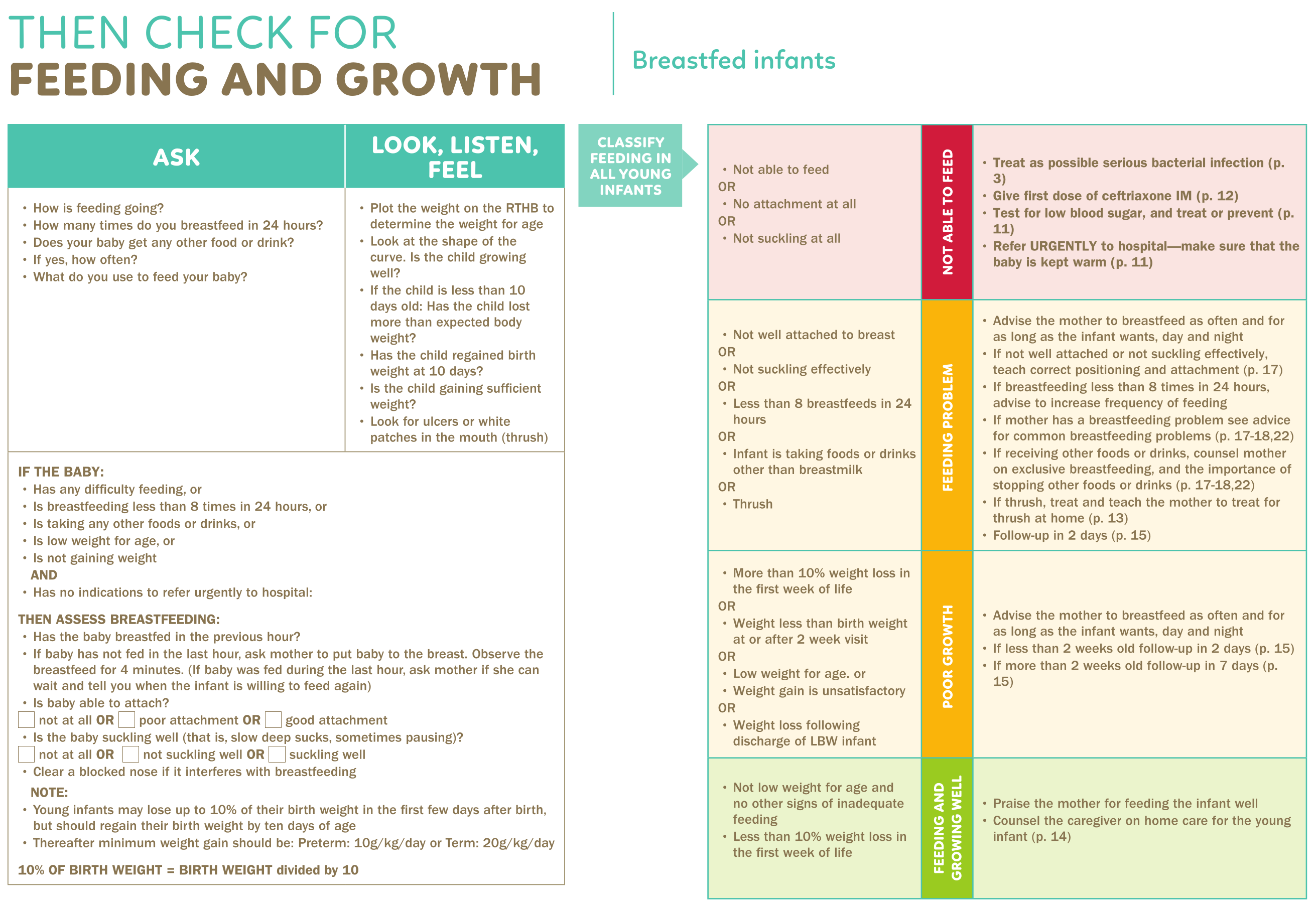
Click here to open the above PDF
Ask
- How is feeding going?
- How many times do you breastfeed in 24 hours?
- Does your baby get any other food or drink?
- If yes, how often?
- What do you use to feed your baby?
Look, Listen, Feel
- Plot the weight on the RTHB to determine the weight for age.
- Look at the shape of the curve. Is the child growing well?
- If the child is less than 10 days old: Has the child lost more than expected body weight?
- Has the child regained birth weight at 10 days?
- Is the child gaining sufficient weight?
- Look for ulcers or white patches in the mouth (thrush)
If the baby:
- Has any difficulty feeding, or
- Is breastfeeding less than 8 times in 24 hours, or
- Is taking any other foods or drinks, or
- Is low weight for age, or
- Is not gaining weight
AND - Has no indications to refer urgently to hospital:
Then assess breastfeeding:
- Has the baby breastfed in the previous hour?
- If baby has not fed in the last hour, ask mother to put baby to the breast. Observe the breastfeed for 4 minutes. (If baby was fed during the last hour, ask mother if she can wait and tell you when the infant is willing to feed again).
- Is baby able to attach?
- not at all OR poor attachment OR good attachment
- Is the baby suckling well (that is, slow deep sucks, sometimes pausing)?
- not at all OR not suckling well OR suckling well
- Clear a blocked nose if it interferes with breastfeeding
Note:
- Young infants may lose up to 10% of their birth weight in the first few days after birth, but should regain their birth weight by ten days of age
- Thereafter minimum weight gain should be: Preterm: 10g/kg/day or Term: 20g/kg/day
10% of birth weight = birth weight divided by 10
Classify Feeding in Breastfed Infants
| Not able to feed | |
|
|
| Feeding problem | |
|
|
| Poor growth | |
|
|
| Feeding and growing well | |
|
|
NON- BREASTFED INFANTS
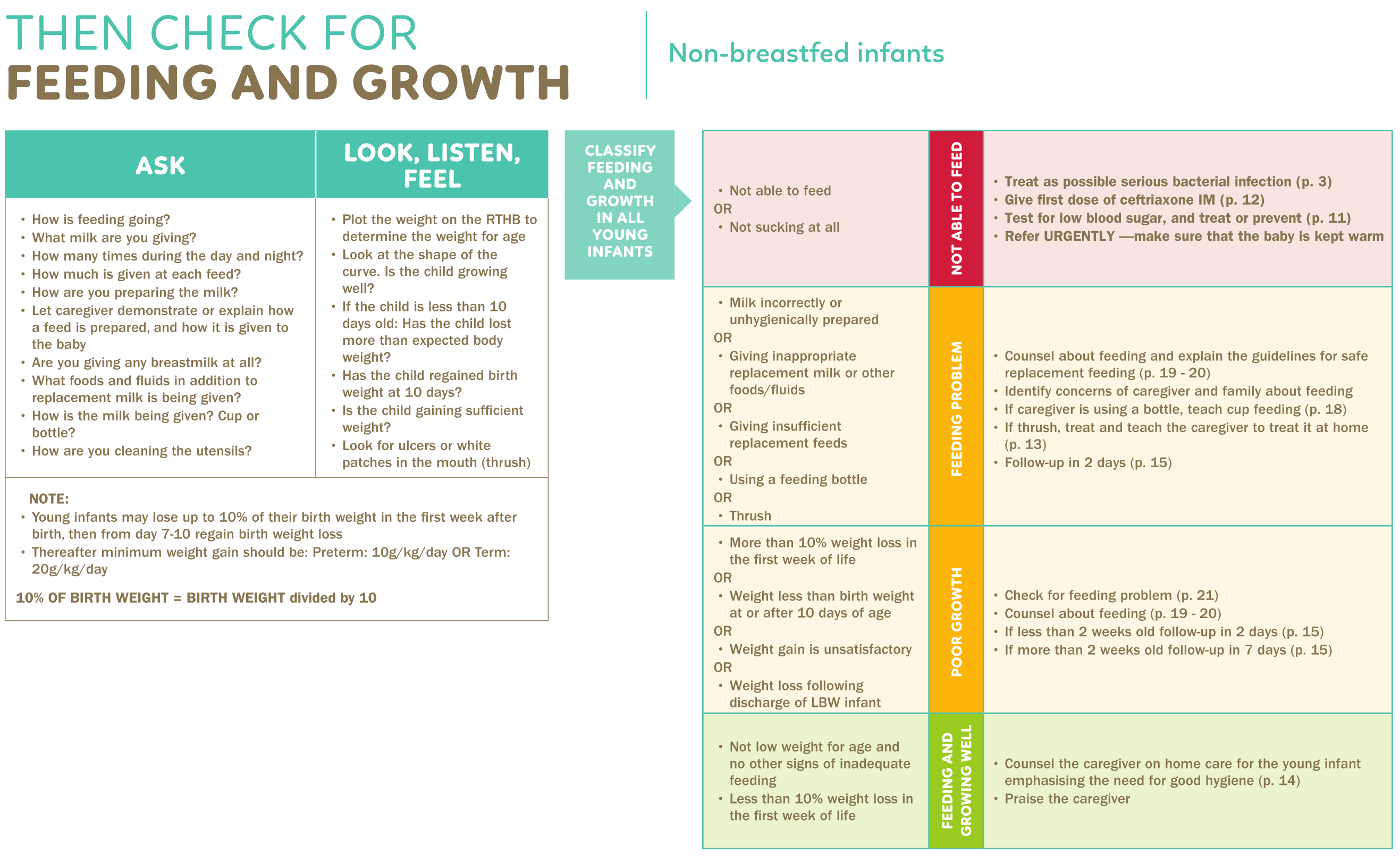
Click here to open the above PDF
Ask
- How is feeding going?
- What milk are you giving?
- How many times during the day and night?
- How much is given at each feed?
- How are you preparing the milk?
- Let caregiver demonstrate or explain how a feed is prepared, and how it is given to the baby
- Are you giving any breast milk at all?
- What foods and fluids in addition to replacement milk is being given?
- How is the milk being given? Cup or bottle?
- How are you cleaning the utensils?
Look, Listen, Feel
- Plot the weight on the RTHB to determine the weight for age
- Look at the shape of the curve. Is the child growing well?
- If the child is less than 10 days old: Has the child lost more than expected body weight?
- Has the child regained birth weight at 10 days?
- Is the child gaining sufficient weight?
- Look for ulcers or white patches in the mouth (thrush)
Note:
- Young infants may lose up to 10% of their birth weight in the first week afterbirth, then from day 7-10 regain birth weight loss
- Thereafter minimum weight gain should be: Preterm: 10g/kg/day OR Term: 20g/kg/day
10% of birth weight = birth weight divided by 10
Classify Feeding & Growth in Non- Breastfed Infants
| Not able to feed | |
|
|
| Feeding problem | |
|
|
| Poor growth | |
|
|
| Feeding and growing well | |
|
|
Integrated Management of Childhood Illness 2022; Young Infant (Birth up to 2 months); Assess, Classify and Identify Treatment: Feeding and Growth (Breastfed), Feeding and Growth (Non-breastfed)
Last checked for updates: June 2023