Fetal Monitoring
The guidelines recommend management of common obstetric conditions at primary and referral level, based on local experience and evidence-based practice. They are not intended as strict protocols nor as standard operating procedures, but rather as a guide to safe effective management of common obstetric problems. The guidelines should be most useful to interns, medical officers and registrars.
Some indications for CTG monitoring in labour
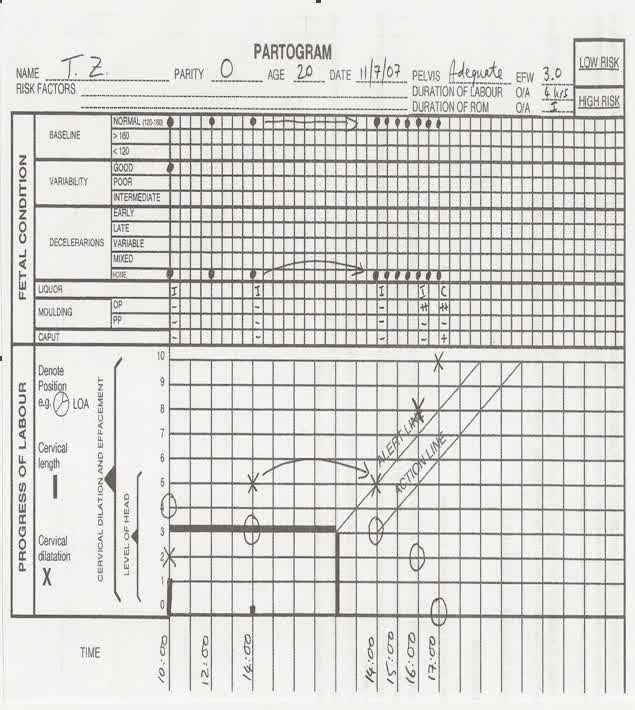
Correct completion of a partogram - normal labour
For low risk labour, listen to the fetal heart with a stethoscope or hand-held Doppler instrument every 30 minutes, between, during and after contractions.
Cardiotocography (CTG) is used for high risk labour.
Some indications for CTG monitoring in labour
- Previous caesarean section
- Meconium stained liquor
- Maternal pyrexia, offensive liquor or suspected chorio-amnionitis
- Labour progress which has crossed the alert line
- Suspected intrauterine growth restriction
- Suspected fetal distress
- Oxytocin augmentation
- Prolonged rupture of membranes (>24 hours)
- Pre-eclampsia
- Induction of labour for post-term pregnancy
- Antepartum haemorrhage
- Multiple pregnancy
Correct completion of a partogram – normal labour
This woman presented in the active phase of labour (cervix 5 cm dilated) at 14:00 and made good progress to full dilatation. Progress crossed neither the alert nor the action line, and head descent was rapid from 3/5 above to 0/5 above the brim in 3 hours.