First Steps in Resuscitation of the Newborn
National Neonatal Resuscitation Guidelines
Baby not requiring resuscitation
Newborn Resuscitation Algorithm
How to give free flowing oxygen
Basic resuscitation of the newborn:
Prevent heat loss
Establish an airway
Tactile stimulation
Give oxygen when necessary
Bag and mask ventilation
Chest compressions
Administer Naloxone
In this guideline you should learn how to:
- Prevent heat loss
- Establish and clear the baby’s airway, with suctioning if needed
- Evaluate the newborn infant
- Give free flowing oxygen
Baby not requiring resuscitation
Follow standard precautions for exposure to blood and body fluids – wear gloves and avoid mouth-to-mouth resuscitation. A baby that is unlikely to require resuscitation can be identified by the following questions:
Was the baby born after 37 weeks completed gestation?
Was the amniotic fluid clear of meconium and evidence of infection? Is the baby breathing / crying normally?
Does the baby have good muscle tone?
If the answer is yes to all the above questions, the baby does not need resuscitating and should not be separated from the mother. The baby should be dried and kept warm to avoid hypothermia. This can be done with the baby lying on the mother’s chest. In babies that do not require resuscitation, clamping of the umbilical cord should be delayed for 30-60 seconds. This is also recommended for premature babies who do not require immediate resuscitation. The cord should not be milked.
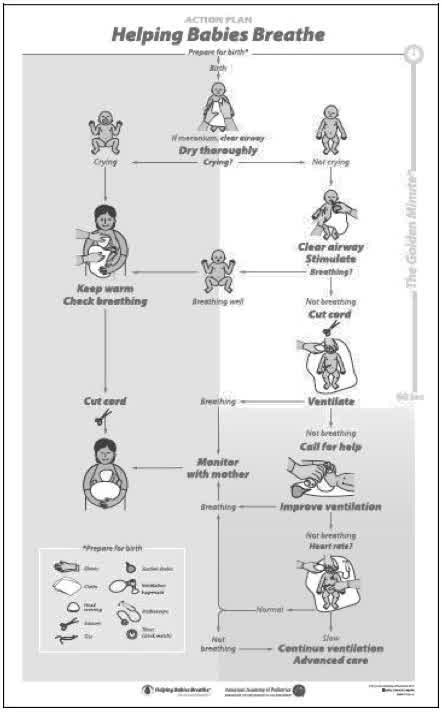
If the answer is no to any of the above questions, proceed with resuscitation as listed below. The following chart should be used as a guideline on initial care of newborn babies:
Prevention of heat loss
Newborn babies lose heat rapidly due to their large surface area to body mass ratio, lack of insulation and limited ability to produce heat. It is very important to stop heat loss in a newly born infant to prevent cold stress, but overheating should also be avoided. The aim is to achieve and maintain normothermia but to avoid hyperthermia. The temperature of non- asphyxiated babies should be maintained between 36.5 – 37.5oC.
Put the resuscitation crib in a warm, draught free area. The room temperature should be between 23 and 25oC. Make sure that the incubator or radiant warmer is switched on. Dry the newborn baby thoroughly, especially the head, and place under a radiant warmer. Remove the wet linen, and wrap the baby in a second dry towel, to prevent heat loss through evaporation. A cap will reduce heat loss through the baby’s head.
A simple way to prevent heat loss in a well baby is to place the dried infant skin-to-skin against the mother’s body. Very low birth weight babies (<1500 grams) should be covered in plastic (food grade plastic wrap or a plastic food storage bag) immediately after birth to prevent heat loss. The rest of the resuscitation can be done with the baby covered in plastic.
Care must be taken not to cover the baby’s face or airway with the plastic.
Establishing a patent airway
Place the baby on his/her back with the neck slightly extended – the so-called neutral position. (See figure below)
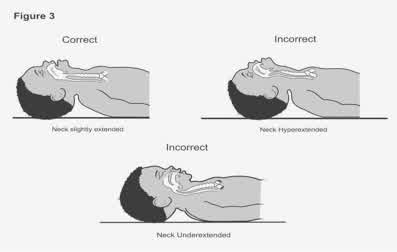
Too much flexion or extension of the neck may cause obstruction of the airway. A folded towel placed under the baby’s shoulders may help in keeping the baby’s head in the correct position. Clear the baby’s airway if necessary. Previous guidelines stated that in all cases of meconium stained liquor, the baby’s mouth, nose and pharynx should be suctioned with a large bore suction catheter as soon as the head is delivered.
However, there is no evidence that this prevents meconium aspiration syndrome and this is no longer recommended. A well infant does not need to have the airway suctioned; any secretions can be cleaned away from the nose and mouth with a clean tissue or gauze swab. If the airway needs to be cleared, the mouth and then the nose are suctioned (any secretions present in the mouth may be aspirated if the order is reversed.).
An 8F or 10F suction catheter should be passed to a depth of 5cm and the duration of suctioning limited to 5 seconds (Rule of 5: 5cm for 5 seconds). The suction pressure should not be more than 100mm Hg (13.3KPa). Vigorous deep suctioning can cause vagal bradycardia, laryngospasm and delayed onset of respiration. If there are lots of secretions, turn the baby’s head to the side. Do not hold the baby upside down to clear the secretions.
If the airways need to be cleared in a baby who is not breathing adequately, it should be done before drying the baby (the stimulation from drying could cause the baby to gasp and aspirate secretions that are present in the mouth or nose).
Tactile stimulation
In most babies, rubbing with a towel is enough tactile stimulation to initiate breathing. A baby in primary apnoea may start breathing in response to mild tactile stimulation such as flicking the soles of the feet.
If the baby does not start breathing in response to gentle tactile stimulation, positive pressure ventilation with a bag and mask must be started immediately.
There is no benefit in excess tactile stimulation such as pricking or smacking the baby and this should not be done.
Evaluation of the infant
There are two important questions regarding the newborn infant, which are the most important items in the Apgar score. These are:
- Is the baby breathing adequately (not just gasping)?
- Is the baby’s heart rate above 100 beats per minute?
If the answer to both questions is “yes”, the baby does not need resuscitation and can be sent to the mother. The initial evaluation of the baby should not take longer than 60 seconds. Heart rate can be determined by auscultation, palpation of the umbilical cord or with the use of monitors (pulse oximeter, cardiac ECG monitor) if available.
The Apgar score is not used to assess whether the baby needs resuscitation or not, the rapid assessment at birth is used for this purpose.
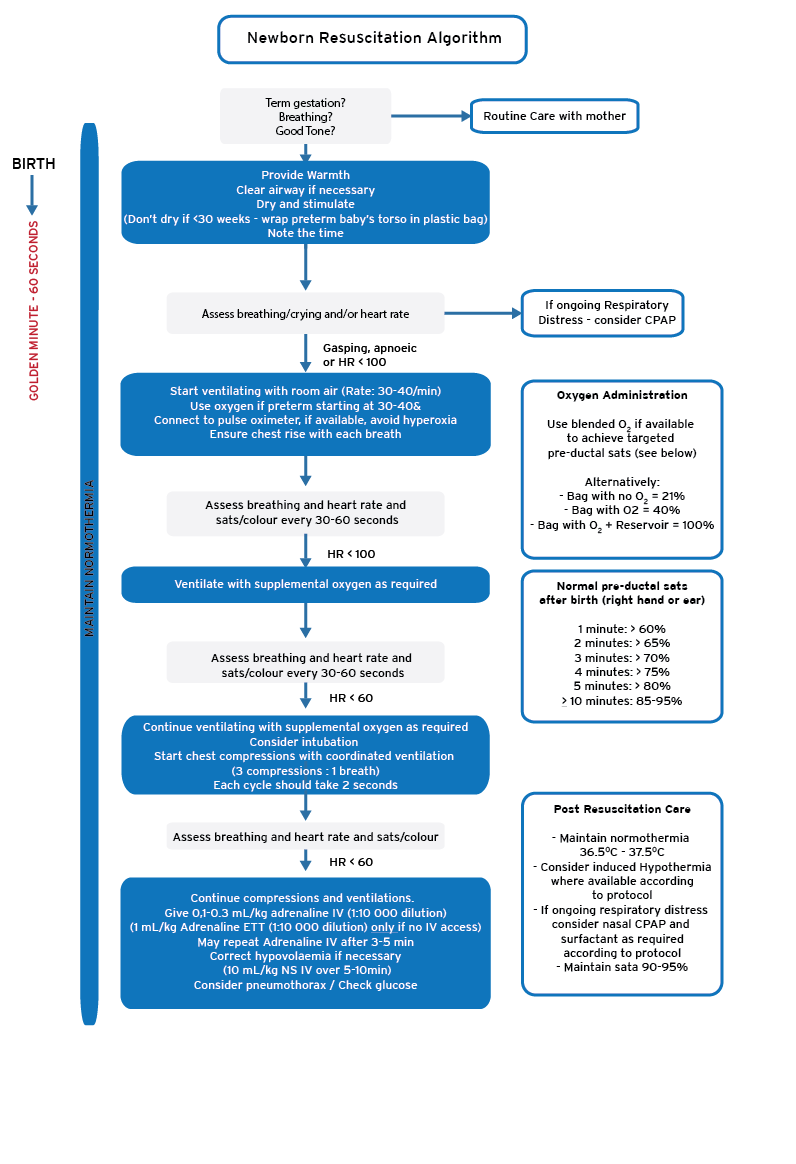
After the initial evaluation, the rest of the resuscitation is directed by repeated evaluation of the baby’s heart rate and respirations, every 30-60 seconds. It is often difficult to determine whether a baby is in fact cyanosed, so pulse oximetry should be used, if available. If the baby is breathing regularly and/or improving, then the intervention, e.g. bagging, can be stopped. If the baby is not breathing and heart rate not responding or getting worse, then further intervention is needed (e.g. start chest compressions). This would mean “moving down” the algorithm if the baby is not responding and “moving up” the algorithm if the baby is improving.
Newborn Resuscitation Algorithm
How to give free flowing oxygen
Give free flowing oxygen to the baby if the baby is breathing well with a good heart rate but is not maintaining saturations on pulse oximetry or remains centrally blue. Where available, the amount of supplementary oxygen should be regulated by blending air and oxygen and the amount should start at 21% (air) and increase to 30%, being guided by pulse oximetry.
Hold the oxygen tubing in your hand, which is gently cupped over the baby’s face for a few minutes. Set the flow meter to at least 5 litres per minute. The baby’s saturations should improve to above 88% or the central colour should become pink within a minute.
If the saturations or central colour do not improve, start bag and mask ventilation (see below). If the baby desaturates or becomes blue out of oxygen, continue to give oxygen either via head box or nasal prongs.
Remember that the self-inflating type bag and facemask will not deliver enough oxygen unless the bag is squeezed.
If pulse oximetry is not available, the use of supplemental oxygen must be guided by the baby’s colour. Remember to look at the baby’s tongue and lips to determine cyanosis, not the fingers.