GuidelinesIMCI
Follow-up Care for Children on ART: Seven Steps
IMCI - Anti-retroviral therapy (ART)
Step 2: Monitor Progress on ART
Step 3: Check for Viral Suppression and Provide ART
Step 4: Provide Other HIV Treatments
Step 7: Arrange Follow-up Care
Click here to open the above PDF
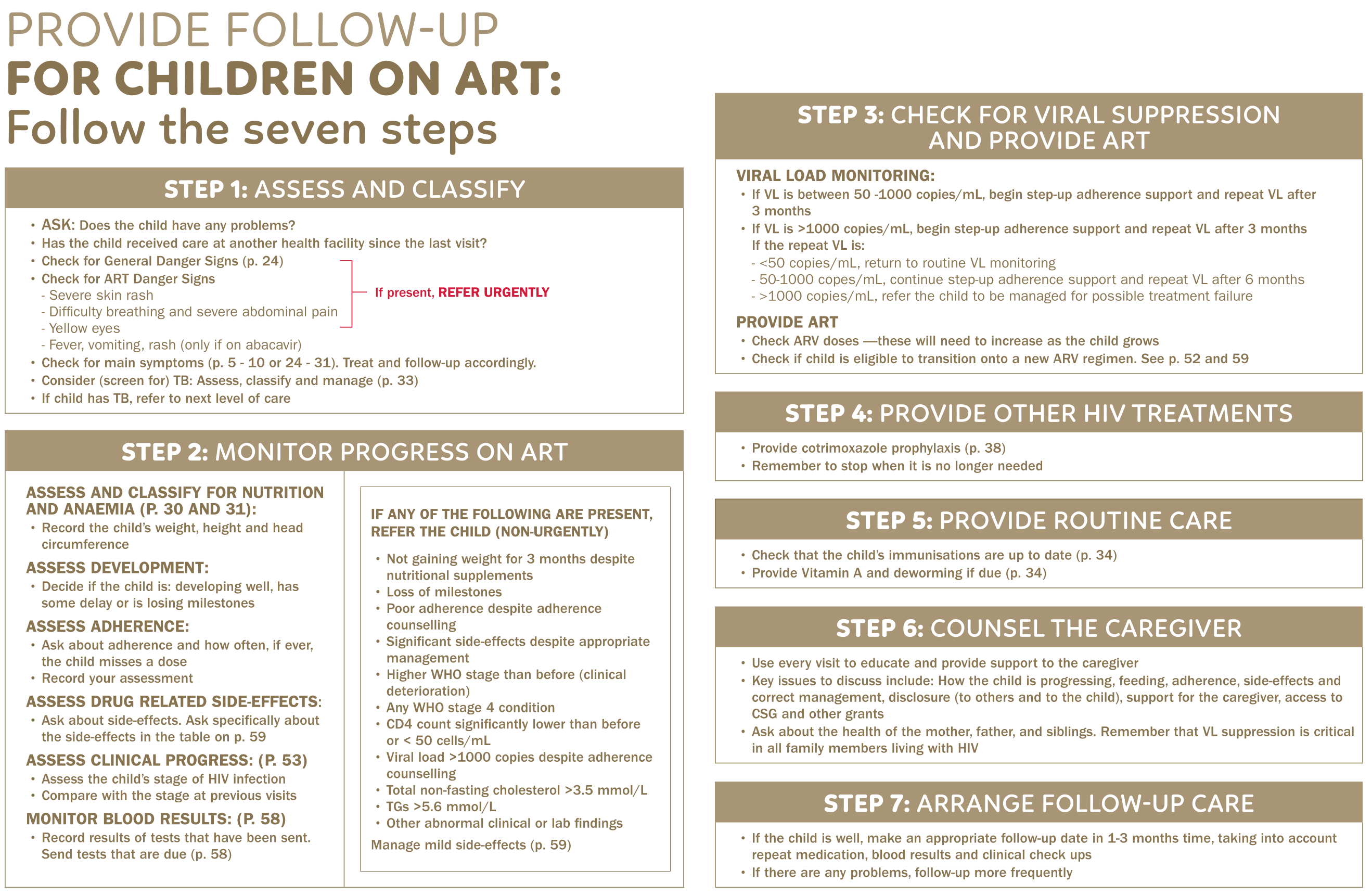
Provide follow-up care for children on ART : Follow the seven steps
Step 1: Assess and Classify
Ask: Does the child have any problems?
- Has the child received care at another health facility since the last visit?
- Check for General Danger Signs (If present, refer urgently)
- Check for ART Danger Signs (If present, refer urgently)
- Severe skin rash (If present, refer urgently)
- Difficulty breathing and severe abdominal pain (If present, refer urgently)
- Yellow eyes (If present, refer urgently)
- Fever, vomiting, rash (only if on abacavir) - Check for main symptoms. Treat and follow-up accordingly
- Consider (screen for) TB : Assess, classify and manage
- If child has TB, refer to next level of care
Step 2: Monitor Progress on ART
Assess and classify for nutrition and anaemia:
- Record the child’s weight, height and head circumference
Assess development:
- Decide if the child is: developing well, has some delay or is losing milestones
Assess adherence:
- Ask about adherence and how often, if ever,the child misses a dose
- Record your assessment
Assess drug related side-effects:
- Ask about side-effects. Ask specifically about the side-effects in the table
Assess clinical progress:
- Assess the child’s stage of HIV infection
- Compare with the stage at previous visits
Monitor blood results:
- Record results of tests that have been sent
- Send tests that are due
If any of the following are present, refer the child (Non-urgently)
- Not gaining weight for 3 months despite nutritional supplements
- Loss of milestones
- Poor adherence despite adherence counselling
- Significant side-effects despite appropriate management
- Higher WHO stage than before (clinical deterioration)
- Any WHO stage 4 condition
- CD4 count significantly lower than before or < 50 cells/mL
- Viral load >1000 copies despite adherence counselling
- Total non-fasting cholesterol >3.5 mmol/L
- TGs >5.6 mmol/L
- Other abnormal clinical or lab findings
Step 3: Check for Viral Suppression and Provide ART
Viral load monitoring:
- If VL is between 50 -1000 copies/mL, begin step-up adherence support and repeat VL after 3 months
- If VL is >1000 copies/mL, begin step-up adherence support and repeat VL after 3 months. If the repeat VL is:
- <50 copies/mL, return to routine VL monitoring
- 50-1000 copes/mL, continue step-up adherence support and repeat VL after 6 months
- >1000 copies/mL, refer the child to be managed for possible treatment failure
Provide ART
- Check ARV doses —these will need to increase as the child grows
- Check if child is eligible to transition onto a new ARV regimen
Step 4: Provide Other HIV Treatments
- Provide cotrimoxazole prophylaxis
- Remember to stop when it is no longer needed
Step 5: Provide Routine Care
- Check that the child’s immunisations are up to date
- Provide Vitamin A and deworming if due
Step 6: Counsel the Caregiver
- Use every visit to educate and provide support to the caregiver
- Key issues to discuss include: How the child is progressing, feeding, adherence, side-effects and correct management, disclosure (to others and to the child), support for the caregiver, access to CSG and other grants
- Ask about the health of the mother, father, and siblings. Remember that VL suppression is critical in all family members living with HIV
Step 7: Arrange Follow-Up Care
- If the child is well, make an appropriate follow-up date in 1-3 months time, taking into account repeat medication, blood results and clinical check ups
- If there are any problems, follow-up more frequently
Integrated Management of Childhood Illness 2022; Anti-Retroviral Therapy; Initiating ART in Children: Follow-up Care for Children on ART: Follow the 7 Steps
Last checked for updates: June 2023