Foreign Body Ingestion
Introduction Dangerous objects Important details on history Important details on examination Management guideline Referral guideline Parental counselling References SETTING Primary and Secondary Healthcare Institutions in the Western Cape which refer to Red Cross War Memorial Children’s Hospital (RCWMCH) FOR STAFF Primary and Secondary Doctors and Nurses who refer patients to RCWMCH PA
Important details on examination
SETTING
Primary and Secondary Healthcare Institutions in the Western Cape which refer to Red Cross War Memorial Children’s Hospital (RCWMCH)
FOR STAFF
Primary and Secondary Doctors and Nurses who refer patients to RCWMCH
PATIENTS
Patients under the age of 13 years old with a history of foreign body ingestion
Introduction
Ingestion of foreign bodies is extremely common. Most objects will pass though the digestive tract without incident, but there are a few situations where the foreign body may cause significant injury through interaction with the body or other objects within the GIT.
This guideline is intended to assist doctors and nurses in identifying patients which are at risk of foreign body impaction or complications related to foreign bodies within the GIT. This guideline does not cover inhaled or aspirated foreign bodies.
Dangerous objects
BUTTON BATTERIES = SURGICAL EMERGENCY
- Button batteries lodged in the oesophagus are a surgical emergency
- These patients should be transferred as soon as possible to an appropriate service for endoscopic removal
- It is possible that the closest unit that has capacity for endoscopic removal is a local hospital
- Under no circumstances should removal be attempted in the emergency unit
- Button batteries cause severe oesophageal injuries within 2 hours of ingestion2
- Complications of these injuries include oesophageal perforation with erosion into surrounding structures such as the airway & vascular structures. These complications result in significant morbidity & occasionally death2,3
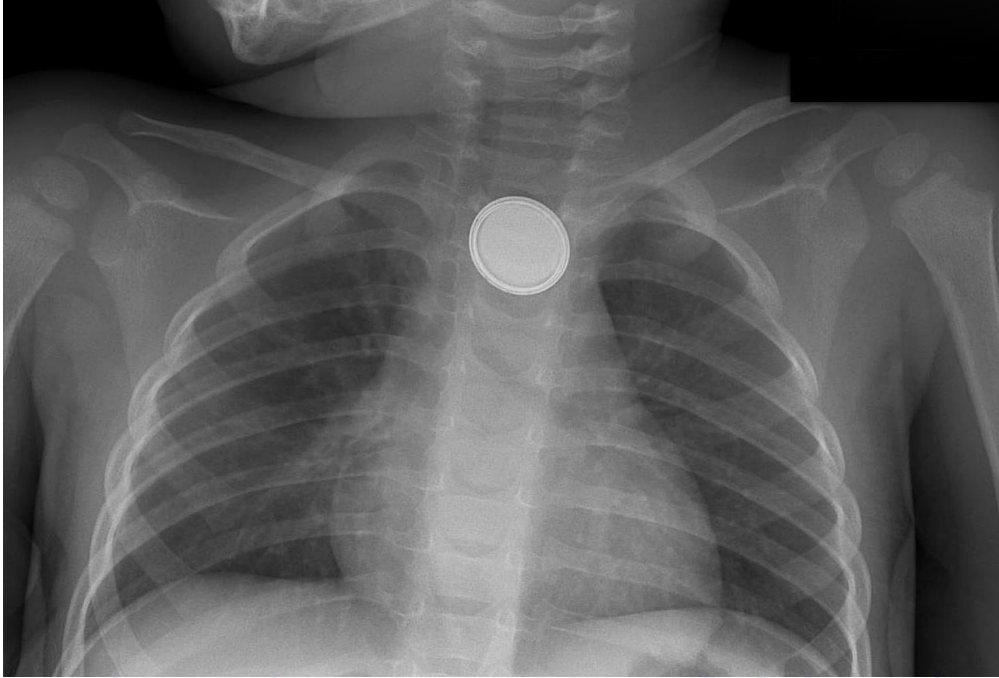
Click on the image to enlarge.
You can Identify a button battery on an Xray by looking for the Halo sign. This is a circle within the disk of the battery where the lip meets the centre.
MULTIPLE MAGNETIC OBJECTS
- One ingested magnet seldom causes problems
- If more than one magnet is ingested, these may conglomerate across different sections of bowel & cause pressure necrosis with perforation or fistulae
- Children who have ingested multiple magnets should always be referred to an appropriate surgical service, & laparoscopy or laparotomy is indicated.4
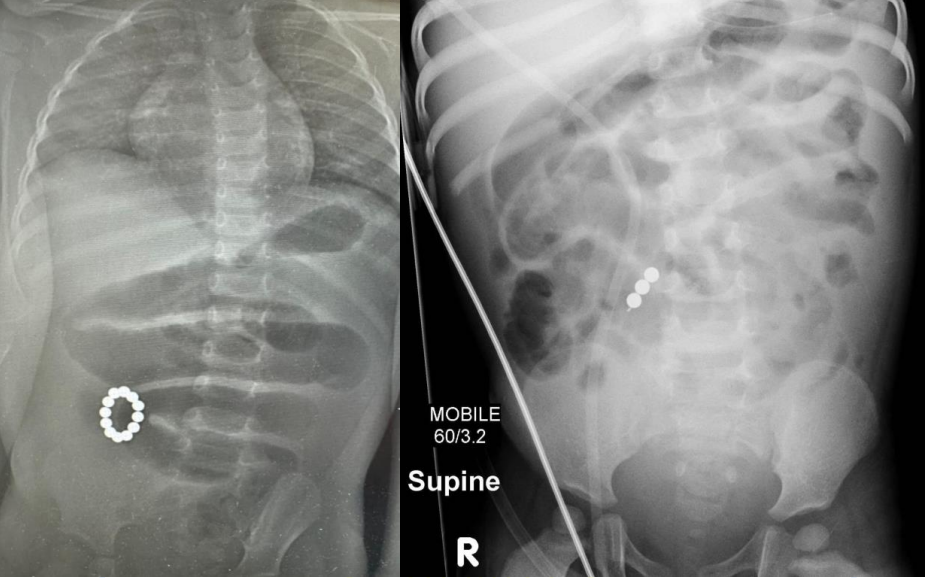
Click on the image to enlarge.
LONG POINTED OBJECTS
- Long objects may become ‘stuck’, frequently lodging in the duodenum where they are unable to navigate the tight bends.
- Most of these objects will actually pass without causing problems however.
COINS
- Coins are frequently ingested and often become lodged at the level of cricopharyngeal muscle.
- Children are usually systemically well but may have drooling & odynophagia.
- Most children with an acute history of ingestion will have an uncomplicated coin removal without any complications.
- Always consider if there might be more than 1 coin stacked together.
- Coins that have been lodged for an extended period may cause oesophageal strictures & erosions.
- Always double check that there is no halo sign to suggest that the foreign body is actually a button battery and not a coin.
Important details on history
- Was the ingestion witnessed?
- What time was the ingestion?
- How many objects were ingested?
- What item is suspected to have been ingested?
- Is it a button battery?
- Is it magnetic?
- What is it made out of?
- Are there sharp edges?
- Was any first aid attempted and, if so, what was this?
- Has the child eaten anything since then and what happened when they did?
- Are there any features suggestive of aspiration instead on ingestion?
- Choking or cyanosis
Important details on examination
Signs of oesophageal obstruction:
- Drooling
- Odynophagia
- Vomiting
In delayed presentation, consider complications
- Stricture (drooling odynophagia, weight loss, failure to thrive)
- Erosion (haematemesis, mediastinitis, acquired tracheoesophageal fistula)
- Distal complications (entero-enteric fistulae, perforation) – rare except with magnet ingestion
Management guideline
Most patients will be well.
Signs of complications require immediate resuscitation:
- Airway management in cases of respiratory complications & distress due to aspiration or infection
- Fluid & blood product administration in cases where the patient is dehydrated or haemodynamically unstable due to blood loss
- Initiation of antibiotic therapy in cases where there is established sepsis
Investigations:
Plain anterior-posterior & lateral chest films including the neck are sufficient to make a diagnosis of a foreign body lodged in the oesophagus or airway if it is radio-opaque.
Certain objects such as plastic toys may be radiolucent & thus not visible on X-Ray: for patients with a suspected history of ingestion of a radiolucent foreign body and symptoms of oesophageal obstruction – please do refer to paediatric surgery.
Abdominal X-Ray:
An abdominal film is indicated in cases of ingestion of more than 1 magnet or objects more than 4cm long such as pins, needles, screws & nails. Also indicated if the patient has peritonism or other concerning abdominal symptoms.
Other objects:
- Most objects that have passed through the oesophagus will pass through the rest of the GIT without causing any harm1
- If lodged in the stomach: repeat plain abdominal radiograph 48 – 72 hours later to confirm object has moved on
- If beyond stomach & duodenum: reassure caregiver. There is no indication for repeat films in other objects unless the patient develops concerning abdominal symptoms.
Referral guideline
Urgent referral to the paediatric surgeon on call is indicated for the following:
- All button battery ingestions should be immediately discussed with surgery (in some cases removal prior to referral may be in the best interest of the patient)
- All foreign bodies lodged in the oesophagus (either confirmed radiologically or where there is a high clinical suspicion in cases of radiolucent objects)
- Large or long foreign bodies lodged in the stomach or duodenum (>4cm long or wide)
- Foreign bodies lodged in the stomach or duodenum that have not passed within 48 hours of ingestion
- Any case where two or more magnetic objects have been ingested
- Any case of foreign body ingestion associated with abdominal pain, peritonism, sepsis, or symptoms of gastro-intestinal obstruction
Parental Counselling
- Foreign bodies lodged in the oesophagus are likely to be removed under general anaesthetic using an endoscope.
- Button batteries are removed emergently as soon as theatre available.
- Coins are removed on an urgent basis once the patient is fasted.
- In the case of missed ingestion with the development of complications, additional surgical procedures such as thoracotomy, neck exploration & oesophagostomy may be indicated.
- Foreign bodies lodged in the stomach for more than 48 hrs are sometimes removed endoscopically on an elective basis if failing to progress and causing symptoms.
- Patients who ingested more than one magnet will most likely require a laparoscopy or a laparotomy.
References
- Uyemura MC. Foreign body ingestion in children. Am Fam Physician. 2005;72(2):287 - 291. doi:10.1016/j.arcped.2011.05.007.
- Milford K, Numanoglu A, Brooks A, Cox S. Button batteries in the oesophagus: A surgical emergency. South African Med J. 2016;106(10):978-980. doi:10.7196/SAMJ.2016.v106i10.11172.
- Loots DP, du Toit-Prinsloo L, Saayman G. Disk battery ingestion: a rare cause of perforation of the brachiocephalic artery. Forensic Sci Med Pathol. 2015;11(4):614-617. doi:10.1007/s12024-015-9706-4.
- Cox S, Brown R, Millar A, Numanoglu A, Alexander A, Theron A. The risks of gastrointestinal injury due to ingested magnetic beads. South African Med J. 2014;104(4):277-278. doi:10.7196/SAMJ.7500.
Children's Surgery Network, Western Cape Government, Red Cross War Memorial Children’s Hospital (RCWMCH), Clinical Guideline_Version 1_2025
Foreign Body Ingestion