General Anaesthesia - Induction of Anaesthesia
Description Medicine treatment for induction of anaesthesia Induction should be learnt in an appropriate learning situation. DESCRIPTION Anaesthesia should only be administered by medical practitioners with appropriate training in anaesthesia. Induction of anaesthesia is the critical part of the transition from consciousness to general anaesthesia. This is a period which requires highly skil
Medicine treatment for induction of anaesthesia
| Induction should be learnt in an appropriate learning situation. |
DESCRIPTION
Anaesthesia should only be administered by medical practitioners with appropriate training in anaesthesia. Induction of anaesthesia is the critical part of the transition from consciousness to general anaesthesia. This is a period which requires highly skilled and attentive care. Depression of the respiratory and cardiovascular systems often occur. The degree of depression depends on the agents used and the patient’s condition.
The following monitors are mandatory to ensure the delivery of safe anaesthesia:
- Clinical observation – a dedicated medical doctor is mandatory.
- 3-lead ECG with heart rate display.
- Automated blood pressure.
- Pulse oximeter.
- Capnograph, displaying end-tidal CO2 in mmHg, kPa or % and capnogram.
- Temperature.
MEDICINE TREATMENT FOR INDUCTION OF ANAESTHESIA
Inhalational agents
Non-irritant inhalational agents, delivered with oxygen with/without medical air/nitrous oxide, are used for induction of anaesthesia. Nitrous oxide can be used to increase the onset of anaesthesia by its ‘second gas effect’, but should be limited to use with a minimum oxygen concentration of 30%, with oxygen analysis, by an experienced user. The following agents are used for gas induction of anaesthesia:
- Sevoflurane (preferred)
- Halothane
Intravenous agents (Use reduced doses if inhalational agents also used).
- Propofol, IV, titrate up to 3.5 mg/kg. Titrate as necessary to achieve required sedation. (Acts within 30 seconds. Effect lasts 3 - 10 minutes).
OR
- Ketamine, IV, 1 - 2 mg/kg. (Acts within 60 seconds. Effect lasts 5 - 10 minutes).
OR
- Etomidate, IV 0.3 mg/kg. Give slowly. This is regarded as being more ‘cardio stable’ and is generally reserved for patients who are at risk of cardiovascular collapse, but must be used with caution even in these patients. A single dose can cause adrenal suppression.
Muscle relaxant during induction for intubation
Note: These agents cause muscle paralysis and apnoea. It is good practice to use a nerve stimulator when non-depolarising muscle relaxants are used to monitor the degree of paralysis/weakness
Ventilate all patients receiving muscle relaxants.
- Suxamethonium, IV, 1 - 2 mg/kg. Onset of action: 30 - 60 seconds. Duration of action: 5 - 10 minutes.
Note: Avoid suxamethonium in patients with or at risk of hyperkalaemia, scoline apnoea, certain neuromuscular diseases and a family history of malignant hyperthermia.
OR
- Rocuronium bromide, IV, 0.3 - 1 mg/kg. Onset and duration of action is dose dependent. Onset of action: 1 - 3 minutes. Duration of action: 30 - 60 minutes.
OR
- Vecuronium, IV, 0.1 mg/kg. Onset of action: 2 - 3 minutes. Duration of action: 30 - 40 minutes.
OR
- Cisatracurium, IV, 0.1 - 0.15 mg/kg. Onset of action: 3 minutes. Duration of action: 30 - 45 minutes. This is the agent of choice in patients with renal dysfunction
Endotracheal intubation
Caution: This procedure should be learnt under supervision.
The condition of the patient and the surgical requirements dictate the choice of airway management – face mask, supraglottic airway device or endotracheal tube (ETT). Traditionally, uncuffed endotracheal tubes were preferred in children. More recently, cuffed endotracheal tubes have been demonstrated to be safe and may offer several advantages over uncuffed tubes. Care must be taken not to overinflate the cuff as this can lead to ischaemia of the tracheal wall and the development of severe complications like sub-glottic stenosis. It is advisable to check cuff pressures with a manometer 4-hourly, and to limit pressures to 15 - 20 cmH2O. Use the smallest volume of air to maintain an adequate seal.
To estimate the correct ETT size, the table below can be used as a guide.
Alternatively, formulas can be used:
ETT size (ID (mm)): Age (years)/4 + 3.5 (cuffed ETT) OR Age (years)/4 + 4 (uncuffed ETT)
Confirm clinically with auscultation that air entry is heard bilaterally, and observe airway pressures.
Table 1: A guide to endotracheal tube sizes and lengths in children with head in the neutral position
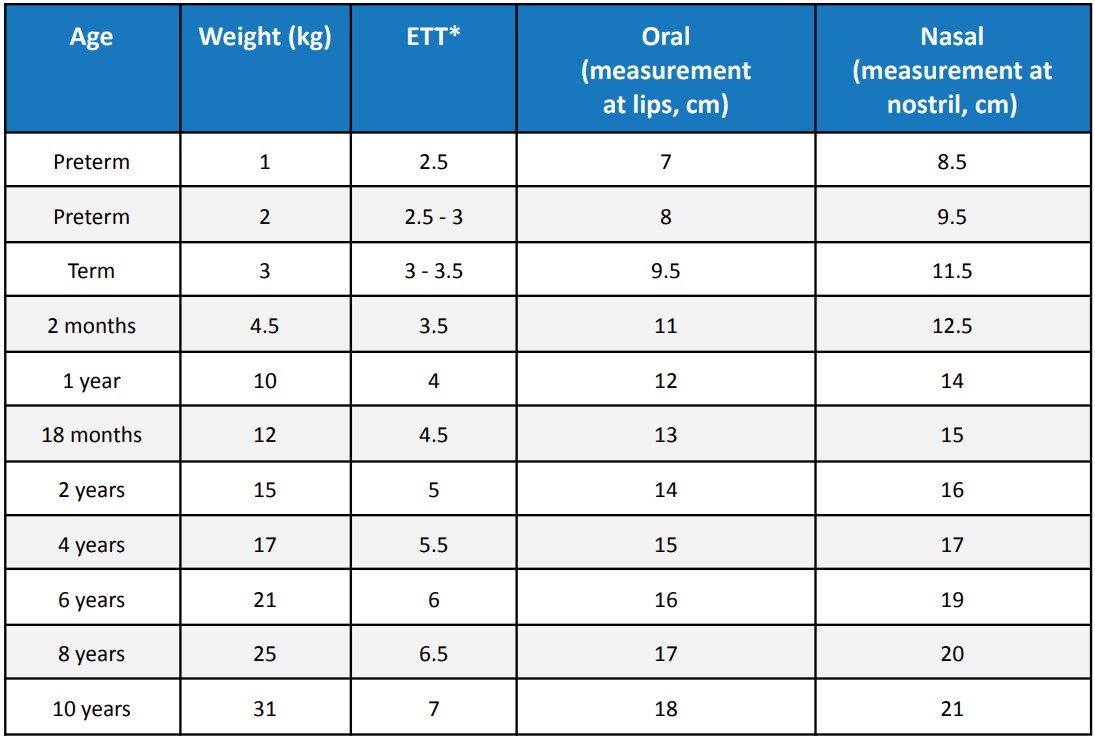
Click on table to enlarge
*If using a cuffed endotracheal tube, use a half-size smaller.
Standard Treatment Guidelines and Essential Medicines List for South Africa, Hospital Level, Paediatrics, 2023 Edition
Chapter 22:Anaesthestics, 22.1 Anaesthetic And Post-anaesthetic Care Of Children, 22.1.2 General Anaesthesia, 22.1.2.2 Induction Of Anaesthesia