General Anaesthesia - Preparation
Description General and supportive measures Medicine treatment DESCRIPTION All patients should be starved before general anaesthesia to prevent regurgitation and aspiration of gastric contents. The preoperative starvation period is: clear fluid: 1 hour, breast milk: 4 hours, and, solids, breast milk substitutes, non-human milk: 6 hours. Clear fluids include water, clear juices with
General and supportive measures
DESCRIPTION
All patients should be starved before general anaesthesia to prevent regurgitation and aspiration of gastric contents. The preoperative starvation period is:
- clear fluid: 1 hour,
- breast milk: 4 hours, and,
- solids, breast milk substitutes, non-human milk: 6 hours.
Clear fluids include water, clear juices without pulp and tea without milk.
Premedication of children for anaesthesia is largely a sedative/anxiolytic intervention.
The goal of anxiolytic premedication is to minimise emotional distress and facilitate mask acceptance for induction of anaesthesia.
The choice of agent should be guided by the child’s condition (previous experiences, comorbidities, severity of anxiety).
Children who are distressed on induction of anaesthesia are more likely to develop distress in the early post-operative period. An active approach to reducing emotional distress with non-medicine and medicine measures is advised.
Avoid sedative premedication in children less than 6 months, children with evidence of airway compromise, obstructive sleep apnoea (OSA) or hypotonia.
GENERAL AND SUPPORTIVE MEASURES
- Distraction techniques, e.g. videos, games, reading, music.
- Caregiver presence is strongly encouraged. Counsel appropriately as to what is expected.
- Medical play is a useful technique that helps address anxiety.
MEDICINE TREATMENT
Premedication
Midazolam and ketamine are bitter tasting. To facilitate acceptance, mix with the recommended dose of paracetamol syrup/ibuprofen syrup or something sweet tasting such as apple juice.
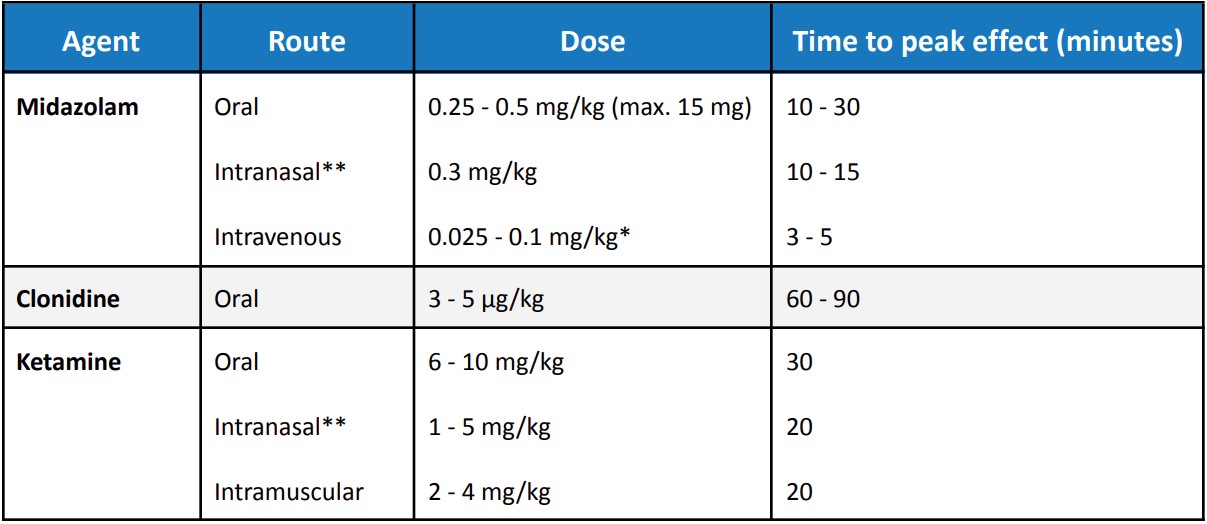
Click on table to enlarge
*Titrate to effect. Repeat dose at 5 minute intervals until desired level of sedation is achieve.
**Off-label route sometimes employed in practice.
Midazolam:
- This is a commonly used premedication agent that is generally well tolerated.
- Can be safely used in most children, but caution is advised in children with:
- Risk factors for paradoxical excitation, e.g. children under 3 years, Attention Deficit Hyperactivity Disorder (ADHD), Autism Spectrum Disorder (ASD).
- Avoid in patients with obstructive sleep apnoea (OSA), as can cause respiratory depression.
OR
Clonidine:
- Preferred agent in children with:
- Behavioural disorders such as ADHD, and children with ASD.
- Obstructive sleep apnoea.
- Does not cause respiratory depression.
- Can cause bradycardia, which is clinically insignificant.
- Provides analgesia in addition to anxiolysis and sedation.
- Is tasteless and well tolerated. Even smaller children will swallow the tablets, but they can also be crushed and added to juice or water.
Alternative in certain circumstance
Ketamine:
- Is cardio stable and does not cause respiratory depression.
- Provides analgesia in addition to anxiolysis and sedation.
- In exceptional circumstances, can be used IM, e.g. when dealing with a combative child who is unable to understand what is needed and will not accept other routes of administration.
Intranasal administration of medicines can be administered with the patient reclining (or held) at 45 degrees, preferably using a mucosal atomiser device. The syringe is held horizontally and applied to the nare, and the contents expelled in one rapid dose. Use undiluted medicines to minimise the volume of drug. Doses of 1 mL or more should be divided between two nares.
Standard Treatment Guidelines and Essential Medicines List for South Africa, Hospital Level, Paediatrics, 2023 Edition
Chapter 22:Anaesthestics, 22.1 Anaesthetic And Post-anaesthetic Care Of Children, 22.1.2 General Anaesthesia, 22.1.2.1 Preparation