General Office Preparation
SADA COVID-19 Guidelines, May 2020
Instructions for Patients Prior to Visiting the OHC Facility
Oral Health Care Facility Preparation
Oral Health Care Facility—Procedural and Environment Upgrades
Oral Health Care Facility Ventilation
Practice Management
- This checklist also applies to all staff, and they must also be actively screened before entering or re-entering the office. Applications are available to declare your health status online and not on paper, as is currently implemented in major hospitals in South Africa. Home printed and signed checklists to be handed in upon entry are advocated at this stage. This declaration becomes part of the practice and patient records. The principal dentist should assume the management of this responsibility at his discretion. The screening process could be referred to an appropriately educated and PPE-protected staff member outside the OHC facility. This would ensure the virus stays outside the healthcare facility.
- All OHC workers and staff must be tested on a 2-weekly basis for COVID-19 to ensure that they are not asymptomatic carriers and could serve as a source of spread of the disease. These status results must be recorded
- Dental service providers are essential workers and are excluded from employee reduction (Clause 13 in Government Gazette). If fewer than 10 employees (clause 40) is applicable (https://www.greengazette.co.za/documents/national-gazette-43257-of-29-april-2020- vol-658_20200429-GGN-43257). If more than 10 employees are employed, all essential workers (clinical and reception employees) may come back to work; admin staff should work from home.
- Coming to work despite having symptoms of illness is a common and loyal human response, but OHC providers should be equally stringent on themselves, their staff and their patients. All staff members reporting for duty, besides regulations set out in 1, should be tested every 2 weeks.
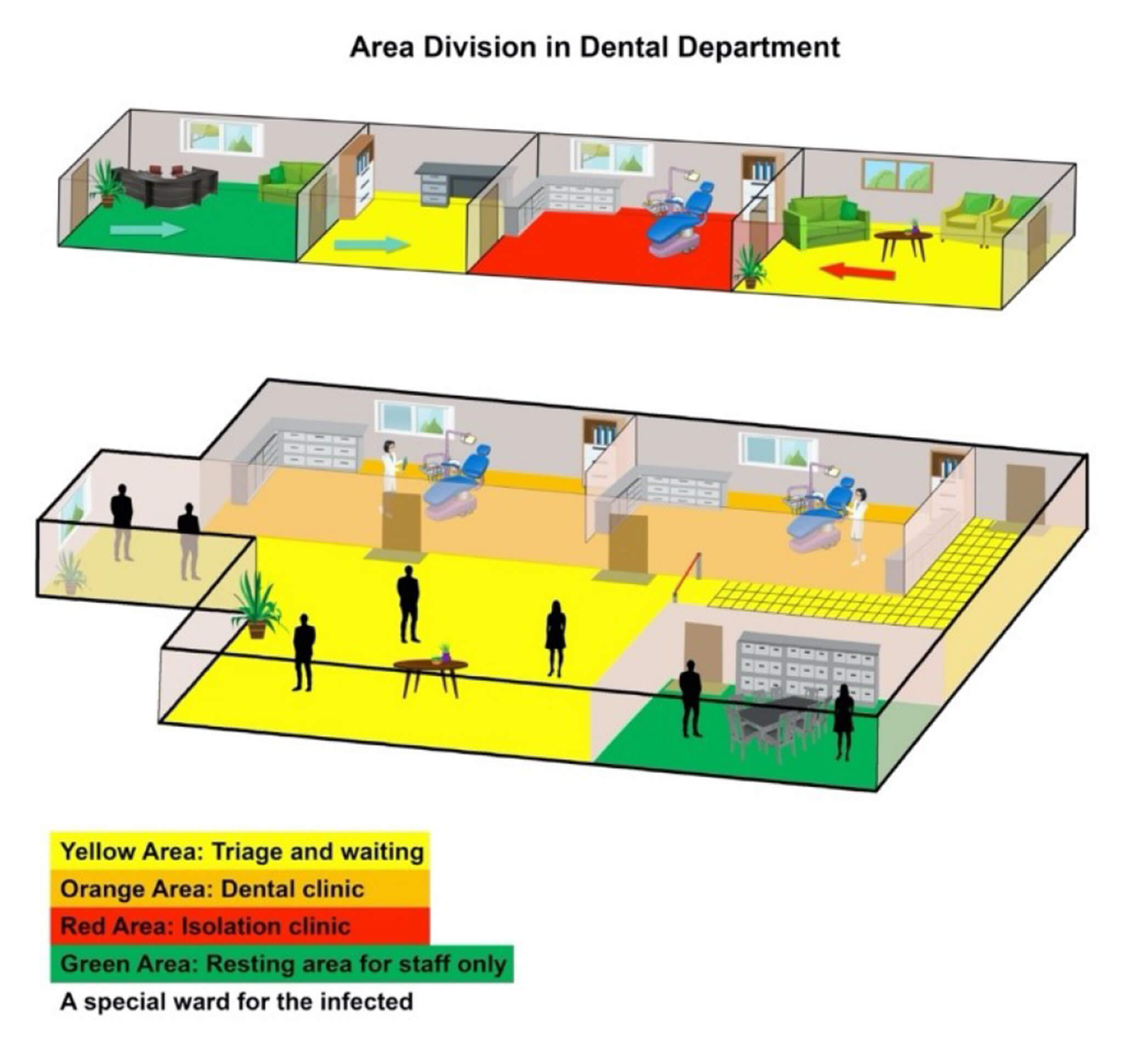
The practice should be demarcated as far as practical possible into clearly defined areas (Figure 1):
A. High risk: Red—The highest probability of contamination—aerosol/droplet formation
B. Medium risk: Orange—Risk area—Dental practice area
C. Low risk: Yellow—Low-risk area—Waiting area
D. No risk: Green—Staff resting area—If possible
 Click on image to enlarge
Figure 1. Personal protective equipment diagram for division care area (Adapted from Meng L, HuaF, Bian, J Dent Res, 2020)
- At this time, communication is essential rather than a courtesy. As such, patients are scheduled with sufficient time between appointments to prevent undue stress. Receptionists, just as the principal OHC worker, should understand the principle of adequate ventilation and governmental orders re COVID-19 that would allow for a safe time period between cases.
a. The minimum time needed to clear the air in a well-ventilated area is 15 minutes after a positive patient has left. This only applies to the Orange and Yellow areas (https://www.eurekalert.org/pub_releases/2020-03/erc-hto031920.php). From this data, it can be extrapolated that significant time (specific practice environment dependant) could be needed for proper ventilation of a high-risk (red) area between cases, especially if AGP were performed. All efforts should be made to minimise the total airborne viral load. In the literature, as above, no benefit is achieved by altering the temperature or humidity of the practice
b. Common courtesies should be respected, but the safety of the practice kept in mind. “We recognise, appreciate and respect your rights and needs, but practic safety is paramount. Keep to social distancing and hand sanitising and please refrain from engaging our staff unnecessarily. We appreciate your urgency and will attend to it as soon as possible.”
c. Rapid COVID-19 testing is currently unavailable as of May 2020. If it becomes available, it may improve flow. All patients should be treated as potentially positive.
d. Patients that clearly do not adhere to or are suspected of not adhering to the lockdown measures (see the notes on staff use of public transport): The OHC facility should have appropriate overalls duly cleaned and ready. Patients should wear these with overshoes and headgear whilst inside the practice, keeping to stringent hand hygiene control and washing of exposed skin and oral rinses (see later first contact) before engaging with DHC worker. Remove the overalls at exit and duly dispense in a suitable sealable container for reuse after cleaning. Disposable items are to be discarded. This will lessen the risk to the DHC worker of being infected. The cleaning and maintenance of these garments will be the responsibility of the principal DHC worker.
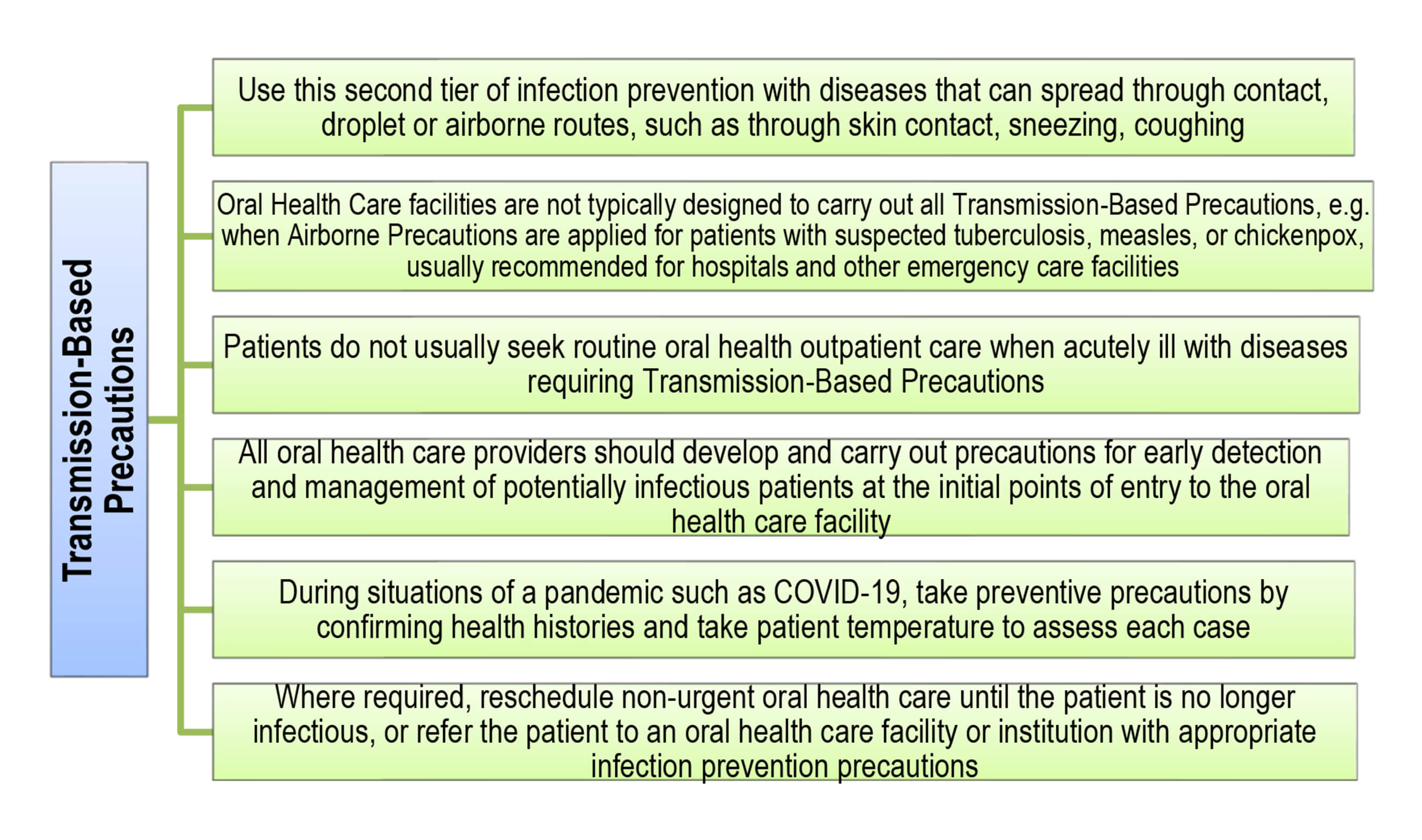
e. When the Standard Precautions alone cannot prevent transmission, such as in the case of COVID-19, it must be supplemented with transmission-based precautions (Diagram 1).
Click on image to enlarge
Diagram 1: Transmission-Based Precautions
Instructions for Patients Prior to Visiting the OHC Facility
- Please wear a new or freshly washed cloth mask at a minimum when visiting the OHC facility. Only the patient will be allowed in the OHC facility unless the patient is a minor or disabled. If the OHC facility is behind schedule, patients must wait outside the office or in
their cars. Please contact our OHC facility before you leave home to prevent an unnecessary long wait. - Please do not wear any nonessential accessories, jewellery, etc., as it can be contaminated. Essential items such as cell phones will be secured in a safe place at entry.
- Please be on time. Patients arriving earlier than 10 minutes prior to their appointments will not be admitted into the premises. Patients arriving late will need to be rescheduled. Most OHC facilities in South Africa have safety doors to the entrance; you may be asked
to use this entrance for proper distancing. Vigilance should not be relaxed. - OHC facilities operating with walk-in patients only should adhere to the above rules. Waiting patients should be asked to line up outside the door, keeping social distancing in mind. These distances should be clearly marked in the expected line-up area. In adverse weather conditions, local situations should be evaluated with informed knowledge to protect the patients against the weather, yet allowing for social distancing.
- Please fill in all paperwork electronically or at home. For older adults or those who are digitally challenged, please contact our receptionist by phone to complete your paperwork ahead of time. This could also be done by a properly protected and informed staff (PPE—see later) member in the waiting area outside the facility.
- Make arrangements for the method of payment. Be aware that cash could be a potential source of the SARS-CoV-2 virus.
- Our personnel adhere to the same strict principles as our patients. Staff at high risk or with comorbidities will be reassigned to positions that do not put them, and you, at additional risk.
- Our staff have also been directed to receive flu vaccinations to prevent infection and keep our practice open.
Oral Health Care Facility Preparation
Remove all nonessential items from any area that a patient might enter; these items are possible surfaces the virus can adhere to. Essential items, such as keyboards, computer screens, cameras, magazines and other recreational items such as water bottles, other drinks and pay-point terminals, should be isolated with a cleansable disposable material, such as a plastic film. These should be changed on a regular basis and the equipment it protects disinfected/decontaminated before reapplication of a new protective barrier. Nonessential items, including any decorative or loose items (such as magazines and toys), should be removed. Stationery should only be kept at hand when being used. Other items should be cleaned after each use and returned to appropriate containers. Flat, hard, smooth surfaces can be disinfected/ decontaminated or deep cleaned easily; all other surfaces should only be used when necessary and kept off-limits to patients, taking into consideration that the virus stays alive the longest on metal surfaces (https://youtu.be/JsXZQACaI2o).
Oral Health Care Facility—Procedural and Environment Upgrades
- Staff using public transport or people not adhering to public announced private vehicle use: Knowledge of public safety information should not be assumed, and each member should be given specific instructions. It is advocated that all staff be notified that only prescribed clean OHC worker attire is allowed beyond the entrance. The normal attire must stay outside the practice or—if this is impossible to implement—as close to the entrance as possible. If possible, the garments should not enter the office and stay in a sealed bag for use when leaving the practice again. The rotational office garments should stay in the office and be exchanged every time the practice is left. The office attire should be cleaned and distributed under the responsibility of the principal OHC worker, a fresh pair available at each entrance to the practice. Hair protection should be disposable and single use.
- Wearing masks in public is mandatory by law, make sure your workers know the proper fit (see further recommendations later in this document pertaining to PPE, as indicated by job description).
- The workers must adhere to hand sanitising but also, at entry, wash any exposed skin, such as the face and neck, for at least 20 seconds.
- If possible, change door handles for ones that can be opened easily by pushing or pulling with a limb rather than the palm of a hand. In the South African scenario, vigilant crime protection must not be compromised.
- Have a dedicated hand cleansing area available at the door.
- Delivery personnel should not be allowed past the front door. All packages should be placed outside the door with the delivery person instructed to practise social distancing. Sanitise/disinfect packages with appropriate sanitiser/disinfectant before taking them past the front door. Arrangements should be made to provide delivery personnel with signed notes on practice stationery rather than signing and handling delivery notes.
- Follow administrative procedures to keep wait times and patient contact with staff to a minimum. Discourage all nonessential talking between the personnel and the patient.
- Add clearly visible red lines and crosses to the floor to help patients with social distancing.
- Add a sheet of Perspex/Acrylic glass/Plexiglas in any area where there will be contact between staff and patients. Attempt to limit this to a single area.
- If possible, cover all furniture and carpets with plastic coverings that can be wiped down
easily.
Oral Health Care Facility Ventilation
- Whilst a viral threat exists, it is essential to ascertain the specifics of proper OHC facility ventilation before starting any treatment. Common areas and areas where droplet or AGP will be done may have differing environments. Some might be self-sustaining with natural airflow if windows are open. However, other cases (such as high-rise buildings) might not have such options and may even be dangerous if aerosol is released into an unprotected area, such as a central air-conditioning system
(https://www.healthcaredesignmagazine.com/trends/perspectives/tips-for-rapid-room-conversion-to-handle-covid-19-patients/). - Contact landlords or building administrators regarding existing ventilation and safety measures, as closed-circuit ventilation (as opposed to open-circuit ventilation) poses a significantly higher risk of building or building floor contamination as this could lead to a significant cumulative viral load of a specific volume of air over time (https://www.eurekalert.org/pub_releases/2020-03/erc-hto031920.php).
- In the case of isolated OHC facilities, such as a stand-alone dwelling, closed room recirculation system with no contact to neighbouring rooms, special measures such as opening windows to natural ventilation or stand-alone medical-grade (Hyper HEPA) air filtration systems can contribute significantly to reducing viral load. (https://www.ncbi.nlm.nih.gov/pubmed/9192919). The Hyper HEPA (or equivalent) filter, equivalent to H13/H14, must be able to remove particles of less than 0.1 μm. Key attributes to the choice of correct filtration system are: (1) Airflow to assure adequate ventilation of the room space; (2) Efficiency to filter out a range of small particle sizes and (3) regular maintenance schedules must be adhered to. The appropriate HEPA filtration is essential to secure the ventilation system or which can be combined with other measures in the HVAC air supply (https://www.fda.gov/media/136533/download) (https://www.ncbi.nlm.nih.gov/pmc/articles/PMC4587002) (https://www.ncbi.nlm.nih.gov/pubmed/2624107).
- Popular commercially available air filter systems, such as air purifiers, air cleaners, etc., and even standard medical-grade HEPA filters that only remove particles up to 0.3 μm are totally inadequate to catch the virus and by removing bigger particles from the air, might in fact increase the viral load in air at the exhaust of the filter/purifier (https://static1.squarespace.com/static/5b68a4e4a2772c2a206180a1/t/5e67a58357b4e0440343e1fa/1583850883797/SpeculationOnAirFIlters.pdf Top Air Purifier or equivalent).
- With this information, an informed decision can be made regarding additional necessary measures. This is a highly specialised field, and it cannot be assumed that it falls within our professional knowledge. If any doubt exists, contact a qualified engineer.
- The most practical solution should your facilities not comply with any of the above scenarios is to create an isolated OHC facility for droplet- and aerosol-generating areas with or without negative pressure. These rooms should have the following characteristics: (1) These rooms do nothing to aid the sick/positive patient nor do they protect the staff who are in the room with the patient (2)The rooms do allow staff to work outside the room with limited PPE and rely on proper PPE to protect staff inside the room
(https:/www.healthcaredesignmagazine.com/trends/perspectives/tips-for-rapid-room-conversion-to-handle-covid-19-patients/). A good solution is to refer to an Intensive Care type of ventilation system and to adapt this to create an AIIR albeit at less stringent measures
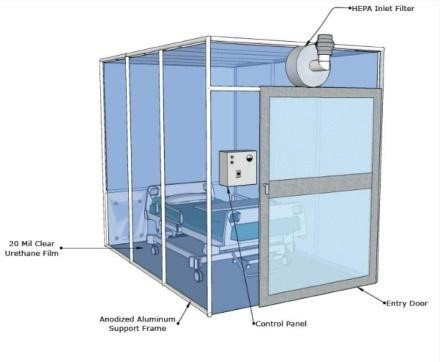
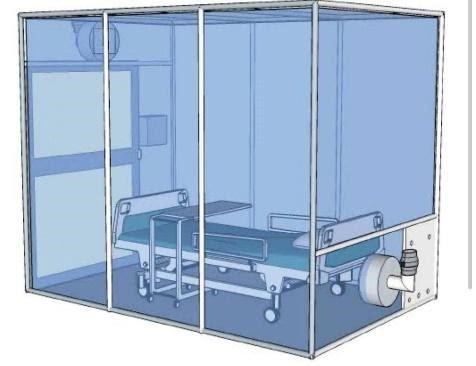
(https://www.cdc.gov/coronavirus/2019-ncov/infection-control/control-recommendations.html). The ideal scenario (Figure 2): A negative pressure ventilated space with a minimum of 12 air changes per hour using an external exhaust connection. Recirculation is only possible with an adequate medical-grade HEPA (H13/H14) filter - as the coronavirus is 0.15 μm in size— in the system. Routine medical HEPA filters only remove particles up to 0.3 μm in size, clearly not stopping the virus.
The American Centers for Disease Control (CDC) guidelines are that all AGPs should be performed in an AIIR environment (https://www.cdc.gov/coronavirus/2019-ncov/infection-control/control-recommendations.html). The negative pressure inlet should always be above the working area and the amount of negative pressure should be visible as per ASHRAE standards (https://www.ashrae.org/). These isolation chambers pose a real possibility of treating patients outside a hospital setting, saving very valuable healthcare resources.
Click on images to enlarge
Figure 2: Example of a free-standing Airborne Infection Isolation Room
7. Every practice needs to determine their own risk and may even fall within the criteria to serve as an AIIR, making an informed professional decision if vapour and virus concentrations pose an additional risk. Insufficient ventilation or circulatory problems in an OHC facility can endanger the OHC provider, staff and the general population; these problems can also create risk in their immediate surroundings. The problem is that when air is not circulated, a gradual increase in viral load can accumulate over time (a comparison is how an automotive wheel is filled with air). It is possible for an OHC facility to become a node for the spread of COVID-19. This would obviously contravene national law with serious consequences.