General - Pain Assessment and Management
An approach to symptom management to guide decision-making in the management of patients with life-threatening illness
Clinical assessment of cause and severity of pain
Explanation to patient and family
Consider disease specific palliative treatment
Prescribe appropriate first-line treatment
The WHO Three-Step Analgesic Ladder
Alternative routes of opioid administration
Combination analgesia treatment
Review assessment and management regularly
Consider involving the interdisciplinary team at all stages of assessment and management
Referral to appropriate palliative care services
Patients have the right to appropriate and effective relief of pain. A clinician who follows the basic principles of pain management will be able to control pain in 75 to 80 percent of patients. This section is based the World Health Organisation (WHO) guidelines for cancer pain control.
Definition of pain
According to the International Society for the Study of Pain, pain is an unpleasant sensory and emotional experience associated with actual or potential tissue damage.
Pain may involve physical, emotional, social and spiritual dimensions that may need to be addressed to achieve effective pain relief.
Clinical assessment of cause and severity of pain
- History
- Accept patients’ description of the pain as being real for them.
- Careful pain history using:
- P - precipitating and relieving factors
- Q - quality
- R - radiation
- S - site and severity
- T - timing and treatment
- Use a formal pain assessment tool, e.g. Numerical Rating Scale, Verbal Descriptor Scale or Visual Analogue Scale.
- Assess every pain.
- Elicit the meaning of the pain to the patient.
- Consider all dimensions of pain.
- Examination
- A careful and appropriate clinical examination is essential.
- Special investigations may be appropriate in some patients.
- E.g. An X-ray or scan may help to detect bone metastases. On the other hand blood tests to determine the levels of tumour markers are seldom needed to treat pain. Consider if the result will actually change the management plan.
Explanation to patient and family
Discuss treatment options, fears, anxieties regarding pain management with opioids, adjustment of activities to reduce painful episodes. Reach consensus regarding the proposed management plan.
Correct reversible factors such as dehydration and constipation.
Consider disease specific palliative treatment
- Single dose of radiotherapy for bone metastases
- Fluconazole for cryptococcal meningitis,
- Antiretroviral treatment for HIV neuropathy.
Consider non-pharmacological approaches (not all are evidence based)
- Application of heat/cold
- Massage
- Meditation
- Relaxation
- Distraction
- Music therapy.
- Reflexology
- Positioning
- Passive movements
- Splinting fractured limb
- Mobility aids
Prescribe appropriate first-line treatment
- First line analgesia following the recommendations of the World Health Organisation (WHO) Analgesic Guidelines.
- General principles of pain management:
- By mouth: use oral medications unless the patient is vomiting or comatose.
- By the clock: for persistent pain, analgesics should be given regularly at a fixed dose on a fixed schedule.
- By the ladder (see below)
- For the individual: the choice of analgesic is determined by the severity, site and type of pain. Individual requirements for analgesics vary enormously and the dosage of analgesic must be titrated against the particular patient’s pain.
- Use of adjuvants: to enhance analgesic effect, e.g. corticosteroids, anti-convulsants.
- Attention to detail:
- Take nothing for granted.
- Be precise in history taking.
- Give precise instructions, verbally and in writing.
The WHO Three-Step Analgesic Ladder
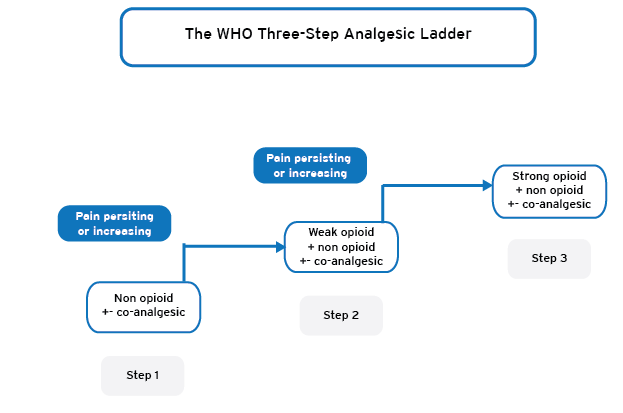
Non-opioids: paracetamol, NSAIDs
Weak opioid: tramadol 50-100mg 6 hourly. Tramadol crosses to step three but does have a ceiling dose
Strong opioids: morphine, fentanyl, methadone, oxycodone, hydromorphone
If a weak opioid ceases to be effective, it is important not to switch to another weak opioid on step 2, but to switch to step 3.
The guidelines describing starting a patient on morphine as a strong opioid as morphine is available on the Essential Drug Lists at all levels.
See: Guidelines on Commencing Morphine.
Alternative routes of opioid administration
- IV bolus or infusion (acute severe pain or compromised oral route and in hospital setting). Parenteral boluses may be given 3 hourly.
- Subcutaneous:
- If parenteral bolus dosing required v no IV access, SC route is preferred to IM route (less painful and equal efficacy).
- As a 24-hour infusion of morphine, using a syringe driver.
- 24-hour subcutaneous dose is 30 – 50 percent of 24-hour oral dose.
- Transdermal – Fentanyl patches deliver 12, 25, 50, 75 or 100 microgram/h over three days. Consult manufacturer’s instruction for conversion from morphine to fentanyl. It is advised that pain control is achieved by rapid release morphine before converting to slow release products as pain control can be achieved more quickly with rapid release morphine.
- Epidural or intrathecal (specialist only)
- Topical morphine: depending on size of wound, 4-20mg morphine sulphate mixed in an inert cream, can be applied to a chronic wound (limited evidence)
Important: DO NOT USE PETHIDINE in palliative care, as its analgesic effect only lasts for 2 hours.
Continuous use may lead to neurotoxicity (myoclonic jerking, confusion and convulsions).
Despite the wide availability of additional strong opioids, morphine is the strong opioid of choice, as it is widely available, predictable and safe.
Combination analgesia treatment
Some patients experience refractory pain - pain that is difficult to control with opioid analgesics alone. If pain is difficult to control it may be that additional medication is required to supplement the use of an opioid analgesic and enhance pain control.
Examples of medication useful in combination with Step 1, 2 and 3 analgesics are described in the table below.
Examples of medication used in combination analgesia, together with their main indications follow are in the table below:
| Class | Main indications | Mechanism(s) of action | Examples | Typical regimen | Undesirable effects |
| Corticosteroids | Nerve compression Spinal cord compression Raised ICP Bone pain | Reduce peri-tumour oedema and inflammation | Prednisolone | 15-30mg daily | Include hyperglycaemia, anxiety, steroid psychosis, myopathy |
| Betamethasone | 8-16mg daily | ||||
| Antidepressants | Nerve injury pain | Potentiation of two spinal descending inhibitory pathways | Amitriptyline | 25-150mg nocte | Anitmuscarinic effects, drowsiness, postural hypotension |
| Duloxetine | 30-120mg daily | ||||
| Venlafaxine | 37.5-225mg daily | ||||
| Anti-convulsants | Nerve injury pain | GABA inhib. and sodium channel blockers | Carbamazepine | 100-200mg bd | Drowsiness and dizziness |
| Sodium valproate | 400-1000mg nocte | ||||
| Ca channel α2 - 𝛿 ligands | Gabapentin | 100mg tds-600mg tds | |||
| Pregabalin | 50mg tds - 100mg tds | ||||
| NMDA-receptor channel blockers | Pain poorly responsive to morphine and other standard therapies Severe neuropathic pain | Inhibits glutamate binding to NDMA receptor | Methadone | 10-60mg bd | Drowsiness (methadone) |
| Ketamine | 100-500mg / 24hrs CSCI 10-20mg q6h PO | Dysphoria, hallucinations (ketamine) | |||
| Antispasmodics | Bowel colic, renal colic | Relax intestinal smooth muscle | Hyoscine Butylbromide | 60-100mg/ 24h SC | Peripheral antimuscarinic effect |
| Muscle relaxants | Muscle spasm | Relax somatic muscle | Diazepam (EDL) Baclofen | 5-10mg nocte 10mg tds | Drowsiness, ataxia |
| Bisphosphonates | Intractable metastatic bone pain | Block osteoclast activity | Zoledronic acid | 4mg IV infusion every 4-8 weeks | Pyrexia, malaise 1-2 days (uncommon) Osteonecrosis of jaw |
Review assessment and management regularly
If pain recurs or increases – reassess, if pain is due to disease progression, titrate dose of morphine to achieve pain control.
Consider involving the interdisciplinary team at all stages of assessment and management
Support and counselling to address psychosocial and spiritual factors can significantly modify the perception of pain.
Referral to appropriate palliative care services
Referral to appropriate palliative care services such as hospice in patient unit, palliative care physician or pain specialist.