Glycaemic Targets
Glycaemic Targets
Monitoring glycaemic control using HbA1c
Monitoring of glycaemic control using SMBG
(See Strength of Recommendations Taxonomy (SORT) for explanation of Grade A-C)
| SEMDSA 2017 Recommendations | |
| Involve the patient with type 2 diabetes in the discussion about setting glycaemic goals, taking into account the duration of their diabetes, general health status, life expectancy and risk of hypoglycaemia | C |
| Aim to achieve and maintain a target HbA1c ≤ 7% in most patients, to prevent microvascular disease | A |
| Achieving an HbA1c target ≤ 7 earlier in the course of type 2 diabetes will also reduce macrovascular disease and mortality | B |
| In newly diagnosed patients in good general health the target HbA1c should be <6.5% to prevent further retinopathy and nephropathy, provided it can be achieved safely | A |
| A target HbA1c of 7.1 to 8.5% may be acceptable for the elderly, the frail, those with limited life expectancy, multiple co-morbidities, severe vascular disease, advanced chronic kidney disease, recurrent severe hypoglycaemia, or hypoglycaemic unawareness | B |
| Monitor the HbA1c at least every 6 months in patients with stable glycaemic control who are maintaining their target, and at 3 month intervals in patients who are not at target in whom interventions have intensified | C |
| Self-monitoring of blood glucose (SMBG) should be encouraged but optimal use requires regular review and interpretation by both the patient and health care provider | C |
| SMBG targets should be individualised to achieve the appropriate HbA1c target. For individuals with an HbA1c target of ≤ 7%, the recommended fasting/preprandial SMBG target is 4.0 to 7.0 mmol/L and the post-prandial SMBG targets is 5.0 to 10 mmol/L These targets can be adjusted based on the individual’s response |
C |
| Patients using insulin 2-4 times a day should perform SMBG at least 3 times a day | B |
| Patients on basal insulin must perform SMBG at least once a day (fasting glucose), in order to titrate their doses More frequent testing may be needed to monitor for post-prandial hyperglycaemia |
B |
| For individuals on oral agents, SMBG should be initiated as part of an overall education process but for most patients 3-5 tests a week is all that may be required | C |
| More intensive testing is necessary in certain situations, such as acute illness, periods of poor glycaemic control, fasting, frequent hypoglycaemia and pregnancy | C |
INTRODUCTION
The primary purpose of treating glycaemia in patients with type 2 diabetes mellitus is to reduce blood glucose sufficiently to relieve any symptoms of hyperglycaemia, but mostly to prevent or delay the onset of microvascular and macrovascular complications (when treatment is started early in the course of the disease). To achieve these goals, targets need to be set for both short and long term glucose control. This will prevent the tendency to under treat patients. This section outlines appropriate targets for long-term glycaemic control as assessed by glycated haemoglobin A1C (HbA1c), and the appropriate blood glucose levels needed to attain those targets. Refer to: Screening and diagnosis of type 2 diabetes and intermediate hyperglycaemia for a discussion on HbA1c measurement.
HbA1c TARGETS
Understanding the need for individualised HbA1c targets
Type 2 diabetes is diagnosed on the basis of elevated blood glucose and HbA1c levels that predict a significantly increased risk of microvascular disease;1 by the time the HbA1c exceeds 7.5%, the risk of microvascular disease is increased 2.5-5 fold.2,3 Type 2 diabetes is also a strong risk factor (2-4 fold increased risk) for cardiovascular disease,4,5,6 although this risk is present even in the prediabetes stage.7 The incidence of both microvascular and cardiovascular disease rises with the degree of hyperglycaemia,1making it a reasonable hypothesis that lowering blood glucose will reduce complications.
Randomised controlled trials of intensive versus non-intensive glycaemic control have provided convincing evidence for microvascular disease risk reduction. The Kumamoto,8 United Kingdom Prospective Diabetes Study (UKPDS),9 Action in Diabetes and Vascular Disease: Preterax and Diamicron MR Controlled Evaluation (ADVANCE),10 Action to Control Cardiovascular Risk in Diabetes (ACCORD)11 and Veterans Affairs Diabetes Trial (VADT)12 achieved HbA1c levels between 6.4% and 7.1% and all demonstrated microvascular benefits.
The relationship between intensive glucose control and cardiovascular disease is not as clear. In the UKPDS, early intensive glycaemic control reduced cardiovascular events and mortality in recently diagnosed individuals over 10 years of treatment, but the reduction was only statistically significant after a further 10 years of observation, even though patients were no longer intensively controlled.13,14
Further observational analysis of the UKPDS confirmed that every 1% reduction of HbA1c was associated with reductions in risk of 21% for any end point related to diabetes, 21% for deaths related to diabetes, 14% for myocardial infarction, and 37% for microvascular complications. No threshold of risk was observed for any end point, and the lowest risk of complications was predicted to occur at an HbA1c of 6.0%. Yet these expected cardiovascular and mortality benefits were not evident in ACCORD, ADVANCE and VADT.12,15,1610,251 patients (mean age, 62.2 years. In fact, the ACCORD study was stopped prematurely because of an unexplained increase in mortality.
These trials have been reviewed and analysed extensively to try to understand their lack of cardiovascular and mortality benefit.17,18,19What is known is that they included older individuals (mean age > 60 yrs) with long diabetes duration (8.5 to 10 yrs); more than a third already had established cardiovascular disease; nonglycaemic risk factors such as blood pressure and dyslipidaemia were better treated than in previous cardiovascular outcomes trials; and the total number of vascular events was lower than expected. Further sub-group and post-hoc analysis of these trials show that patients with shorter diabetes duration, better glycaemic control and no/lesser degrees of cardiovascular disease at baseline benefited more from the intensive intervention.20,21,22 All three studies reported higher rates of severe hypoglycaemia in the intensively treated group. Severe hypoglycaemia was a strong risk factor for cardiovascular events and mortality, but more so in the cohorts that were not treated intensively.23,24
Longer-term follow-up (up to ten years post-trial) in UKPDS showed significant reductions in cardiovascular events and mortality despite the loss of intensive glycaemic control; ADVANCE remained neutral for cardiovascular events and mortality,25but lowered the rate of end-stage renal disease;26 the VADT cohort showed a reduction in the risk of cardiovascular events;27 and ACCORD had a neutral effect for cardiovascular events and no further increase in mortality.28
An interpretation summary after a review of the current evidence would be as follows:
- Intensive glycaemic control significantly reduces microvascular outcomes (especially diabetic kidney disease and retinopathy), even in older individuals and those with diabetes of longer duration, with clinical trial evidence of benefit at HbA1c levels as low as 6.4%, and observational trial benefits at HbA1c levels as low as 6.0%.8,9,11,12,16,29
- Intensive glycaemic control earlier in the course of diabetes appears to have a “legacy effect”, whereby an earlier period of intensive control results in better outcomes many years later, even after glycaemic control may have deteriorated.13,14,27
- Long-term macrovascular and mortality benefits are more likely to accrue when intensive glycaemic control is achieved earlier in the course of diabetes and in the absence of established cardiovascular disease,9,13 rather than later.12,15,16
- Severe hypoglycaemia is a strong risk factor for cardiovascular events and mortality in patients fitting the profile of the ACCORD, ADVANCE and VADT cohort (age 60+ yrs; diabetes
duration > 8yrs; high prevalence of cardiovascular disease or risk factors).12,15,16 Despite numerous analyses, causality between severe hypoglycaemia and outcomes has not been proven.17,23,24,30,31It is equally possible that severe hypoglycaemia may be a marker of patient vulnerability, i.e. that patients who are ill and at risk for mortality, are more likely to develop severe hypoglycaemia.16 Nevertheless, it remains a risk factor for cardiovascular events and mortality and must be avoided. - Targeting intensive glycaemic control (HbA1c <6.5%) in individuals with longer duration of diabetes (> 8 years) or those with very high cardiovascular risk, does not improve cardiovascular or mortality outcomes,16 and may be harmful when done aggressively.15 In these patients with advanced disease, the aim should be to achieve the lowest HbA1c reasonably possible to prevent microvascular disease, without causing hypoglycaemia.17
- Optimal treatment of non-glucose risk factors, such as smoking, dyslipidaemia, hypertension and pre-existing cardiac or vascular disease probably led to an overall reduction in the expected number of vascular events in the trials discussed above.17 These risk factors are often present before the diagnosis of diabetes, which is when cardiovascular risk increases. They should be sought early and managed aggressively. A multifactorial intervention does best at improving patient outcomes.32
Choosing individualised HbA1c Targets
The discussion above provides the basis for individualised goals of treatment and HbA1c targets.
- For the majority of patients, the recommended HbA1c target is <7 % to prevent microvascular complications, and macrovascular complications when intensive treatment is instituted early in the course of the disease.13
- For newly diagnosed patients in good general health and reasonable life expectancy an HbA1C target of <6.5 % is reasonable to aim for to further reduce microvascular risk, provided it can be achieved safely.16,11,12,29 As a guide, reasonable life expectancy may be defined as being longer than the time taken to achieve benefit in clinical trials, which for UKPDS-33 was 10 years.9
- For those who are frail, have a high level of dependency, multiple comorbidities, severe cardiac or vascular disease, advanced renal disease, limited life expectancy or hypoglycaemic unawareness, an HbA1c target between 7.1% and 8.5% may be reasonable. For palliative care, for example, the aim would be simply to avoid symptomatic hyperglycaemia.
Figure I illustrates some of the factors that need to be considered when discussing individualised HbA1c targets with the patient.
Figure I: Selection of HbA1c Targets according to risk (adapted from Ismail-Beigi et al33)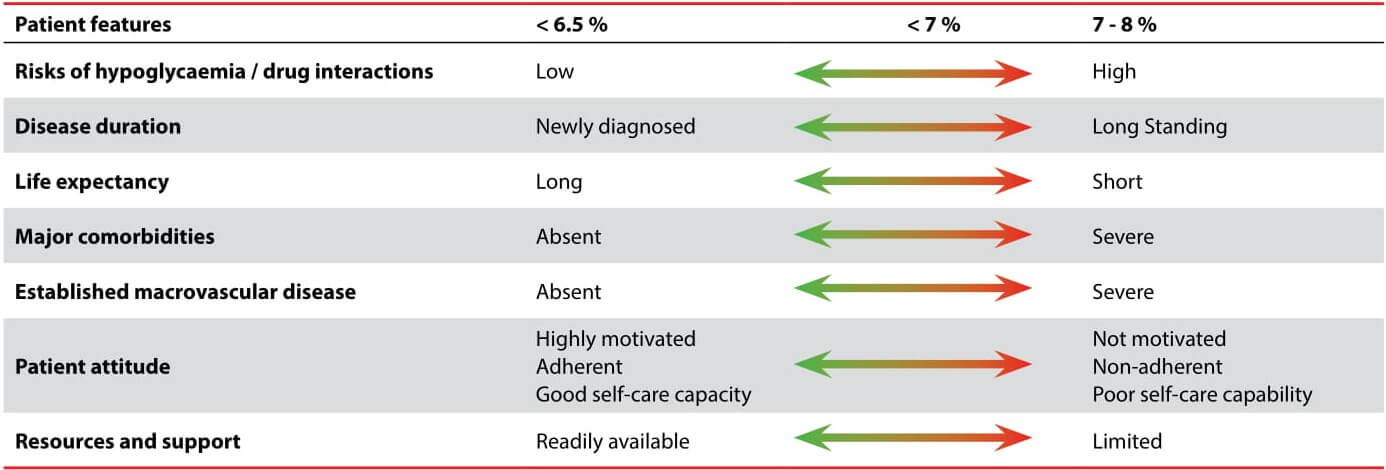
BLOOD GLUCOSE TARGETS
Fasting plasma glucose (FPG) ≤6.0 mmol/l is generally classified as “normal” using the WHO criteria. While a meta-analysis of 38 prospective studies has found an association of increased risk of CV events with a FPG >5.5 mmol/l34, the Diabetes Epidemiology: Collaborative analysis Of Diagnostic criteria in Europe (DECODE) Study suggested a FPG below 7.0 mmol/l is low-risk for CVD35. Overall, a fasting or pre-prandial (before a meal) target of 4.0-7.0 mmol/l is recommended.36 In non-diabetic individuals, the peak post-prandial Glucose (PPG) generally does not exceed 7.8 mmol/l. However, the DECODE Study has demonstrated a linear progression between the post-glucose load glucose level and CVD with no ‘lower’ limit cut-off.12 The International Diabetes Federation (IDF) recommends a PPG target of <9.0 mmol/l,37while the American Diabetes Association (ADA) recommends a PPG target of ≤10 mmol/l.38 The actual target to be aimed for will depend on the target HbA1c (See Table I).
Table I: Average Fasting and Post-prandial glucose levels in relation to HbA1C
| Target HbA1c | Target FPG | Target PPG |
| < 6.5 % | 4.0-7.0 mmol/l | < 8 mmol/l |
| < 7 % | 4.0-7.0 mmol/l | < 10 mmol/l |
| < 8 % | 4.0-7.0 mmol/l | < 12 mmol/l |
MONITORING OF GLYCAEMIC CONTROL USING HbA1c
HbA1c reflects average levels of glycaemia over 2-3 months and should be performed routinely in all patients with diabetes, both at the initial appointment and then regularly as part of continuing care, to aid in therapeutic decisions. The frequency of HbA1c testing is dependent upon the clinical situation and response to therapy, but should not be done less than every 6 months.
Recommendations:
- HbA1c should be checked every 6 months in patients with stable control who are meeting their target goal
- HbA1c should be checked at 3 month intervals in patients who are not reaching their target goal and in whom therapy has been changed or intensified
- Point-of-care testing can be used for monitoring (but not diagnosis), provided that assay and measurement standards are met (Refer to: Screening and diagnosis of type 2 diabetes and intermediate hyperglycaemia).
Understanding HbA1c and average glucose
The level of HbA1c at any point in time is contributed to by all circulating erythrocytes, from the oldest (120 days) to the youngest. HbA1c is a “weighted” average of blood glucose levels during the preceding 120 days of the erythrocytes’ life span, meaning that glucose levels in the preceding 30 days contribute substantially more to the level of HbA1c than do glucose levels from 90-120 days earlier. This explains why the level of HbA1c can increase or decrease relatively quickly with large changes in glucose; it does not take 120 days to detect a clinically meaningful change in HbA1c following a clinically significant change in average glucose.
The HbA1c assay is now a well-standardised test and a useful tool for guiding therapy and predicting outcomes. However, its interpretation is not intuitive, as practitioners and patients are more familiar with discussing glucose levels rather than a percentage test. Understanding the relationship between HbA1c and average glucose can be useful in educating patients and adjusting therapy. The correlation between HbA1c and average glucose is strong enough to justify reporting both the HbA1c result and an estimated average glucose (eAG) result when a clinician orders the HbA1c test. Laboratories are now encouraged to report both values.
Table II shows the correlation of various levels of HbA1c with the corresponding eAG values (A calculator for converting HbA1c results into eAG is available at http://professional.diabetes.org/GlucoseCalculator.aspx).
Table II: Estimated average glucose levels in relation to HbA1c (from:Nathan DM et al39)
| HbA1c (%) | eAG (mmol/l) |
| 6 | 7.0 |
| 7 | 8.6 |
| 8 | 10.2 |
| 9 | 11.8 |
| 10 | 13.4 |
| 11 | 14.9 |
| 12 | 16.5 |
Limitations of HbA1c
The HbA1c is dependent upon the lifespan and turnover time of the red blood cells. In situations of altered red blood cell turnover time (such as anaemia, blood loss, renal failure etc.) and when haemoglobinopathies are present, the HbA1c may not be a true reflection of prevailing levels of glycaemia. When the HbA1c is discrepant with the results of self- monitoring of blood glucose (SMBG), the clinician should consider the above possibilities and request laboratory screening for a possible haemoglobinopathy. The HbA1c also does not measure the frequency or severity of hypoglycaemia or glycaemic variability and thus results must be interpreted together with SMBG records and the patient history.
MONITORING OF GLYCAEMIC CONTROL USING SMBG
SMBG for individuals on insulin
SMBG is an essential and integral part of effective therapy and will help drive treatment decisions and insulin dose adjustments. However, optimal use of SMBG requires regular review and interpretation by both the patient and doctor or diabetes nurse educator. The frequency depends on the insulin regimen being used:
- In those individuals injecting insulin two to four times per day, testing should be undertaken at least three times per day.40,41
- In those individuals on once-daily insulin, with or without oral hypoglycaemic agents, there is insufficient evidence regarding when or how often to prescribe SMBG. However, it is generally recommended that once-daily testing, first thing in the morning, should be done to assess the efficacy of the basal insulin dose.
- Should the HbA1c be above target in the face of a satisfactory fasting glucose, a second test should be performed after the largest meal of the day to exclude postprandial hyperglycaemia. However, it is considered unnecessary to perform a postprandial test if the HbA1c is at target.42
SMBG for individuals on oral glucose lowering drugs
Evidence is conflicting, and there are numerous publications discussing the advantages and disadvantages of SMBG in patients being treated with oral hypoglycaemic agents. 43,44,45 However, in those who were recently diagnosed, SMBG46 and structured testing combined with appropriate patient education has been shown to be of benefit.47,48,50 A meta-analysis of appropriate studies has suggested that in patients on oral agents, the HbA1c may be reduced by 0.25 % at 6 months. Performing SMBG alone without appropriate education does not reduce blood glucose levels without concurrent education.
The IDF (2009)42 recommends that SMBG should only be used in patients who have been taught the skills to incorporate SMBG into their diabetes care plan. It should be considered at the time of diagnosis to enhance understanding, and ongoing SMBG may assist patients in understanding and participating in their care. However, SMBG protocols should be individualised and the purpose of using SMBG should be agreed upon by the patient and the healthcare provider.
SMBG Recommendations
- SMBG should only be initiated in patients on oral agents only, when prescribed as part of an overall educational process (C)
- For most patients, 3-5 tests per week (<25 strips per month) is all that may be required (C)
- Testing must be structured and meaningful
- Patients need to understand their (glycaemic) targets and know what to do if these are not being achieved
Circumstances demanding more frequent SMBG
In certain situations it may be necessary to advocate more regular testing which may be up to 4 times a day or more. These include:
- Acute illness
- Periods of poor glycaemic control
- Frequent hypoglycaemic episodes
- Pregnancy
- Adjustments to therapy
CONTINUOUS GLUCOSE MONITORING
Continuous Glucose Monitoring (CGM) may be done either to assess retrospective glycaemic control to aid in therapeutic decisions or to assess the results of changes in therapy. This is seldom employed in patients with type 2 diabetes. Longer term CGM is primarily employed in unstable type 1 patients to allow patients real time monitoring of glucose profiles. It may be useful in insulin-treated type 2 diabetes patients who have hypoglycaemia unawareness, or unexplained discrepant HbA1c and SMBG recordings. Should the need for CGM be deemed necessary, these patients should be referred to an endocrinologist for further assessment and management.
Authors: Larry A Distiller and Aslam Amod
Editor: Imran Paruk
References
- World Health Organisation. Definition and Diagnosis of Diabetes Mellitus and Intermediate Hyperglycaemia: Report of a WHO/IDF Consultation. Geneva: WHO Press; 2006.
- Standl E, Balletshofer B, Dahl B, et al. Predictors of 10-year macrovascular and overall mortality in patients with NIDDM: the Munich General Practitioner Project. Diabetologia. 1996;39(12):1540-1545.
- Heine RJ, Balkau B, Ceriello A, Del Prato S, Horton ES, Taskinen M-R. What does postprandial hyperglycaemia mean? Diabet Med. 2004;21(3):208-213.
- Goff DC, Gerstein HC, Ginsberg HN, et al. Prevention of Cardiovascular Disease in Persons with Type 2 Diabetes Mellitus: Current Knowledge and Rationale for the Action to Control Cardiovascular Risk in Diabetes (ACCORD) Trial. Am J Cardiol. 2007;99(12):S4-S20. doi:10.1016/j.amjcard.2007.03.002.
- Gerstein HC, Pogue J, Mann JFE, et al. The relationship between dysglycaemia and cardiovascular and renal risk in diabetic and non-diabetic participants in the HOPE study: a prospective epidemiological analysis. Diabetologia. 2005;48(9):1749-1755. doi:10.1007/s00125-005-1858-4.
- Selvin E, Steffes MW, Zhu H, et al. Glycated Hemoglobin, Diabetes, and Cardiovascular Risk in Nondiabetic Adults. N Engl J Med. 2010;362(9):800-811. doi:10.1056/NEJMoa0908359.
- DeFronzo RA, Abdul-Ghani M. Assessment and Treatment of Cardiovascular Risk in Prediabetes: Impaired Glucose Tolerance and Impaired Fasting Glucose. Am J Cardiol. 2011;108(3):3B-24B. doi:10.1016/j.amjcard.2011.03.013.
- Ohkubo Y, Kishikawa H, Araki E, et al. Intensive insulin therapy prevents the progression of diabetic microvascular complications in Japanese patients with non-insulin-dependent diabetes mellitus: a randomized prospective 6-year study. Diabetes Res Clin Pract. 1995;28(2):103-117.
- Turner R. Intensive blood-glucose control with sulphonylureas or insulin compared with conventional treatment and risk of complications in patients with type 2 diabetes (UKPDS 33). Lancet. 1998;352(9131):837-853. doi:10.1016/S0140-6736(98)07019-6.
- ADVANCE Collaborative Group, Patel A, MacMahon S, et al. Intensive Blood Glucose Control and Vascular Outcomes in Patients with Type 2 Diabetes. N Engl J Med. 2008;358(24):2560-2572. doi:10.1056/NEJMoa0802987.
- ACCORD Study Group, ACCORD Eye Study Group, Chew EY, et al. Effects of medical therapies on retinopathy progression in type 2 diabetes. N Engl J Med. 2010;363(3):233-244.doi:10.1056/NEJMoa1001288.
- Duckworth W, Abraira C, Moritz T, et al. Glucose Control and Vascular Complications in Veterans with Type 2 Diabetes. N Engl J Med. 2009;360(2):129-139.doi:10.1056/NEJMoa0808431.
- Holman RR, Paul SK, Bethel MA, Matthews DR, Neil HAW. 10-Year Follow-up of Intensive Glucose Control in Type 2 Diabetes. N Engl J Med. 2008;359(15):1577-1589. doi:10.1056/NEJMoa0806470.
- Orchard TJ, Nathan DM, Zinman B, et al. Association Between 7 Years of Intensive Treatment of Type 1 Diabetes and Long-term Mortality. JAMA. 2015;313(1):45. doi:10.1001/jama.2014.16107.
- Action to Control Cardiovascular Risk in Diabetes Study Group, Gerstein HC, Miller ME, et al. Effects of Intensive Glucose Lowering in Type 2 Diabetes. N Engl J
Med. 2008;358(24):2545-2559. doi:10.1056/NEJMoa0802743. - ADVANCE Collaborative Group, Patel A, MacMahon S, et al. Intensive Blood Glucose Control and Vascular Outcomes in Patients with Type 2 Diabetes. N Engl J Med. 2008;358(24):2560-2572. doi:10.1056/NEJMoa0802987.
- Skyler JS, Bergenstal R, Bonow RO, et al. Intensive Glycemic Control and the Prevention of Cardiovascular Events: Implications of the ACCORD, ADVANCE, and VA Diabetes Trials: A position statement of the American Diabetes Association and a scientific statement of the American College of Cardiology. Diabetes Care. 2009;32(1):187-192. doi:10.2337/dc08-9026.
- American Diabetes Association. Glycemic Targets. Sec. 1. In Standards of Medical Care in Diabetesd2017. Diabetes Care. 2017;40(Supplement 1):S48-S56.doi:10.2337/dc17-S009.
- Dluhy RG, McMahon GT. Intensive Glycemic Control in the ACCORD and ADVANCE Trials. N Engl J Med. 2008;358(24):2630-2633. doi:10.1056/NEJMe0804182.
- Reaven PD, Moritz TE, Schwenke DC, et al. Intensive Glucose-Lowering Therapy Reduces Cardiovascular Disease Events in Veterans Affairs Diabetes Trial Participants With Lower Calcified Coronary Atherosclerosis. Diabetes. 2009;58(11):2642-2648. doi:10.2337/db09-0618.
- Riddle MC, Ambrosius WT, Brillon DJ, Buse JB, Robert P. Epidemiologic Relationships Between A1C and All-Cause Mortality During a Medi ... Diabetes Care. 2010;33(May):983-990. doi:10.2337/dc09-1278.
- Duckworth WC, Abraira C, Moritz TE, et al. The duration of diabetes affects the response to intensive glucose control in type 2 subjects: the VA Diabetes Trial. J Diabetes Complications. 2011;25(6):355-361. doi:10.1016/j. jdiacomp.2011.10.003.
- Zoungas S, Patel A, Chalmers J, et al. Severe Hypoglycemia and Risks of Vascular Events and Death. N Engl J Med. 2010;363(15):1410-1418. doi:10.1056/NEJMoa1003795.
- Saremi A, Bahn GD, Reaven PD. A link between hypoglycemia and progression of atherosclerosis in the Veterans Affairs Diabetes Trial (VADT). Diabetes Care.2016;39(3):448-454. doi:10.2337/dc15-2107.
- Zoungas S, Chalmers J, Neal B, et al. Follow-up of Blood-Pressure Lowering and Glucose Control in Type 2 Diabetes. N Engl J Med. 2014;371(15):1392-1406. doi:10.1056/NEJMoa1407963.
- Perkovic V, Heerspink HL, Chalmers J, et al. Intensive glucose control improves kidney outcomes in patients with type 2 diabetes. Kidney Int. 2013;83(3):517-523.doi:10.1038/ki.2012.401.
- Hayward R a., Reaven PD, Wiitala WL, et al. Follow-up of glycemic control and cardiovascular outcomes in type 2 diabetes. N Engl J Med. 2015;372(23):2197-2206. doi:10.1056/NEJMoa1414266.
- Gerstein HC, Beavers DP, Bertoni AG, et al. Nine-year effects of 3.7 years of intensive glycemic control on cardiovascular outcomes. Diabetes Care. 2016;39(5):701-708. doi:10.2337/dc15-2283.
- Stratton IM, Adler AI, Neil HA, et al. Association of glycaemia with macrovascular and microvascular complications of type 2 diabetes (UKPDS 35): prospective observational study. BMJ. 2000;321(7258):405-412. doi:10.1136/bmj.321.7258.405.
- Bonds DE, Miller ME, Bergenstal RM, et al. The association between symptomatic, severe hypoglycaemia and mortality in type 2 diabetes: retrospective epidemiological analysis of the ACCORD study. BMJ. 2010;340(jan08 1):b4909-b4909. doi:10.1136/bmj.b4909.
- Gerstein HC, Miller ME, Ismail-Beigi F, et al. Effects of intensive glycaemic control on ischaemic heart disease: analysis of data from the randomised, controlled ACCORD trial. Lancet (London, England). 2014;384(9958):1936-1941. doi:10.1016/S0140-6736(14)60611-5.
- Gaede P, Lund-Andersen H, Parving H-H, Pedersen O. Effect of a multifactorial intervention on mortality in type 2 diabetes. N Engl J Med. 2008;358(6):580-591. doi:10.1056/NEJMoa0706245.
- Ismail-Beigi F, Moghissi E, Titken M et al. Individualising glycaemic targets in type 2 diabetes mellitus: implications of recent clinical trials. Ann Int Med.2011;154:554-559
- Levitan EB, Song Y, Ford ES, Liu S. Is nondiabetic hyperglycaemia a risk factor for cardiovascular disease? A meta-analysis of prospective studies. Arch Intern Med. 2004;164:2147-2155.
- DECODE Study Group, on behalf of the European Diabetes Epidemiology Group. Glucose tolerance and cardiovascular mortality: comparison of fasting and 2-hour diagnostic criteria. Arch Intern Med. 2001;161: 397-405
- Rodbard HW, Jellinger PS, Davidson JW. Statement by an American Association of Clinical Endocrinologists/American College of Endocrinology consensus panel on type 2 diabetes mellitus. Endocr Pract. 2009;15:540-559.
- Guideline for management of postmeal glucose in diabetes. International Diabetes Federation Guideline Development Group. Diabetes Research and Clinical Practice, 103 (2014), pp. 256-268.
- American Diabetes Association. Standards of Medical Care in Diabetes 2017. Diabetes Care. 2017: (Supp 1) 40;1-142
- Nathan DM, Kuenen J, Borg R, et al; for the A1c-Derived Average Glucose (ADAG) Study Group. Translating the A1C assay into estimated average glucose values. Diabetes Care.2008;31:1473–1478.
- Murata GH, Shah JH, Hoffman RM, et al. Intensified blood glucose monitoring improves glycemic control in stable, insulin-treated veterans with type 2 diabetes: The Diabetes Outcomes in Veterans Study (DOVES). Diabetes Care. 2003;26:1759-1768.
- Sheppard P, Bending JJ, Huber JW. Pre- and post-prandial capillary glucose self-monitoring achieves better glycaemic control than pre-prandial only monitoring. A study in insulin treated diabetic patients. Practical Diabetes Int.2005;22:15-22.
- Hans DJ. Postprandial or Fasting Hyperglycaemia: Time to move on? Diabetes Technology & Therapeutics. 2015;17:441-442
- International Diabetes Federation. IDF Clinical Guidelines Taskforce and SMBG International Working Group. Global guideline on self-monitoring of blood glucose in non-insulin treated type 2 diabetes. International Diabetes Federation. c2009 [cited 2012 Mar 6]. Available from: http://www.idf.org/webdata/docs/SMBG_EN2.pdf.
- Klonoff D, Bergenstal R, Blonde LS, et al Consensus report of the Coalition for Clinical Research -- self-monitoring of blood glucose. J Diabetes Sci Technol.
2008, 2:1030-1058. - National Institute for Health and Clinical Excellence. Type 2 diabetes in adults: management - self-monitoring of blood glucose. NICE guidelines [NG28],
December 2015. Available from: http://www.nice.org.uk/guidance/ng28/chapter/1-Recommendations#self-monitoring-of-blood-glucose. - Davis WA, Bruce DG, Davis TME Is self-monitoring of blood glucose appropriate for all type 2 diabetic patients? The Fremantle Diabetes Study. Diabetes Care. 2006; 29:1764–1770.
- Davis WA, Bruce DG, Davis TME Is self-monitoring of blood glucose appropriate for all type 2 diabetic patients? The Fremantle Diabetes Study. Diabetes Care. 2006; 29:1764–1770.
- Kempf K, Kruse J, Martin S. ROSSO-in-praxi: a self-monitoring of blood glucosestructured 12-week lifestyle intervention significantly improves glucometabolic control of patients with type 2 diabetes mellitus. Diabetes Technology and Therapeutics. 2010;12:457-558.
- Polonsky WH, Fisher L, Schickman CH, et al. Structured self- monitoring of blood glucose significantly reduces A1c levels in poorly controlled, noninsulin-treated type 2 diabetes: results from the structured testing program study. Diabetes Care.2011;34:262-267.
- Polonsky WH, Fisher L, Schickman CH, et al. The value of episodic, intensive blood glucose monitoring in non-insulin treated persons with type 2 diabetes: design of the Structured Testing Program (STeP) Study, a cluster-randomised, clinical trial [NCT00674986]. BMC Family Practice. 2010,11:37-47.