Haematuria: Approach in Children
Guideline to the approach to haematuria in children
Lead Authors: Dr Shaegan Irusen & Dr Christel du Buisson
Acknowledgements: Dr PJ Sinclair, Dr P Nourse, Dr P Gajjar, Prof M McCulloch
Summary algorithm
Introduction
Clinical presentation
Examination and assessment
Differential diagnosis
Investigations
Management guided by suspected diagnosis
Referral criteria
Summary algorithm
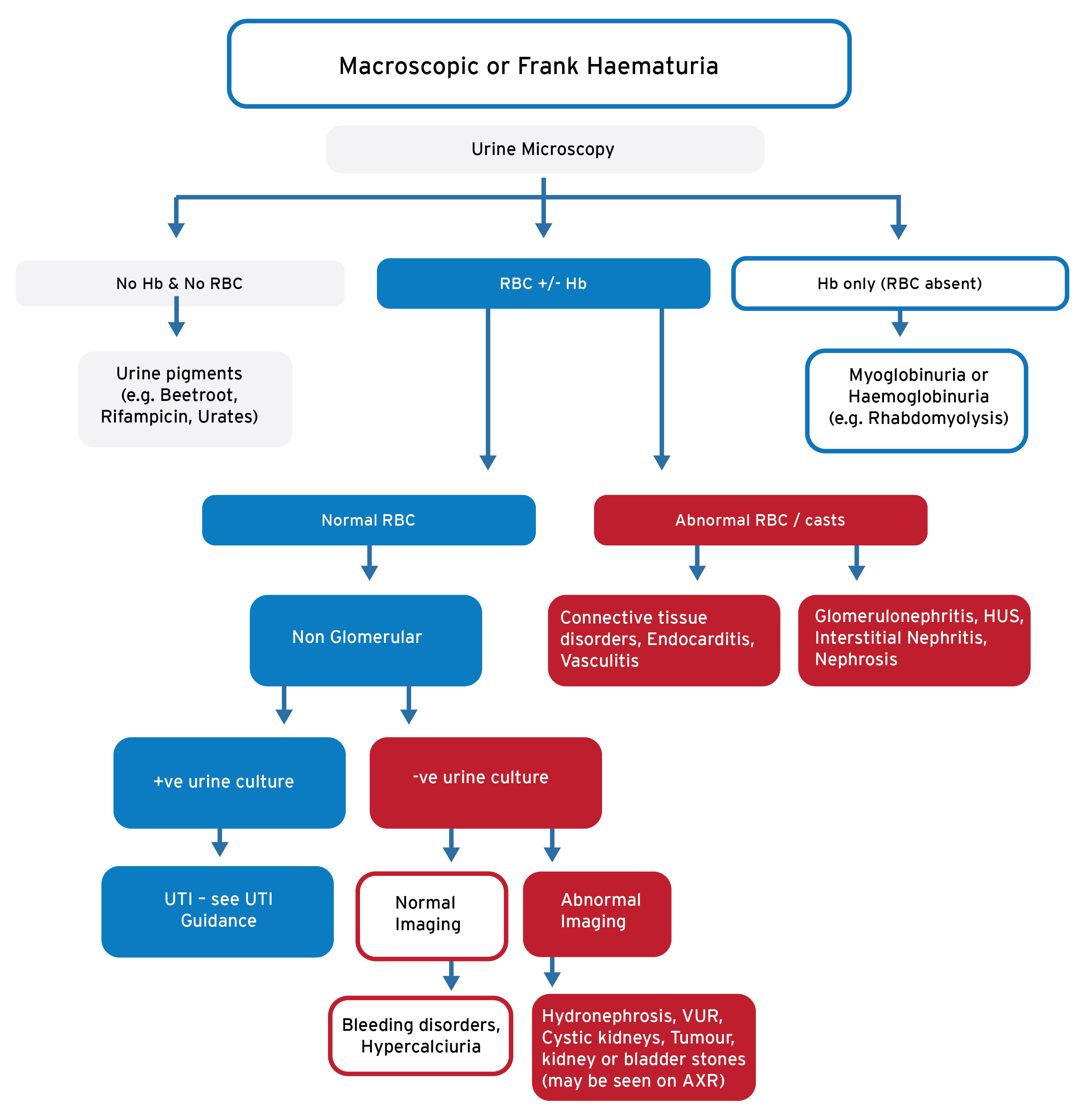
Click on image to enlarge
Introduction
Haematuria is defined as the presence of red blood cells, haemoglobin or myoglobin in urine. It is a common presenting symptom of renal & urinary tract disorders.
Clinical presentation
- Symptoms: fever, lethargy, abdominal pain, dysuria & frequency
- Ask about patterns of bleeding
- Urine colour (e.g. Coke colour = myoglobin)
- Pharyngitis, skin infection/rash, arthralgia, myalgia or haemoptysis
- Any history of trauma (incl. urethral catheterisation) – discuss with urology
- Bleeding tendency or bruising
- Any ingested food pigments
- Travel history: bilharzia, malaria or TB contact
- Family history: haematuria or kidney stones
- For Neonates: Central line insertion (e.g. UAC & UVC) can predispose renal vein & artery thrombosis
Examination and Assessment
- Check ABC for signs of imminent collapse
- Pallor/oedema
- Signs of dehydration (dry mucus membranes, decreased skin turgor etc.) and/or poor perfusion (capillary refill >3 sec, weak pulses etc.)
- Proptosis
- Epistaxis, septal perforation, saddle nose (Wegners Granulomatosis)
- Blood pressure, signs of fluid overload & congestive cardiac failure
- Abdominal mass
- Abdominal/flank pain
- Malar/discoid rash or impetigo
- Arthralgia
- Purpura/petechiae
- Petechial rash behind thighs/buttocks (?Henoch Schonlein Purpura)
- Urethral injury (discuss with urology)
Differential Diagnosis
Investigations
- Should be done in children with a positive history & symptoms of nephritis or features suggestive of autoimmune disease (e.g. rash, arthralgia, petechial rash on legs, thighs. buttocks)
Urgent tests:
- Full blood count, Electrolytes, Urea & Creatinine
- Type and Screen & Coagulation screen
- Urine Culture, urine protein: creatinine ratio
- Serum & urine myoglobin, creatinine kinase (CK)
Tests to consider if patient is in EC >24hours:
- C3/C4 fractions
- ASOT
- Anti-DNAse
- ANA
- ANCA
- Renal ultrasound
Management guided by suspected diagnosis:
Refer to a Paediatric Inpatient Unit:
- Episodic Macroscopic haematuria
- Family history
- Stones
- Decreased hearing or visual acuity
- Palpable kidney or bladder mass
- Hypertension
- Features of nephritic or nephrotic (proteinuria and oedema) syndrome
- Renal impairment
- Bruising/ petechiae or bleeding from other sites
Discuss with urology team:
- Any history of trauma
- Abnormal anatomy
- Abnormal cytology
Referral criteria:
Paediatric Outpatient referral: only if ISOLATED asymptomatic haematuria
Refer to a Paediatric Inpatient Unit:
- Episodic Macroscopic haematuria
- Family history
- Stones
- Decreased hearing or visual acuity
- Palpable kidney or bladder mass
- Hypertension
- Features of nephritic or nephrotic (proteinuria & oedema) syndrome
- Renal impairment
- Bruising/ petechiae or bleeding from other sites
Refer to urology team:
- Any history of trauma
- Abnormal anatomy
- Abnormal cytology
References
1. Wallis LA, Reynolds TA. AFEM Handbook of Acute and Emergency Care. South Africa: Oxford University Press; 2013.
2. Motala C, Davidson A, Figaji A, Levin M, editors. Handbook of Paediatrics. 7th edition. South Africa: Oxford University Press; 2012.