Haemovigilance, Risks and Adverse Reactions Associated with Blood Transfusion
SANBS Clinical Guideline, 6th Edition, 2023
Risks associated with blood transfusion
Haemovigilance
Haemovigilance involves the recording, reporting, analysis and evaluation of suspected adverse donation and transfusion events. Corresponding measures are then derived to improve the quality and safety of transfusions, thereby promoting patient safety. The system is based on the reporting of all incidents and reactions occurring during the transfusion process, from donor selection to the administration of blood products to the patient.
The evaluation of haemovigilance provides a picture of the current transfusion-related risks, can pinpoint the cause of preventable transfusion incidents, and can reveal areas where corrective measures are necessary and possible.
Accurate and valuable haemovigilance monitoring is dependent on reliable reporting. This responsibility lies with the donor, the blood transfusion services (as producers of labile blood products) and the prescribing clinicians. The treating doctor is responsible for identifying and then reporting a transfusion reaction that occurs in their institution to a reporting body.
The analysis and evaluation of this data provide an up-todate overall picture of transfusion safety and the nature and magnitude of the risks expected during the transfusion of labile blood products. In order to obtain a comprehensive overview of transfusion-related incidents, the involvement of all institutions that administer blood components is essential. This requires direct communication between all involved stakeholders, as haemovigilance thrives on the interdisciplinary cooperation of all professionals involved in the handling of blood products.
The implementation and maintenance of a high-quality haemovigilance system poses a major challenge that should not be underestimated. It requires great commitment from responsible stakeholders, as well as considerable resources and time.
Reporting of transfusion-related adverse events
SANBS and Western Cape Blood Service (WCBS) have in place systems whereby healthcare professionals can report TRAEs occurring as a result of transfusion of blood and blood products. This is done by submitting a transfusion reaction form to the blood bank via fax or email, or by making a telephonic report.
Management of reported transfusion-related adverse events
- Reporting forms are either dispensed by SANBS or WCBS with the issued products or they are kept in hospital wards and the local blood bank. A form must be completed by the attending healthcare worker should a TRAE occur or be suspected.
- The healthcare worker must then send the form and 2 post-transfusion ethylenediamine tetraacetic acid (EDTA) blood samples from the patient to the blood bank to reach the Haemovigilance Officers and the appropriate laboratory – Red Cell Serology (RCS) laboratory in SANBS or Immunohaematology laboratory at WCBS – for further investigation.
- Once received, the clinical information will be analysed by the blood bank staff or Haemovigilance Officer to establish the suspected reaction type.
- Serological testing is performed on the samples by the blood bank, RCS or Immunohaematology laboratories.
- Complicated or severe transfusion reactions are referred to the Independent Haemovigilance Committee for impartial review.
- A transfusion reaction is classified according to definitions provided by the International Haemovigilance Network (IHN), and a report or letter is sent to the treating doctor of the patient (private sector) or the clinical manager of the hospital (public sector).
- The results of all TRAEs for SANBS and WCBS are summarised in the annual Haemovigilance Report. No patient identification details are provided in this report.
- The latest Haemovigilance Report is available on both the SANBS and WCBS websites: www.sanbs.org.za and www.wcbs.org.za.
Risks associated with blood transfusion
Mortality associated with transfusion
As per Section 68 of the National Health Act 61 of 2003, in the event that a patient demises while receiving or following a transfusion, the following steps must take place:
- The blood bank must be notified of the case as a ‘Mortality following a transfusion’.
- Post-transfusion samples must be taken immediately and sent to the blood bank.
- A post-mortem must be conducted to establish the cause of death.
- The treating doctor’s report and post-mortem results must be sent to the blood bank or directly to the Haemovigilance office.
- Once the blood transfusion service has completed the investigation, a report will be sent to the treating doctor and/or hospital manager, and the Deputy Director-General of the National Department of Health.
- The case will be classified according to the outcome of the investigations and post-mortem results.
Lookback programme
The objective of the Lookback Programme is to trace all patients who are identified as potential window-period recipients of blood from donors who, on subsequent donations, test positive for transfusion-transmissible infections (TTIs) for which SANBS and WCBS test.
The Lookback Programme also investigates cases where the recipient of a blood transfusion alleges that they were infected with a TTI through blood transfusion.
Types of lookback process
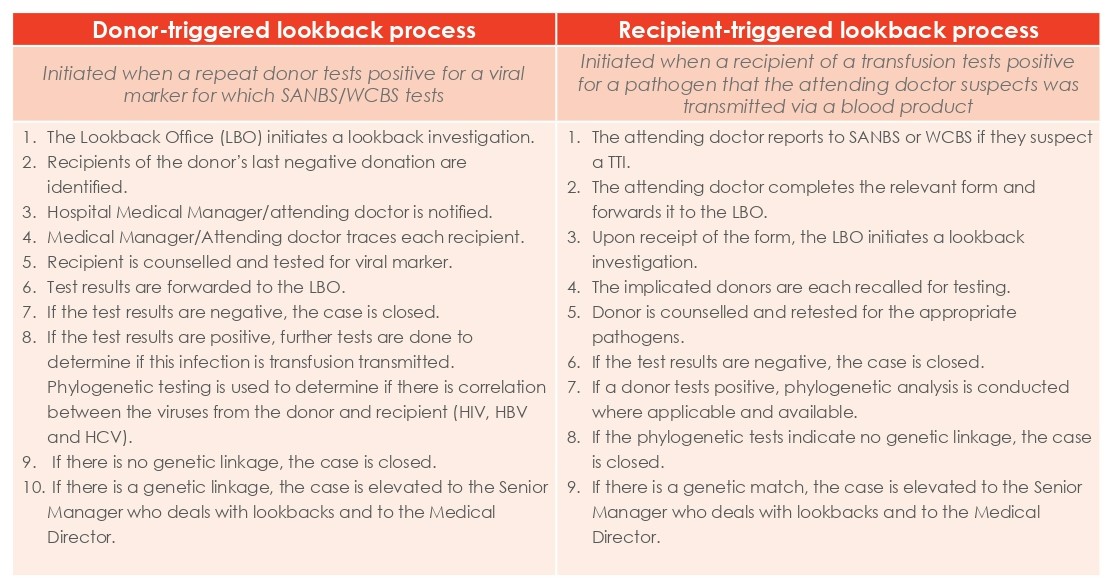
Click on table to enlarge
Transfusion reactions
A transfusion reaction is defined as any potentially adverse sign or symptom which occurs after the start of any transfusion of blood or blood products. It stands to reason that, in order to notice any adverse effect, the patient’s condition prior to, during and after the transfusion must be monitored.
It is good medical practice to err on the side of caution when a reaction is suspected, and to take swift action. The steps are simple and apply in all instances:
- Stop the transfusion immediately.
- Maintain venous access with crystalloids in a new drip set, in case fluid, medication or further transfusion therapy is required.
- Manage the acute symptoms and stabilise the patient.
- Contact the transfusion service for advice, if needed.
- Complete the reporting form for the blood services and submit with post-transfusion blood samples from the patient.
Monitoring
The basic monitoring of the patient prior to the start of the transfusion and during the infusion includes:
- Pulse
- BP
- Temperature
- Respiration rate
- General visual observation
- Verbal enquiry as to the patient’s well-being
Any abnormal symptoms at the start of transfusion should be noted, e.g. dyspnoea, chills, oliguria. Changes in intensity of these symptoms may indicate the potential for a transfusion reaction and should be assessed clinically. These patients are, however, usually closely monitored for changes in their primary condition and transfusion reactions are readily detected.
Extra care must be taken to monitor and react to changes in vital signs in the unconscious patient. Excessive oozing from the operative site or venous access points and unexplained hypotension may indicate that a haemolytic transfusion reaction is occurring.
Signs and symptoms highly suggestive of a transfusion reaction
- Chills/rigors
- Fever/sweating
- Tachycardia/bradycardia
- Dyspnoea/bronchospasm
- Hypertension/hypotension
- Urticaria/pruritus
- Chest/flank pain
- Nausea/vomiting
- Haemoglobinuria
- Oliguria/anuria
- Agitation
- Jaundice
Investigation
The transfusion service has a specific set of instructions for investigating reactions and it is the legal responsibility of the clinician to assist with this undertaking. The clinician should send clearly labelled appropriate samples, including the following as a minimum requirement:
- Clotted blood sample
- EDTA tube
- Post-transfusion urine sample, depending on the nature of the reaction
- Suspected unit/s, empty blood bags and drip set, returned to the nearest blood bank. If there is concern about possible bacterial contamination of the implicated unit:
- ensure that the blood bank is informed so that cultures and gram stains are performed
- obtain blood for blood culture from the patient
- Completed reaction report form, specifying:
- patient details
- reason for transfusion
- pre- and post-transfusion signs and symptoms
Transfusion reaction classification
The list of potential reactions is lengthy and there are many different criteria for classification. Reactions include those attributable to:
- Incompatibility
- Transmissible disease
- Bacterial contamination
- Storage lesions due to the age of the transfused blood products
However, for most practical purposes, the following table lists and describes the most frequently observed or serious TRAEs:
Transfusion-related adverse events
Table 1
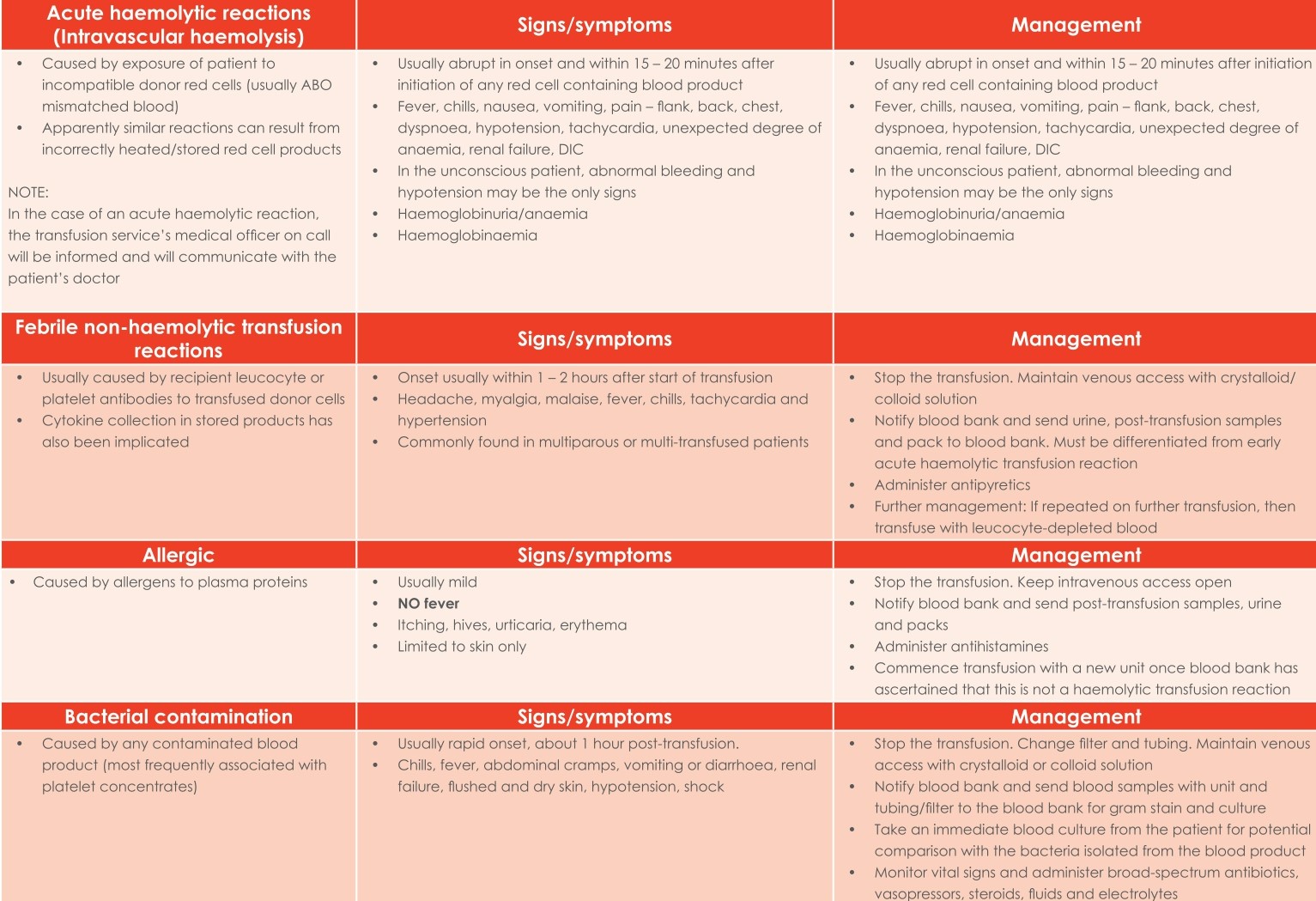
Click on table to enlarge
Table 1 continued
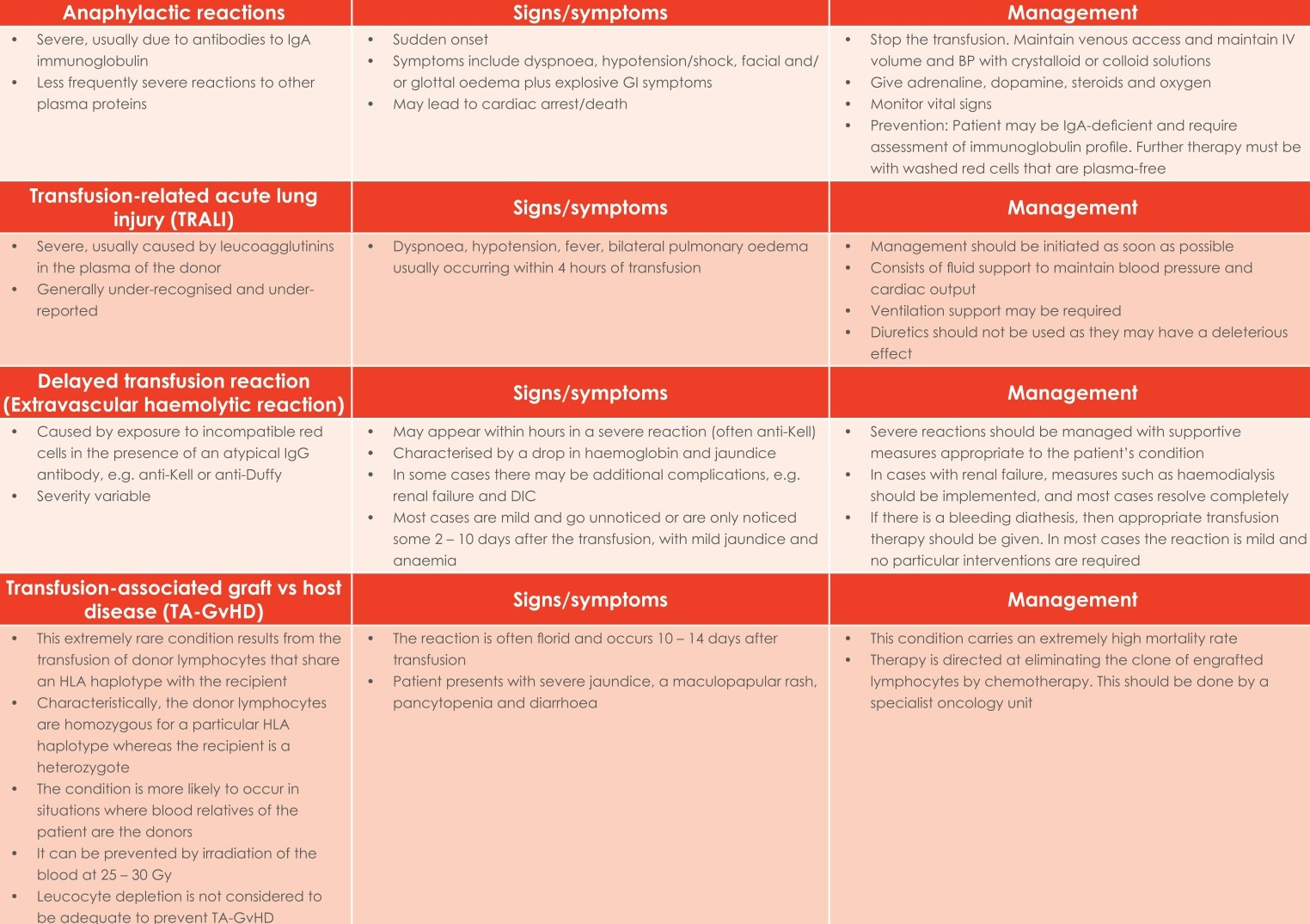
Click on table to enlarge
Table 1 continued

Click on table to enlarge
Further reading
- SANBS/WCBS. Haemovigilance reports. Accessed March 7, 2023. https://sanbs.org.za/clinical-services/ or https://www.wcbs.org.za/wp-content/uploads/2021/1 1/2020-south-african-haemovigilance-report.pdf
- Serious Hazards of Transfusion. SHOT Report 2019. Accessed March 7, 2023. https://www.shotuk.org/shot-reports/report-summary-and-supplement-2019
- Blood safety and availability. World Health Organization. 26 May 2022. Accessed March 7, 2023. https://www.who.int/news-room/fact-sheets/detail/blood-safety-and-availability
- Global status report on blood safety and availability. World Health Organization. 2021. Accessed March 7., 2023. https://www.who.int/publications/i/item/9789240051683
- Basu D. Diseases of public health importance in South Africa. Southern African Journal of Public Health. 2018:2(3):48. doi: 10.7196/SHS.2018.v23.72 South African National Blood Service. http://www.sanbs.org.za
- Western Cape Blood Service. http://www.wcbs.org.za
- Sauer DA, McDonald CE, Boshkov L. Errors in transfusion medicine. Laboratory Medicine. 2001:32(4):205-207. https://doi.org/10.1 309/WHVV-VUC9-J1VT-W4NL
Clinical Guidelines for the Use of Blood and Blood Products in South Africa, 6th Edition, 2023