Head Injury: District Level Facilities
Head Injury: District Level Facilities
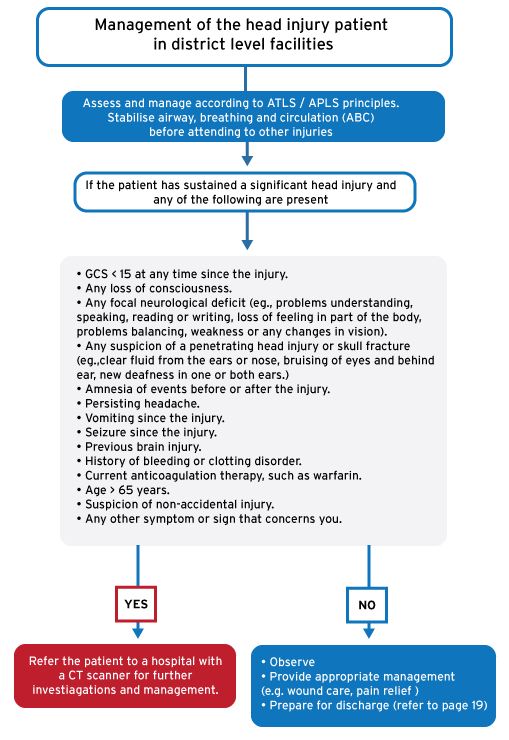
Management of the head injury patient in district level facilities
Preparing the patient for transfer to a secondary or tertiary level facility
Further management of patients who are not referred
Management of the head injury patient in district level facilities
Preparing the patient for transfer to a secondary or tertiary level facility
- The referring professional should determine if an ambulance is required based on the patient’s condition.
- Telephonically notify the receiving Emergency Centre physician.
- A letter summarising all the symptoms and signs should be sent with the patient.
- Transportation should be undertaken within 4 hours.
- Monitor at regular intervals before and after transport: GCS, pupil size and reactivity, RR, HR, BP, O2 sats
In all circumstances complete initial resuscitation and stabilisation of patients, and monitor at regular intervals to avoid complications during transport
Further management of patients who are not referred
Discharge patient if:
- Normal examination
- Normal observations
- No indication for transfer
Discharge into care of competent adult
Provide written and verbal instructions: refer to page 19.
If patient returns to the Emergency Centre within 48 hours of discharge with persistent complaints relating to the initial head injury such as:
- Drowsiness
- Confusion, agitation, abnormal behaviour
- Severe headache
- Vomiting
- Seizures
- Neurological signs or symptoms such as limb weakness or paraesthesia
Involve a senior clinician and refer for CT scan.