neobookRx
GuidelinesIMCI

HIV Infection (Birth up to 2 months)

IMCI - Young Infant (Birth up to 2 months)
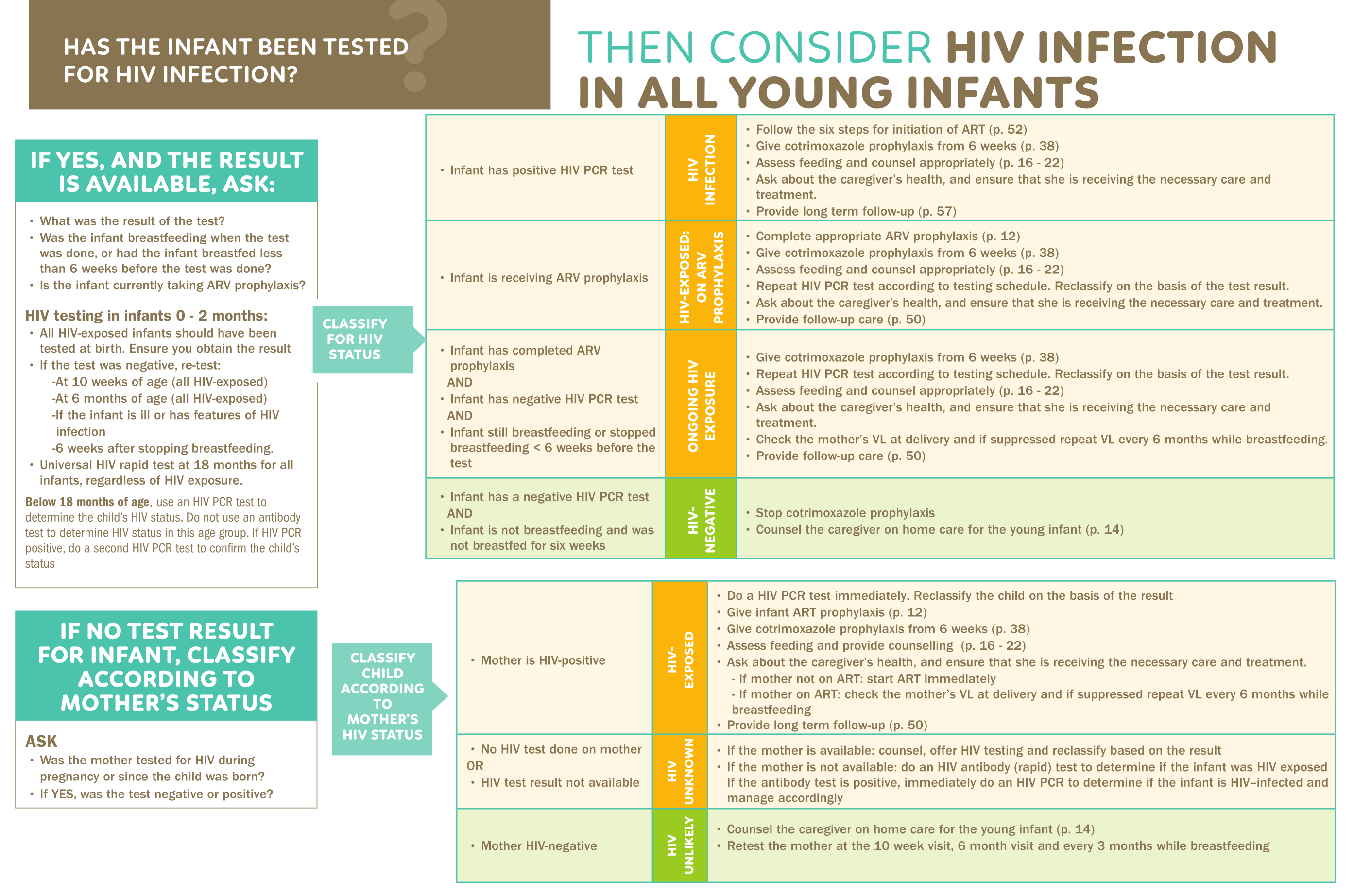
image

Click here to open the above PDF

If the infant has been tested for HIV Infection and the results are available, ask:

  • What was the result of the test?
  • Was the infant breastfeeding when the test was done, or had the child breastfed less than 6 weeks before the test was done?
  • Is the child currently taking ARV prophylaxis?

HIV testing in infants 0 - 2 months:

  • All HIV-exposed infants should have been tested at birth. Ensure you obtain the result.
  • If the test was negative, re-test:
    • At 10 weeks of age— all HIV-exposed infants
    • At 6 months of age— all HIV-exposed infants
    • If the child is ill or has features of HIV infection
    • 6 weeks after stopping breastfeeding
  • Universal HIV rapid test at 18 months for all infants, regardless of HIV exposure.

Below 18 months of age, use an HIV PCR test to determine the child’s HIV status. Do not use an antibody test to determine HIV status in this age group. If HIV PCR positive, do a second HIV PCR test to confirm the child’s status

Classify for HIV Status

HIV Infection
  • Infant has positive HIV PCR test
HIV-Exposed: On ARV Prophylaxis
  • Infant is receiving ARV prophylaxis
  • Complete appropriate ARV prophylaxis 
  • Give cotrimoxazole prophylaxis from 6 weeks 
  • Assess feeding and counsel appropriately
  • Repeat HIV PCR test according to testing schedule. Reclassify on the basis of the test result.
  • Ask about the caregiver’s health, and ensure that she is receiving the necessary care and treatment
  • Provide follow-up care
Ongoing HIV exposure
  • Infant has completed ARV prophylaxis
    AND
  • Infant has negative HIV PCR test
    AND
  • Infant still breastfeeding or stopped breastfeeding < 6 weeks before the test
  • Give cotrimoxazole prophylaxis from 6 weeks 
  • Repeat HIV PCR test according to testing schedule. Reclassify on the basis of the test result
  • Assess feeding and counsel appropriately 
  • Ask about the caregiver’s health, and ensure that she is receiving the necessary care and treatment.
  • Check the mother’s VL at delivery and if suppressed repeat VL every 6 months while breastfeeding.
  • Provide follow-up care 
HIV-Negative
  • Infant has a negative HIV PCR test
    AND
  • Infant is not breastfeeding and was not breastfed for six weeks


If  the infant has NOT been Tested for HIV Infection, Classify According to Mother's Status

Ask

  • Was the mother tested for HIV during pregnancy or since the child was born?
  • If yes, was the test negative or positive?

Classify Child According to Mother's HIV Status

HIV-Exposed
  • Mother is HIV-positive
  • Do a  HIVPCR test immediately. Reclassify the child on the basis of the result.
  • Give infant ART prophylaxis 
  • Give cotrimoxazole prophylaxis from 6 weeks 
  • Assess feeding and provide counselling 
  • Ask about the caregiver’s health, and ensure that she is receiving the necessary care and treatment.
    - If mother not on ART: start ART immediately
    - If mother on ART: check the mother’s VL at delivery and if suppressed repeat VL every 6 months while breastfeeding.
  • Provide long term follow-up 
HIV Unknown
  • No HIV test done on mother
    OR
  • HIV test result not available
  • If the mother is available: counsel, offer HIV testing and reclassify based on the result.
  • If the mother is not available: do an HIV antibody (rapid) test to determine if the infant was HIV exposed. If the antibody test is positive, immediately do an HIV PCR to determine if the infant is HIV–infected and manage accordingly
HIV Unlikely
  • Mother HIV-negative
  • Counsel the caregiver on home care for the young infant 
  • Retest the mother at the 10 week visit, 6 month visit and every 3 months while breastfeeding.


Integrated Management of Childhood Illness 2022; Young Infant (Birth up to 2 months); Assess, Classify and Identify Treatment: HIV Infection 


Last checked for updates: June 2023

NeoHealth® ID 18135 · updated 8/21/2023