HIV Infection in Children (<10 years old)
Please click on the link below to access the most up-to-date version of this guideline. The content on this page is currently being updated to align with the latest publication. Always check the version number at the bottom of the screen to confirm which version you are using. Click here to access the Primary Health Care - PHC Chapter 11: Human Immunodeficiency Virus and Acquired Immune Deficienc
Please click on the link below to access the most up-to-date version of this guideline. The content on this page is currently being updated to align with the latest publication. Always check the version number at the bottom of the screen to confirm which version you are using.
Click here to access the Primary Health Care - PHC Chapter 11: Human Immunodeficiency Virus and Acquired Immune Deficiency Syndrome (HIV and AIDS) - 26 February 2026
Description
Diagnosis in Children
WHO Clinical Staging of HIV and AIDS for Infants and Children
DESCRIPTION
HIV is a retrovirus affecting immune cells, especially CD4 T-lymphocytes. In advanced HIV disease the body loses its ability to fight infections and this is characterised by organ damage, opportunistic infections, malignancies and very low CD4 counts.
In infants and children, most infection is transmitted from mother to child. In adolescents and adults sexual spread is the usual cause.
Infants born of HIV-infected mothers may be:
- HIV-infected,
- HIV-exposed uninfected, or
- HIV-exposed, unknown infection status (at risk of becoming HIV-infected).
For the purpose of the ART guidelines:
- Children <10 years of age: follow the paediatric antiretroviral therapy (ART) guidelines.
- Adolescents (10–19 years of age): follow the adult ART guidelines.
LoE:IIIb44
DIAGNOSIS IN CHILDREN
Testing must be done with counselling of parent/legal guardian/primary caregiver and, where appropriate, the child. The appropriate consent/assent should be obtained.
HIV TESTING IN CHILDREN
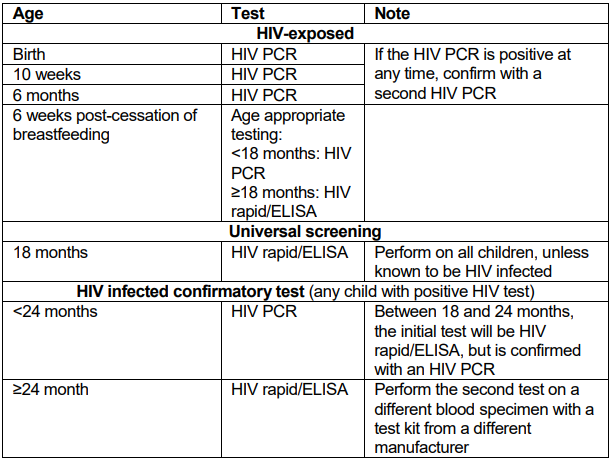
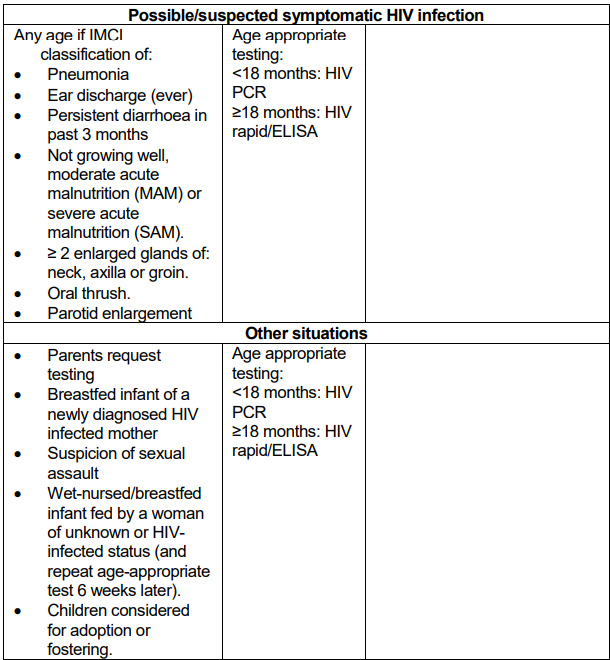
Click on image to enlarge
If an HIV PCR test is indeterminate or discordant, refer to the National Department of Health Guidelines for prevention of Mother to Child Transmission of Communicable Infections, 2023.
Table 1: HIV testing in children
WHO CLINICAL STAGING OF HIV AND AIDS FOR INFANTS AND CHILDREN
https://iris.who.int/bitstream/handle/10665/69058/WHO_HIV_2005.02.pdf
| Adapted WHO clinical staging of HIV and AIDS for infants and children For persons ≤15 years of age with confirmed laboratory evidence of HIV infection |
|
Clinical Stage 1 - asymptomatic |
|
Clinical Stage 2 - unexplained persistent weight loss |
|
Clinical Stage 3 - moderate unexplained malnutrition (not adequately responding to standard therapy) |
|
Clinical Stage 4 - unexplained severe wasting, stunting or severe malnutrition not adequately responding to standard therapy |
Table 2: WHO clinical staging for infants and children
Standard Treatment Guidelines and Essential Medicines List for South Africa, Primary Healthcare, 2020-2024_Version 2.1_09 December 2024
Chapter 11: Human Immunodeficiency Virus and Acquired Immune Deficiency Syndrome (HIV AND AIDS)_ HIV Infection in Children (<10 years old)