HIV Infection in Pregnancy
The guidelines recommend management of common obstetric conditions at primary and referral level, based on local experience and evidence-based practice. They are not intended as strict protocols nor as standard operating procedures, but rather as a guide to safe effective management of common obstetric problems. The guidelines should be most useful to interns, medical officers and registrars.
Counselling a pregnant woman about being HIV positive
ART and prevention of mother-to-child transmission (PMTCT)
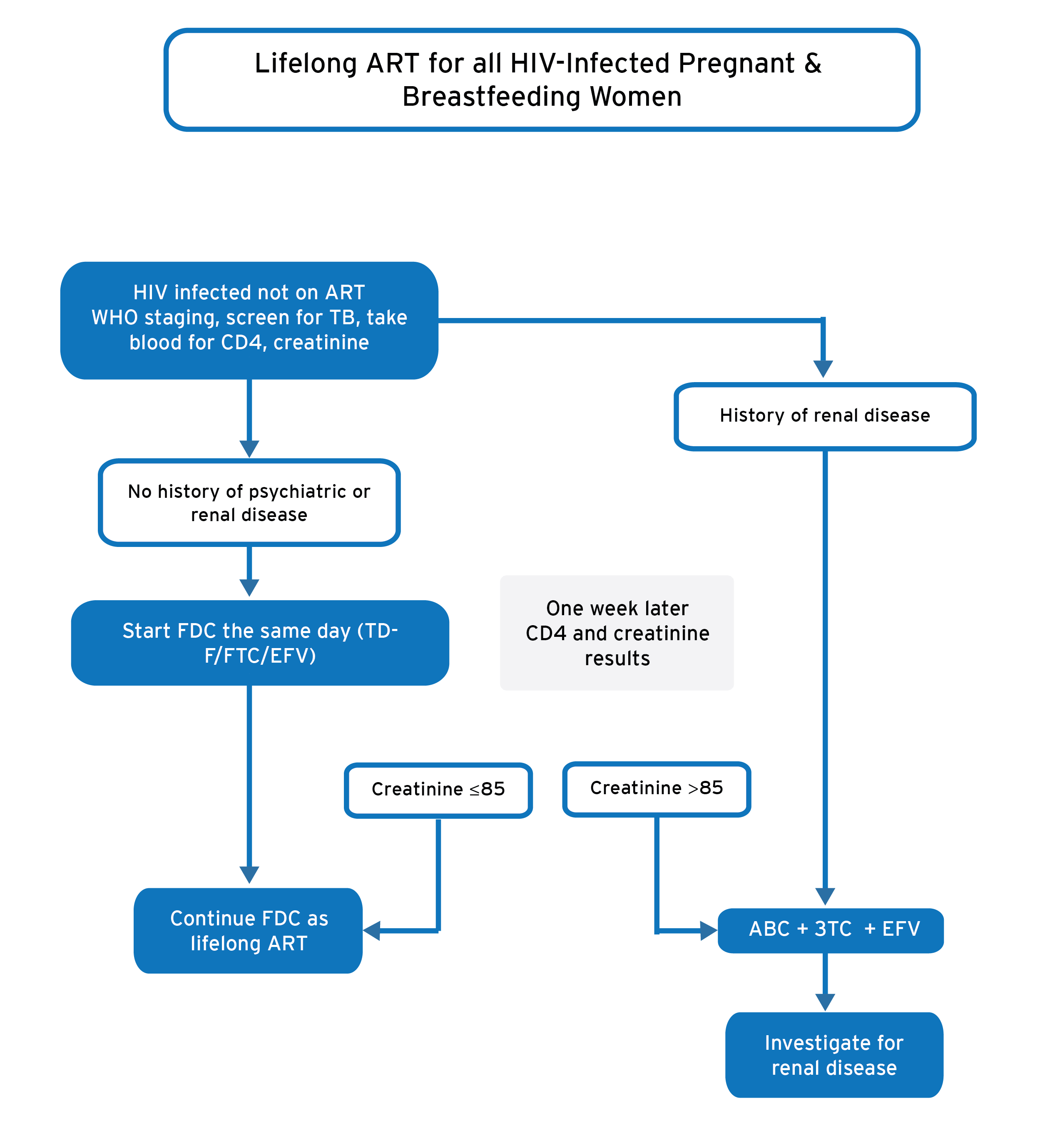
Lifelong ART for all HIV-infected pregnant & breastfeeding women
Without antiretroviral drug treatment, infection with human immunodeficiency virus (HIV) results in acquired immune deficiency syndrome (AIDS), & has a high risk of transmission of the virus from an infected pregnant or breastfeeding woman to her baby.
All women who book for antenatal care should be offered HIV testing, according to the principles of provider-initiated HIV counseling & testing (PICT). Only women who have a documented positive HIV status, & are on antiretroviral therapy (ART) are not offered an HIV test. Rapid antibody tests are used. A positive test is confirmed using another rapid HIV test kit. If one result is positive & the other is negative, the results are indeterminate & an ELISA must be done to confirm the HIV status.
Counselling a pregnant woman about being HIV positive
- Counselling is best provided by a trained counsellor
- Establish what the woman knows about HIV
- Give information on how the virus is transmitted
- Discuss the symptoms, signs & progression of the disease
- Explain the importance of CD4 count & viral load (VL) monitoring
- Discuss the benefits & potential side-effects of ART
- Explain the risk of mother-to-child transmission of HIV & how this may be reduced: safe infant feeding choice & antiretrovirals (ARVs)
- Discuss who the woman may want to tell about the result – disclosure is associated with better treatment adherence
- Discuss condom use & other safe sex practices to prevent transmission to & from the partner, & also discuss partner testing
- Discuss future fertility plans, & further contraception
Antenatal care
Antenatal care is usually conducted at the woman’s local clinic, but women with obstetric risk factors will attend hospital as is usual practice.
Clinical assessment:
- Ask about chronic illnesses in the past, & about current health
- Ask about the presence of any psychiatric illness
- Screen for TB: ask about cough, weight loss, night sweats & fever
- On physical examination, look for evidence of opportunistic infections: oral candidiasis, herpes zoster, & pulmonary TB
- Look for evidence of sexually transmitted infections & treat appropriately
- Stage the woman according to the World Health Organization staging system
Investigations:
- Take blood for CD4 count, Hb & creatinine at ART initiation, & follow up in one week for results
- Once on ART, do a VL every 3 months during pregnancy
- Investigate for TB if screen positive
Treatment:
- Initiate ART, preferably on the day of diagnosis
- Give the usual antenatal supplements, such as folate, iron & calcium
- Give isoniazid preventive therapy (IPT) 300 mg with pyridoxine 25 mg daily for 12 months to all women initiated on ART who screen TB-negative
- Give cotrimoxazole 2 tablets orally daily to women with CD4 cell count <200/mm3
- Do a serum cryptococcal antigen (CRAG) on asymptomatic women with CD4 <100 cells/mm3. If positive, start oral fluconazole pre-emptive therapy
- Fluconazole 800 mg daily for 2 weeks
- Then 400 mg daily for 8 weeks
- Then 200 mg daily, until her CD4 cell count has risen above 200 cells/mm3
Note: fluconazole should not be used in the first trimester, unless it is used for the treatment of cryptococcal meningitis.
Continuing antenatal care:
- All women who test HIV negative in early pregnancy should be offered a repeat test every 3 months, at the onset of labour, at 6 weeks postpartum, & every 3 months during breastfeeding.
- Women on ART should have VL monitoring every 3 months throughout pregnancy, then 6-monthly during breastfeeding
- Creatinine is repeated at 3 months, 6 months, 12 months, then annually while on TDF
- If there is a need for antenatal invasive procedures, initiating ART 6 weeks before the procedure gives some reassurance of viral suppression to allow the procedure to be done
- Consider elective caesarean section for women likely to require an emergency caesarean section in labour, e.g. previous caesarean section
- HIV infection alone is not a valid indication for Caesarean section.
ART AND PREVENTION OF MOTHER-TO-CHILD TRANSMISSION (PMTCT)
All HIV-infected pregnant women are offered lifelong ART, irrespective of CD4 count or HIV disease stage.
ART regimens
- The first-line regimen comprises a fixed dose combination (FDC) tablet containing:
- Tenofovir (TDF) 300 mg, Emtricitabine (FTC) 200 mg, and Efavirenz (EFV) 600 mg, taken once at night
- Alternative ART regimens include Abacavir (ABC) in place of TDF for women with renal dysfunction (serum creatinine >85 µmol/L)
- Nevirapine (NVP) in place of EFV for women with active psychiatric illness, provided her CD4 <250 cells/mm3
- OR
- Lopinavir/ritonavir (LPV/r) if her CD4 ≥250 cells/mm3
- While NVP is rarely initiated in pregnancy because of the risk of life-threatening toxicity, women who become pregnant on NVP and are stable on treatment may continue with NVP.
Labour and delivery
Women must not miss their ARV doses during labour. During labour for women who are unbooked & diagnosed HIV positive:
- Give single-dose NVP 200 mg orally at onset of labour
- Give single-dose TDF 300 mg with FTC 200 mg orally at onset of labour
- Give AZT 300 mg 3 hourly orally
- Commence lifelong ART within 24 hours after delivery
HIV prevention & testing for infants
All HIV-exposed infants, regardless of infant feeding method & whether the mother is on ART or not, should receive daily NVP syrup for the first 6 weeks of life.
NVP syrup is stopped at 6 weeks in formula fed infants. It is also stopped at 6 weeks if the infant is breastfed & the mother is on ART. If the infant is breastfed & the mother is not on ART, daily NVP is continued until 1 week after stopping breast-feeding. The dose of NVP syrup changes as the infant grows.
All HIV-exposed infants must have an HIV PCR test done at birth, & again at 10 weeks of age, &, if positive, must be referred for ART initiation immediately. Infants who have received extended NVP prophylaxis, i.e. 12 weeks, the PCR is done at 18 weeks. If they test negative & are breastfed, the HIV test is repeated 6 weeks after stopping breastfeeding. All HIV-exposed infants who tested negative previously must have an HIV antibody test at 18 months.
| Infant’s age | Nevirapine syrup dose |
| Birth to weeks | Birthweight <2500 g: 1.0 mL (10 mg) daily Birthweight ≥2500 g: 1.5 mL (15 mg) daily |
Notes on ARVs
Minor side-effects are common at ART initiation, & usually resolve after a few weeks, & are not a reason to discontinue treatment. Patients should be advised to report to their clinics any side-effects they develop on ARVs, especially skin rashes, persistent vomiting, jaundice or severe malaise, & be referred if there are concerns about the seriousness of the side effects. ART should only be interrupted or switched in consultation with an HIV treatment expert.
Interactions may occur between ARVs & other medications, & this may be due to similar side effect profiles or altered metabolism. Consult a reference guide or HIV expert for advise.
Antiretrovirals and common side-effects (not a comprehensive list)
- Tenofovir (TDF): renal dysfunction, only use if serum creatinine <85 µmol/L
- Lamivudine (3TC) and Emtricitabine (FTC): side-effects not common, generally well-tolerated
- Efavirenz (EFV): central nervous system effects – dizziness, insomnia, bad dreams, also rash, hepatitis
- Abacavir (ABC): drug-induced hypersensitivity reaction (uncommon)
- Nevirapine (NVP): rash including Stevens-Johnson syndrome, hepatitis. Avoid NVP in women with CD4 cell count >250 cells/mm3
- Lopinavir/ritonavir (LPV/r): diarrhea, nausea, dyslipidaemia
Labour and delivery
Labour is generally managed in the same way as for women who are HIV-negative.
- Do not rupture membranes for poor progress unless her VL is undetectable
- Avoid using penetrating fetal scalp electrodes for heart rate monitoring
- Avoid episiotomy wherever possible
Postpartum care
- Give normal postpartum care, irrespective of mode of delivery
- Inform the woman about handling & disposal of soiled pads & linen
- Treat infections promptly & aggressively
- Give information about advantages & disadvantages of breast & formula feeding – strongly discourage mixed feeding
- All HIV-positive women should be encouraged to exclusively breastfeed for the first 6 months, with complementary feeding only from 6 months & breastfeeding continued until 12 months, unless contraindicated
- Give contraceptive advice & discuss sterilization if appropriate
Women with advanced HIV disease
The following problems may be expected:
- Opportunistic infections, e.g. meningitis, pneumonia, TB, chronic diarrhoea
- Severe puerperal sepsis
- Spontaneous preterm labour with or without chorio-amnionitis
- The need for preterm elective delivery in a terminally ill pregnant woman – requires a discussion with the family
- Rapid deterioration & death after delivery, especially after spontaneous preterm labour
- Possible need for disclosure of the illness to the relatives
Treatment is individualized according to each patient’s specific disease profile & family circumstances, in consultation with physicians & infectious disease or HIV treatment specialists.
LIFELONG ART FOR ALL HIV-INFECTED PREGNANT & BREASTFEEDING WOMEN