Hyperbaric Oxygen Therapy
Hyperbaric Oxygen Therapy
What is this new hyperbaric oxygen therapy centre?
What is HBO used for?
Who can access this facility?
What are the potential risks and side effects?
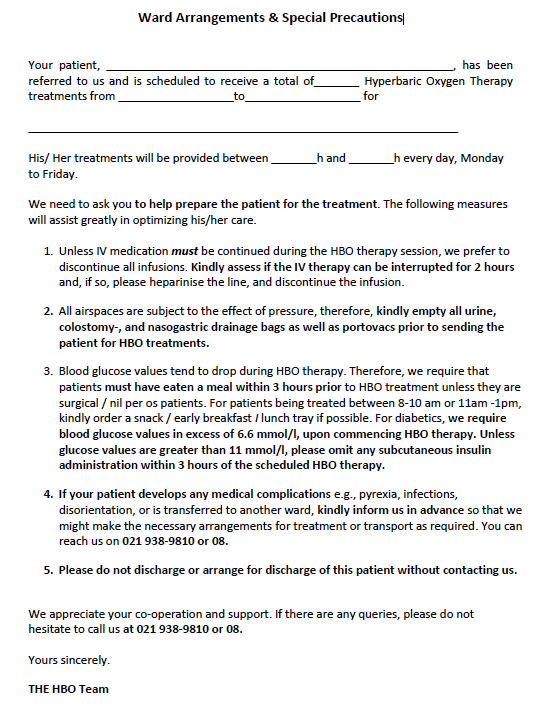
Ward Arrangements and Special Precautions
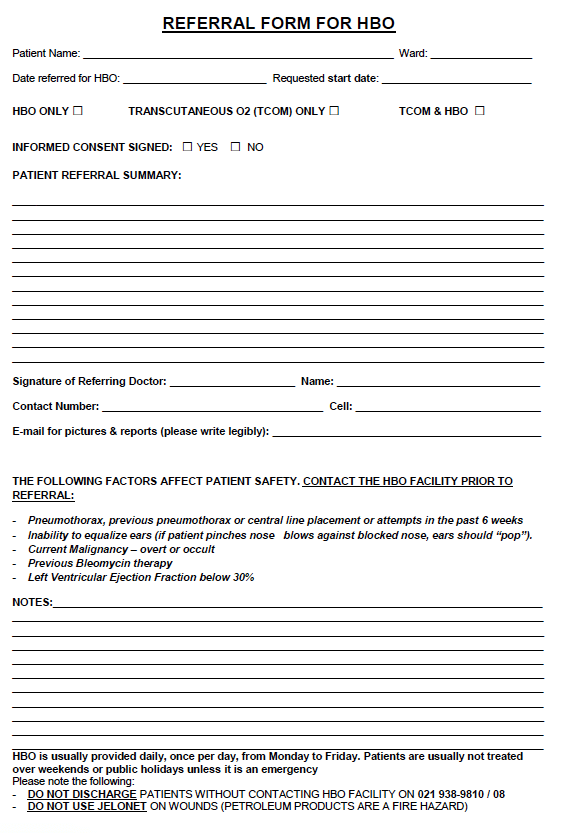
Referral form for HBO
Referrals:
Between 08:00 - 16:00 Monday-Friday contact the hyperbaric medicine facility on the grounds of the faculty of Medicine & Health Sciences of the University of Stellenbosch on Tel: 021 938 9810 to speak to a consultant.
For 24 hour emergency referrals contact Divers Alert Network (DAN) on Tel: 0800 020 111
The word hyperbaric is derived from the Greek hyper (above) and baros (βάρος = weight). Hyperbaric medical treatments take place at pressures greater than one atmosphere absolute (1 ATA), the atmospheric pressure at sea level, and hyperbaric oxygen therapy (HBO) occurs when a patient breathes 100% oxygen in such an environment. Breathing 100% oxygen at one atmosphere, as commonly happens in many hospital situations, is not considered hyperbaric, in nature or effect.
HBO therapy is administered in either a monoplace chamber (room for a single occupancy) or a multiplace chamber (room for two or more people) that have been specially designed to withstand increased internal pressures. In a monoplace chamber, the patient is pressurised using 100% oxygen to a maximum of 3 ATA; in a multiplace chamber, compressed air is used for pressurization, typically to a maximum of six atmospheres absolute. The multiplace chamber patient breathes 100% oxygen through an oxygen delivery device. Because attendants may accompany a patient in the multiplace chamber, surgical procedures can be performed. Time limitations for HBO exposure exist in both kinds of chambers and are primarily related to the development of oxygen toxicity.
The South African Underwater and Hyperbaric Medicine Association (SAUHMA), in conjunction with UHMS (Underwater and Hyperbaric Medicine Society) in the USA and the ECHM (European Committee for Hyperbaric Medicine), only endorses treatments for which there is sufficient research or empiric evidence in support of the risk/ benefit ratio for HBO treatment.
What is this new hyperbaric oxygen therapy centre?
The Hyperbaric Medicine Facility on the grounds of the Faculty of Medicine and Health Sciences of the University of Stellenbosch was recently re-opened under the auspices of the Western Cape EMS, and is available for both public and private patients. The facility consists of a Sechrist 3200 and a Hyox hyperbaric system that can treat up to 8 patients per day.
The facility is one of two in the Western Cape that is able to offer hyperbaric oxygen (HBO) to the local community. It is also the only facility in the northern suburbs. The other is at the SA Navy in Simonstown. The Stellenbosch facility is also only one of two in tertiary institutions (the other is in Pretoria) where research can be conducted on the effects and value of HBO in various medical and surgical conditions.
What is HBO used for?
There are 14 recognised medical conditions where HBO is valuable and may be life saving:
- Arterial Gas Embolism (i.e. gas bubbles trapped in blood vessels of the brain)
- Decompression Sickness (“the bends”)
- Carbon monoxide poisoning
- Gas gangrene
- Crush injuries, where there is serious tissue swelling which compromises tissue oxygen delivery (compartment syndrome)
- Problem wounds (certain selected diabetic, arterial, venous and pressure sores)
- Necrotising infections
- Refractory Osteomyelitis
- Therapeutic radiation tissue damage to the mandible & soft tissue (including skin & bladder)
- Compromised skin grafts & flaps
- Acute Thermal Burns
- Acute Blood Loss Anaemia (where transfusion is not possible) - e.g. Jehovah’s Witnesses
- Brain abscesses that are inoperable
- Acute Retinal Artery Insufficiency
Please remember that in all cases, initial treatment involves standard resuscitation & stabilisation before considering HBO treatment.
This may involve surgical debridement in events such as crush injury, thermal burns or necrotising infections, as dead tissue first needs to be removed. In patients who have been diving in the preceding 24 hours, always consider decompression illness as the reason for unexplained muscle & joint pains &/or neurological symptoms of sudden onset, while ruling out common medical emergencies.
Who can access this facility?
For state patients
Referrals based on the recommended indications will be taken by the unit from referring clinicians in any state facility. Diving emergencies need to be called in to the DAN hotline and patients transferred to the nearest facility upon arrangement (Stellenbosch or Simonstown). Please complete a referral form provided at the end of this chapter.
Private patients
Similar referrals are accepted. Diving emergencies should still go via DAN. (Please note that only a few Medical Aids pay for HBO treatments based on sufficient motivation and that co-payments are a reality in most cases).
In all cases, the following may present relative and/ or absolute contraindications to HBO therapy. Discuss with the facility! (Tel: 021 9389810/ 08)
- Untreated pneumothorax, previous pneumothorax or central line placement or attempts in the past 6/52
- Inability to equalise ears (if patient pinches nose blows against blocked nose, ears should “pop”).
- Current Malignancy – overt or occult
- Previous Bleomycin therapy
- Left Ventricular Ejection Fraction below 30%
What are the potential risks and side effects?
The following risks and side effects are covered with patients when offering HBO or recompression therapy:
- Barotrauma or pain in the ears or sinuses: Although hyperbaric therapy is normally entirely painless, one may experience pain in my ears or sinuses during pressurisation if the nasal passages are congested and air is unable to pass into them. If unable to equalise ears or sinuses, pressurisation will be slowed or halted and suitable remedies will be applied. If this remains a problem, myringotomies may have to be performed under local anaesthetic or grommets may be required.
- Cerebral Air Embolism and Pneumothorax: Whenever there is a rapid change in pressure surrounding the body, there is a remote possibility of rupture of the lungs with escape of air into the arteries or into the pleural cavity. However, this can only occur if the normal passage of air out of the lungs is blocked during decompression. Only slow decompressions are used in hyperbaric oxygen treatment to avoid this possibility. The patient may never hold their breath during treatment.
- Oxygen Toxicity: Oxygen under pressure is used as a medicine, with potential adverse events. An important, but rare side effect (less than 1 per 10 000 hyperbaric treatments) is oxygen related convulsions (neurological oxygen toxicity). Such seizures, similar to fever convulsions in children, are mostly unpredictable and entirely harmless and do not result in brain damage. The onset of seizures may be preceded by a sudden change in vision or hearing or sudden unexplained apprehension. If this occurs, remembering the patient is hyper-oxygenated, they will then be provided with a mask to breathe air inside the chamber to avoid a seizure. A further possibility is pulmonary oxygen toxicity, manifested initially as an reversible decrease in vital capacity. This effect is predictable and dependent on the duration of HBO treatment.
- Risk of fire: With the use of oxygen in any form there is always an increased risk of fire, but strict precautions have been taken to prevent this and all applicable safety codes have been complied with. The patient will be given special hospital cotton clothing to wear during therapy and should refrain from using deodorant, hair spray or apply makeup before treatment. In addition, patients may never take anything into the hyperbaric chamber unless specifically allowed to do so.
- Risk of worsening of near-nearsightedness (Myopia): After twenty or more treatments, especially in patients over forty years, it is possible that myopia may worsen. This is usually temporary and in the majority of patients, vision returns to its pre-treatment level about six weeks after the cessation of therapy. It is not advisable to get new prescription glasses until at least eight weeks after hyperbaric therapy has been completed.
- Maturing or Ripening Cataracts: In individuals with existing cataracts it has occasionally been demonstrated that there may be a maturing or ripening of the cataracts. Patients with existing cataracts may require a lens replacement sooner than otherwise.
- Temporary improvement in farsightedness (Presbyopia): After twenty or more treatments, especially in patients over forty years, there is a possibility of improvement in the ability to see things close by, or to read without reading glasses. This is usually temporary and that in the majority of patients, vision returns to its pre-treatment level about six weeks after the cessation of therapy. Patients are cautioned that it is not advisable to be fitted for new prescription glasses for eight weeks after the end of treatments.
- Numb fingers: A small proportion of patients sometimes notice a numb feeling in the fourth and fifth fingers of the hands after twenty or more treatments. There is no need for concern as this should disappear within a few days to weeks following cessation of therapy.
- Serous Otitis: Fluid in the ears sometimes accumulates as a result of breathing high concentrations of oxygen. It feels like the patient has a "pillow over the ear". This disappears after hyperbaric treatment ceases and often can be eased with decongestants.
- Fatigue: On rare occasions, some people may subjectively feel fatigue following hyperbaric treatment, but this is not a consistent finding.
Ward Arrangements and Special Precautions
Referral form for HBO
With thanks to the South African Underwater & Hyperbaric Medicine Society (www.sauhma.co.za) for allowing the adaptation of some of their protocols.