Hyperbilirubinaemia, Unconjugated
General and supportive measures Phototherapy Medicine treatment Excessive haemolysis Defective conjugation - ABO incompatibility - rhesus disease - enclosed haemorrhages - polycythaemia - infections* - spherocytosis - G6PD deficiency - prematurity - infection - hypoxia - hypoglycaemia - hypothyroidism* - breast milk jaundice* * may cause prolonged neonatal jaundice. GENERAL AND SUPPORTIVE
General and supportive measures
Phototherapy
Medicine treatment
| Excessive haemolysis | Defective conjugation |
|
- ABO incompatibility - rhesus disease - enclosed haemorrhages - polycythaemia - infections* - spherocytosis - G6PD deficiency |
- prematurity - infection - hypoxia - hypoglycaemia - hypothyroidism* - breast milk jaundice*
|
* may cause prolonged neonatal jaundice.
GENERAL AND SUPPORTIVE MEASURES
- Treat the underlying cause.
- Monitor the infant’s body temperature and maintain within thermoneutral range.
- Maintain adequate nutrition and hydration.
- Correct factors known to increase the risk of brain damage in babies with jaundice, e.g.:
- hypoxia,
- prematurity,
- hypoglycaemia,
- hypothermia,
- acidosis,
- hypoalbuminaemia, and
- haemolysis.
PHOTOTHERAPY
Guideline for initiating phototherapy:
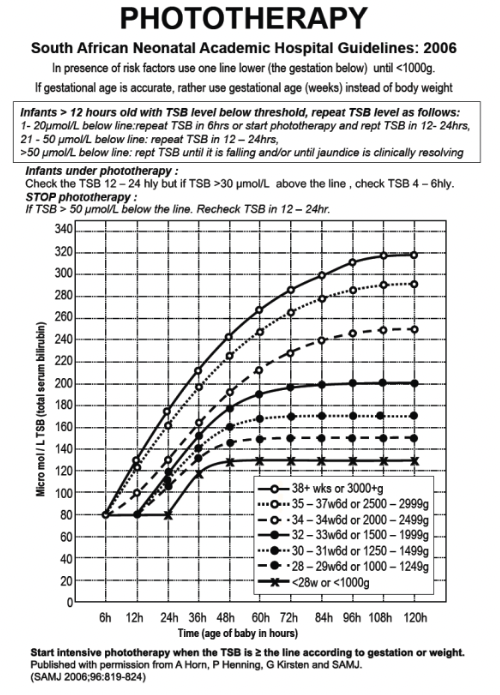
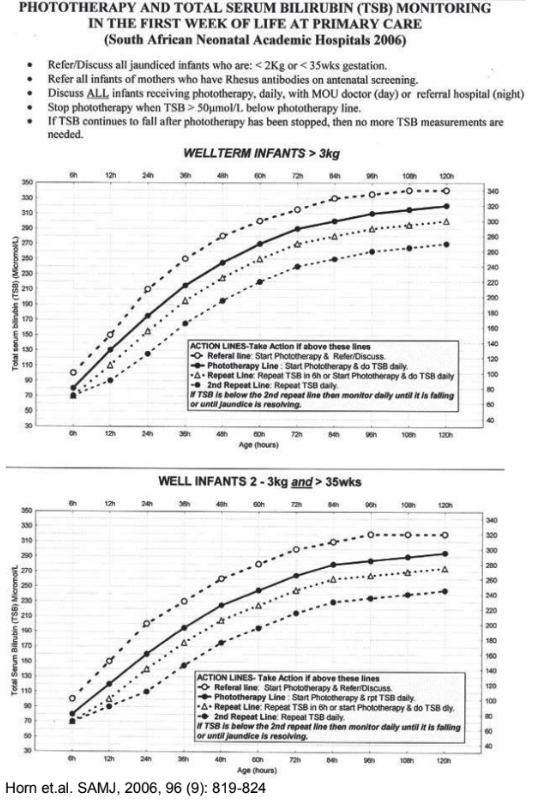
- Commence phototherapy based on total serum bilirubin measurements, correlated with phototherapy graph attached. The need for phototherapy is determined by the level according to hours of life and gestation or weight.
- The skin colour of a baby receiving phototherapy does not reflect the degree of jaundice (bilirubin blood level) or the efficacy of the phototherapy.
- Undress the baby and cover the eyes with gauze pads or commercially available eye covers.
- Position the phototherapy unit (fluorescent light bulbs of 400–500 nm wavelength) not higher than 45 cm above the baby.
- Check spectral irradiance of the fluorescent lights using a radiometer after every 200–300 hours of use to ensure that they are effective.
- The spectral irradiance should be above 10 µwatt/cm2 /nm of wavelength. If spectral irradiance cannot be checked regularly, replace fluorescent light bulbs after 1 000 hours of continuous use.
- A quartz halogen light source (400–500 nm wavelength) can also be used for phototherapy.
- Phototherapy units with diodes emitting light in the blue spectrum or fibre-optic phototherapy units can be used instead of the fluorescent/quartz halogen units.
- Terminate phototherapy when the total serum bilirubin level is more than 50 µmol/L below the recommended phototherapy initiating level, and the cause of the jaundice has been determined and adequately addressed.
- A rebound increase in bilirubin may follow termination of phototherapy.
- Monitor bilirubin levels approximately 6 hourly after phototherapy has been stopped.
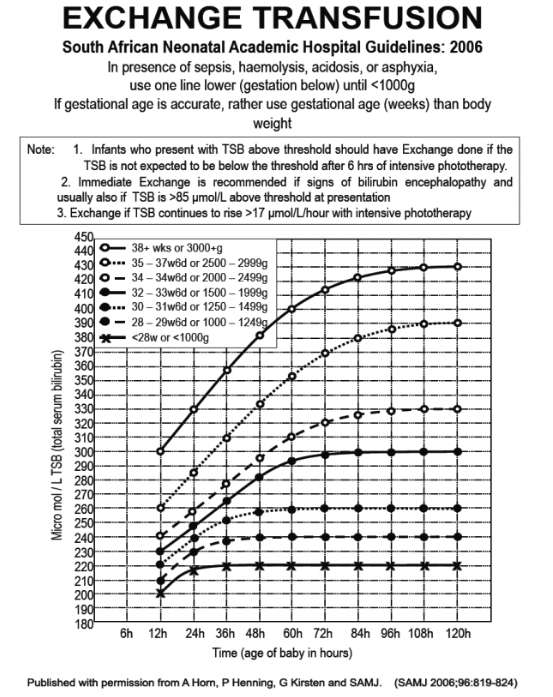
Guideline for exchange transfusion (see also the graphs below):
- Exchange transfusion is indicated when the risk of bilirubin encephalopathy and kernicterus is significant. Referral for exchange transfusion may be needed.
MEDICINE TREATMENT
Rh incompatibility (i.e. mother Rh-negative, baby Rh-positive).
ABO incompatibility (i.e. mother = O, baby = A, B or AB).
Once the diagnosis of Rh- or ABO-related haemolysis is confirmed, together with a positive direct Coombs test; and the serum bilirubin is rising rapidly (> 17 µmol/L/hour with intensive phototherapy) or is approaching exchange transfusion level, then administer (in consultation with a specialist):
- Immunoglobulin, IV, 500 mg/kg over 1 hour.
- Can be repeated once after 6–8 hours.
Mothers of babies with Rh incompatibility should receive:
- Anti-D immunoglobulin, IM, 100 mcg as soon as possible after birth but within 72 hours of birth.
Click on the image to enlarge
Click on the image to enlarge
Click on the image to enlarge
Standard Treatment Guidelines And Essential Medicines List For South Africa, Hospital Level, Paediatrics, 2023 Edition
Chapter 19: Prematurity And Neonatal Conditions, 19.2 Newborn, 19.2.1 Jaundice, Neonatal, 19.2.1.1 Hyperbilirubinaemia, Unconjugated