Hypercalcaemia
Hypercalcaemia
Introduction
Identification
Management
Relevant history, Examination
Investigations
Discharge Criteria
Treatment Algorithm
Introduction/ Description
- Corrected Ca2+ > 2.7 mmol/L is defined as HyperCa2+ (normal value 2.1–2.6 mmol/L). Corrected Ca2+: measured calcium (mmol/L) + [0.02 x (40 – measured albumin g/L)] (NHLS will calculate provided an albumin was ordered)
- HyperCa2+has a potent diuretic effect and often leads to severe volume depletion and dehydration. HyperCa2+ in malignant disease is a poor prognostic sign. HyperCa2+ in terminal malignant disease may not always need correcting. Treatment should ideally be tailored to the needs of each patient.
Identification/recognition/diagnosis of problem
HyperCa2+ is often only retrospectively diagnosed. Where prospectively diagnosed the cues were taken from the history and examination that pointed to the underlying cause. An early venous blood gas can provide an early diagnosis in the form of an ionised Ca2+ level (see below). Causes of HyperCa2+ include the following:
- Malignancy associated hyperCa2+ (most common cause requiring treatment)
- Parathyroid Hormone (PTH) mediated hyperCa2+
- Primary hyperparathyroidism
- Familial benign hypocalcuric hyperCa2+
- Granulomatous disorders: Sarcoidosis, Tuberculosis, Leprosy, Crohn’s disease
- Drugs: thiazides, lithium, vitamin A or D toxicity, excessive ca2+ ingestion
- Miscellaneous: Endocrine (thyrotoxicosis, adrenal insufficiency, pheochromocytoma), parenteral Nutrition, renal failure (acute and chronic), Milk Alkali Syndrome
Differential Diagnosis
- Hyperkalaemia
- Hypermagnesaemia
- Hypernatremia
- Hyperparathyroidism
- Hyperphosphataemia
Management
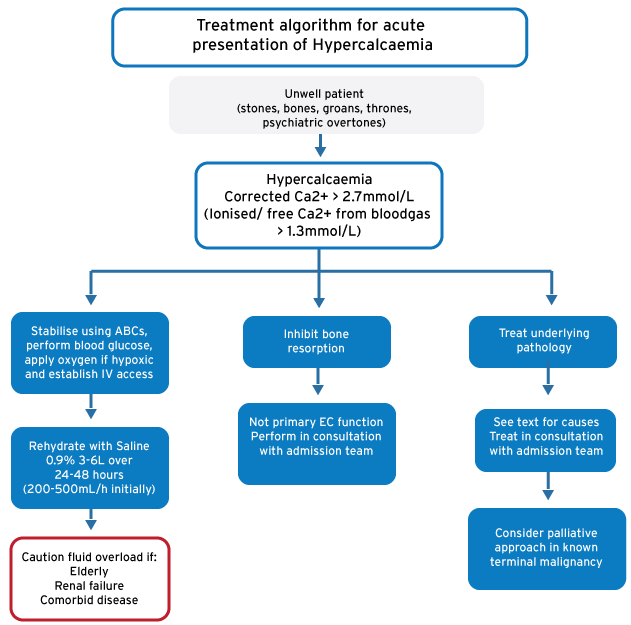
- Management is based on three principles: hydration (with/ without enhancement of renal excretion); inhibition of increased bone resorption; treating the underlying pathology. Initiate treatment of hyperCa2+ and refer to physician for further investigation of hyperCa2+ if cause not yet known. If unsure whether to refer or not contact the Physician at your closest referral facility
Immediate action:
Non-drug treatment
- Stabilise using ABCs, perform blood glucose, apply oxygen if hypoxic and establish IV access.
- Resuscitation with Saline 0.9% 3-6 litres over 24-48 hours.
- May need aggressive volume resuscitation of 200-500mL/hour if clinically indicated. Amount/ rate will depend on severity of hyperCa2+, degree of dehydration, age and co-morbid diseases of patient. Beware of volume resuscitation in the elderly (especially if underlying cardiac or renal disease), may cause volume overload. Give fluids carefully while monitoring for development of pulmonary oedema.
Drug treatment
- Bisphosphonates (Alendronate): Not for routine use, used in malignancy associated hyperCa2+. Consult your referral physician.
- Prednisone 20-40mg/day: In granulomatous diseases, lymphoma
- Renal replacement therapy: If indicated, in patients with severe hyperCa2+ and renal failure. Consult your referral physician.
- Treatment of underlying malignancy, if malignancy cause of hyperCa2+.
Relevant history, Examination
History
History is non-specific and related to underlying disease (see causes above). Some specific symptoms include GIT (nausea, vomiting, constipation, and abdominal pain), renal (polyuria, polydipsia, nephrolithiasis), neurological (lethargy, muscle weakness, fatigue, headache, confusion, coma and skeletal (bone pain, arthralgia)
- "Stones" Renal stones
- "Bones" Bone pain
- "Groans" Abdominal pain
- "Thrones" Polyuria (sitting on the throne)
- "Psych overtones" Depression, anxiety, insomnia, coma
Examination
Usually unremarkable and will depend on the underlying cause. General and systemic examination should be done to look for causes/ precipitants. Dehydration is often apparent in the emergency setting.
Investigations
- Blood gas: a blood gas can give an early indication of abnormal Ca2+. It should be noted that ionized (or free) Ca2+ is reported in a blood gas and not total Calcium. Ionised Ca2+ has different reference ranges: 1.1-1.3 mmol/L (about half the reference of total Ca2+). A total, corrected Ca2+ should always be ordered.
- ECG changes include (not always seen)
- Shortened QT-interval
- Bradycardia
- Blocks: Bundle branch block, AV-nodal blocks
- Dysrhythmia may occur
- Cardiac arrest rare
- Renal function – Look for renal/ electrolyte abnormalities
- Albumin – used to calculate corrected Ca2+
- Calcium – confirm hyperCa2+
- Phosphate
- Other tests to be guided by suspected underlying pathology
Discharge criteria/checklist
- Ca2+ Corrected
- Underlying cause found and treated/ corrected where possible
- Drugs causing/ aggravating HyperCa2+ discontinued/ decreased
- Appropriate outpatient follow-up arranged
Treatment algorithm for acute presentation of Hypercalcaemia
References
Makras P, Papapoulos SE. Medical treatment of hypercalcaemia. Hormones. 2009;8(2):83-95
Marx, Hockberger, Walls. Rosen’s Emergency Medicine. Concepts and clinical practice. Volume II.2002
Rossiter D, Blockman M (eds.). South African Medicines Formulary. 11th Ed. Cape Town: Health and Medical Publishing Group; 2014
Cameron P, Jelinek G, Kelly A, et al. Textbook of Adult Emergency Medicine. 4th Ed. Elsevier; 2015