Hypernatraemia
Hypernatraemia
Introduction
Identification
Severity assessment
Management based on severity
Relevant history
Investigations
Referral criteria
Discharge criteria
Treatment Algorithm
Introduction/ Description
HyperNa+ is diagnosed when the serum sodium >145 mmol/l
Identification/recognition/diagnosis of problem
- ↓Total body water
- Pure water (isolated free water loss): insensible losses (dermal/ respiratory), hypodipsia, Diabetes insipidus or drugs (e.g. Lithium, amphotericin B)
- Hypotonic fluid loss (water loss > Na+ loss): renal (loop diuretics, osmotic diuretics, post-obstructive diuresis), gastrointestinal (vomiting, nasogastric drainage, fistula, diarrhoea, lactulose), cutaneous (burns, excessive sweating), high glucose in uncontrolled diabetes mellitus
- ↑ Sodium
- Includes: acute renal failure, hypertonic feeds (formula too concentrated), Sodium Bicarbonate or hypertonic saline administration, sea water ingestion, or endocrine abnormalities (primary hyperaldosteronism, Cushing’s syndrome)
- Groups at highest risk for HyperNa+ are patients with altered mental status, intubated patients, infants and the elderly
Differential Diagnosis
- Cirrhosis
- Diabetes Mellitus, Type 1
- HypoCa2+
- HypoNa+
Severity assessment (Triage)
- A reduced level of consciousness (confusion vs coma) is a critical finding as brain shrinkage from a sudden increase in Na+ can cause SAH/ intracerebral bleeding.
- Assess fluid status for
- Hypovolaemia: tachycardia, decreased skin turgor, decreased cap refill, orthostatic hypotension and/ or decreased urine output
- Euvolaemia
- Hypervolaemia: ↑ JVP and/ or signs of fluid overload (oedema and S3)
Management based on severity
- What is the cause of the HyperNa+? – Find and treat the cause.
- What is the patient’s volume status – Management plan to correct the Na+
- How long did it take for HyperNa+ to develop? – How quickly can it be corrected?
Immediate action:
Non-drug treatment
- Stabilise using ABCs, perform blood glucose, apply oxygen if hypoxic and establish IV access.
- If depressed level of consciousness, intubate and ventilate as indicated. Terminate seizures with benzodiazepines/ phenytoin (check glucose).
- Find and treat the cause of the HyperNa+:
- Stop GIT fluid loss
- Control pyrexia
- Correct feeding preparation
- Correct Hyperglycaemia/ glycosuria
- Withhold lactulose/ diuretics
- Treat HyperCa2+/ HypoK+
Added tables/dose charts
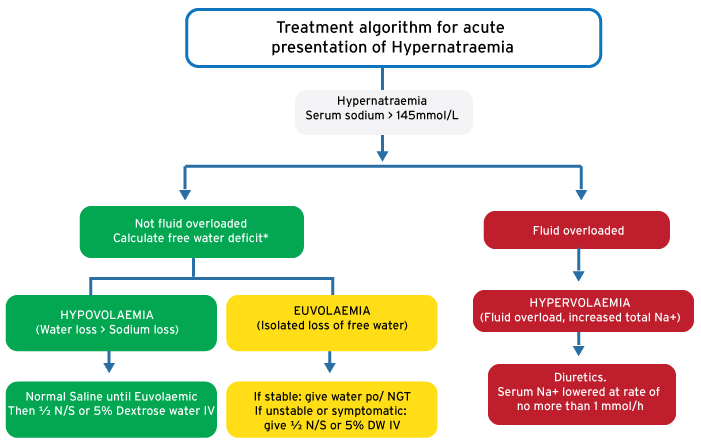
| What is the patient’s fluid status? | ||
HYPOVOLAEMIA (Water loss > Sodium loss) | EUVOLAEMIA (Isolated loss of free water) | HYPERVOLAEMIA (Fluid overload, increased total Na+) |
Normal Saline until Euvolaemic Then ½ N/S or 5% Dextrose water IV | If stable: give water po/ NGT If unstable or symptomatic: give ½ N/S or 5% DW IV | Diuretics. Serum Na+ lowered at rate of no more than 1 mmol/h |
| Water Deficit Calculation Water deficit (L) =  This deficit needs to be replaced over 24-48hrs depending of rapidity of development of HyperNa+ | ||
| How long did it take for the HyperNa+ to develop? | ||
| ||
Relevant history
Includes thirst, muscle weakness, fatigue to malaise, confusion, coma and/ or seizures. The severity of symptoms are determined by speed of rise in serum Na+
Investigations
- Serum sodium. A venous blood gas can give an early indication of sodium levels
- Urine sodium and osmolality
- Renal function
- CXR to assess fluid overload
- CT head if level of consciousness out of keeping with Na+, altered mental state not attributable to Na+ or if there is a clinical suspicion of head injury
Referral criteria
All patients with severe symptoms, Na+ >160 or an unidentifiable cause for the HyperNa+ need to be discussed with a physician for investigation and/or management. Others can be managed in overnight or short stay wards. If Diabetes Insipidus is suspected, then obtain a consultation from endocrinologist (this need not occur in EC).
Discharge criteria/checklist
May be discharged with appropriate follow-up a Primary Care facility
If they are asymptomatic and Na+ <150 mmol/l and aetiology identified and addressed
Treatment algorithm for acute presentation of Hypernatraemia
| *Water Deficit Calculation |
| Water deficit (L) = x 0.6 x weight in kg This deficit needs to be replaced over 24-48hrs depending of rapidity of development of HyperNa+ |
| Time taken for the HyperNa+ to develop? |
LONG: (Developed over > 12 hours, OR Unknown length of time) – Avoid rapid and extreme changes in serum sodium in patients with prolonged HyperNa+ as this may cause cerebral oedema. (Aim to lower Na+ by 0.5 mmol/L/hr (<10mmol/L/24 hr) SHORT: (Known to have developed over a period of hours) – can be corrected more rapidly. Aim to lower Na+ by 1mmol/L/hr |
References
Adrogue, Madias. Hypernatraemia. New England Journal of Medicine. 342 (20) p1493-1499.
Ramrakha, Moore. Oxford Handbook of Acute Medicine. Second edition 2005. P576
Rossiter D, Blockman M (eds.). South African Medicines Formulary. 11th Ed. Cape Town: Health and Medical Publishing Group; 2014
Cameron P, Jelinek G, Kelly A, et al. Textbook of Adult Emergency Medicine. 4th Ed. Elsevier; 2015