Hypertension
Standard Treatment Guidelines and Essential Medicines List for South Africa, Hospital Level, Adults 2019 Edition
Hypertension, asymptomatic severe
Hypertensive crisis, hypertensive emergency
I10
KEY POINTS
Hypertension control has significant benefit for patients. Detect and treat co-existent risk factors. Assess cardiovascular risk (see Figure 1). Lifestyle modification and patient education is essential for all patients.
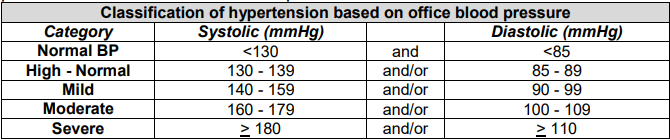
Click on image to enlarge.
Table 1: Classification of hypertension (office-based blood pressures)
LoE:IIIblxxxi
Medicine treatment is needed for SBP ≥140 mmHg and DBP ≥90 mmHg that remains elevated despite lifestyle modification. See medicine treatment choices below.
LoE:IIblxxxii
See medicine treatment choices below.
Immediate medicine treatment is needed for DBP ≥110 mmHg and/or SBP ≥180 mmHg (defined as severe hypertension - see sections hypertension, asymptomatic severe, hypertensive urgency and hypertensive crisis, hypertensive emergency) or for patients with 3 or more risk factors, hypertension mediated organ damage (HMOD) and/or associated clinical conditions.
Patients should be evaluated for cardiovascular risk factors, HMOD and associated clinical conditions.
Other major risk factors for ischaemic cardio- and cerebrovascular disease (see Ischaemic Heart Disease and Atherosclerosis, Prevention).
Hypertension mediated organ damage:
- left ventricular hypertrophy,
- hypertensive retinopathy,
- microalbuminuria, or positive dipsticks for albuminuria or elevated albumin/creatinine ratio, or
- elevated creatinine level (or eGFR <60 mL/minute).
Associated clinical conditions:
- ischaemic heart disease,
- heart failure,
- stroke or transient ischaemic attack,
- chronic kidney disease,
- peripheral arterial disease.
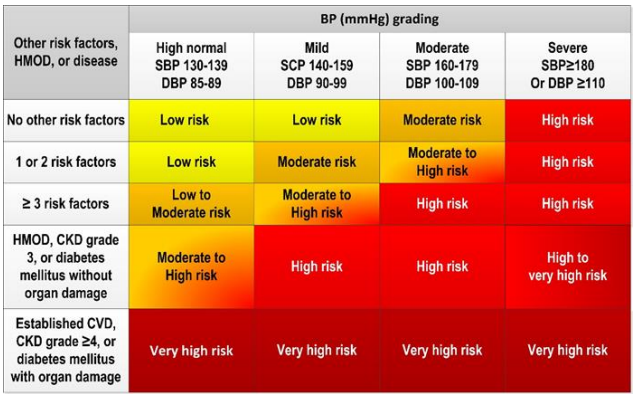
Click on image to enlarge.
Figure 1: Simplified classification of hypertension risk
Source: Williams B, et al. Authors/Task Force Members: 2018 ESC/ESH Guidelines for the management of arterial hypertension: The Task Force for the management of arterial hypertension of the European Society of Cardiology and the European Society of Hypertension. J Hypertens. 2018 Oct;36(10):1953-2041.
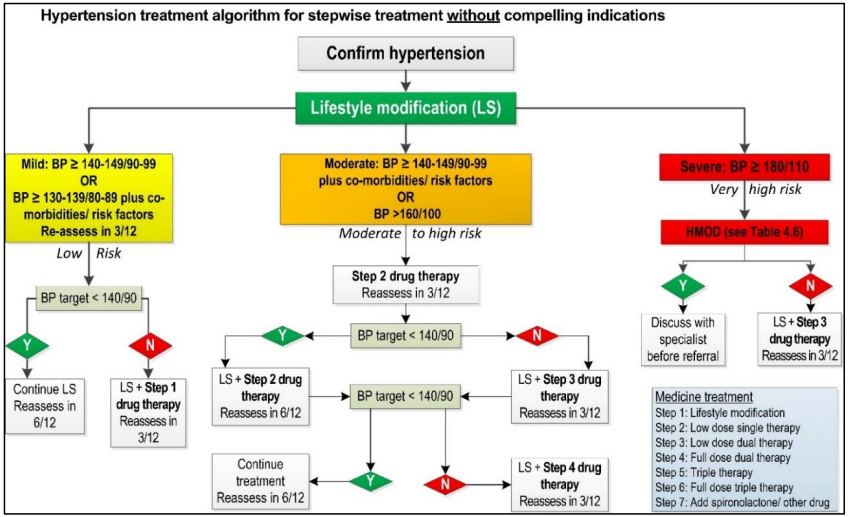
Click on image to enlarge.
Caution: Consider monotherapy in low-risk grade 1 hypertension and patients > 80years or the frail (monitor for postural hypotension)
Figure 2: Algorithm for the stepwise approach of treating hypertension without compelling indications
LoE:IIIb83
Investigations
If overweight, record body weight and waist circumference at each visit when BP is measured. Central obesity is defined as waist circumference:
- >102 cm in men, and
- >88 cm in women.
Do urine test strip analysis for protein, blood and glucose at presentation.
- If normal, repeat urine test strip every 6 months.
- If abnormal, do spot urine ACR. Repeat yearly.
- If haematuria >1+, investigate further.
- If glycosuria, exclude diabetes mellitus.
Other investigations at presentation
- If known diabetic, HbA1c.
- Random total cholesterol.
- Perform a resting ECG to exclude left ventricular hypertrophy or ischaemia.
- Assess renal function (serum creatinine and eGFR).
Goals of treatment
Aim for SBP <140 mmHg and DBP <90 mmHg.
GENERAL MEASURES
Lifestyle modification
All people with hypertension should be encouraged to make the following lifestyle changes as appropriate.
- Smoking cessation.
- Maintain ideal weight, i.e., BMI 18.5 kg/m2 to 25 kg/m2. Weight reduction in the overweight patient.
LoE:IVblxxxiv
- Salt restriction with increased potassium intake from fresh fruits and vegetables (e.g., remove salt from the table, gradually reduce added salt in food preparation and avoid processed foods). Dietician’s advice recommended.
- Reduce alcohol intake to no more than 2 standard drinks per day for males and 1 for females. (1 standard drink = a can of beer = a glass of wine = a shot of spirits).
- Follow a prudent eating plan, i.e., low fat, high fibre and unrefined carbohydrates, with adequate fresh fruit and vegetables. Dietician’s advice recommended.
- Regular moderate aerobic exercise, e.g., 30 minutes brisk walking 5-7 times/week (150 minutes/week).
MEDICINE TREATMENT
Initial medicine choice in patients qualifying for treatment is dependent on the presence of compelling indications (seeTable 3.9); the severity of the elevated BP; and the presence of target organ damage, cardiovascular risk factors, and associated clinical conditions.
| Advise patient to take medication regularly, including on the day of the clinic visit, but a single missed dose does not account for severe elevations in BP. |
Note:
Check adherence to antihypertensive therapy by doing pill counts and questioning family members.
The use of fixed dose combination medication for control of hypertension may improve adherence and such agents should be used when they are available.
Monitor patients monthly and adjust therapy if necessary until the BP is controlled.
After target BP is achieved, patients can be seen at 3–6 monthly intervals.
LoE:IIIblxxxv
MEDICINE TREATMENT CHOICES WITHOUT COMPELLING INDICATIONS
Stepped-care approach to BP treatment
Note:
In low risk (high-normal or mild hypertensive patents) lifestyle intervention may be considered initially, for 3-6 months.
If lifestyle modification failed to achieve BP control: counsel patient on the risk of major cardiovascular events associated with elevated BP; and initiate monotherapy.
If BP control is suboptimal: Up titrate treatment (maximise dose of current antihypertensives and/or add additional medicine). Evidence suggests that treatment inertia contributes to suboptimal BP control with patients remaining on monotherapy and/or suboptimal doses.
LoE:IIIblxxxvi
The timing of the dose should be guided by the time of day that is most convenient for patients and that would optimize adherence and minimize side effects for individual patients.
In 60–80% of patients a combination of antihypertensive therapy is needed. Combination therapy, i.e. hydrochlorothiazide plus a calcium channel blocker or ACE-inhibitor should be considered at the outset in patients with BP >160/100 mmHg. Refer to Figures 1 and 2, above.
Initiate combination medicine therapy in cases of severe hypertension (see hypertension, asymptomatic severe) and hypertensive urgency
BP 140-159/90-99 mmHg:
- < 3 risk factors, no target organ damage or associated clinical conditions:
- Lifestyle modification for 3–6 months.
- Start antihypertensive therapy with a single medicine if target BP not achieved.
- ≥3 risk factors, target organ damage and/or associated clinical conditions:
- Start antihypertensive therapy immediately (together with lifestyle modification).
BP 160-179/100-109 mmHg:
- Even in absence of risk factors, or target organ damage or associated clinical conditions:
- Start antihypertensive therapy (together with lifestyle modifications) with a combination of two medicines.
BP ≥180/100 mmHg: this is severe hypertension: see sections hypertension, asymptomatic severe, hypertensive urgency and hypertensive crisis, hypertensive emergency
Initial antihypertensive medicine:
- Hydrochlorothiazide, oral, 12.5 mg daily
- Caution in patients with gout.
- Less effective in impaired renal function.
- Caution in patients with a history or family history of skin cancer; and counsel all patients on sun avoidance and sun protection.
LoE:IIIblxxxvii
If target BP is not reached after one month despite adequate adherence (or immediately in patients with BP160-179/100-109 mmHg), add one of the following: ACE-inhibitor or calcium channel blocker.
ADD
- Long-acting calcium channel blocker, e.g.:
- Amlodipine, oral, 5 mg daily.
LoE:IIalxxxviii
OR
- ACE-inhibitor, e.g.:
- Enalapril, oral, 10 mg daily.
LoE:IIIblxxxix
If ACE-inhibitor intolerant, i.e. intractable cough:
- Angiotensin receptor blocker (ARB), e.g.:
- Losartan, oral, 50 mg daily. Specialist initiated.
If target BP is still not achieved after one month despite adequate adherence, increase the dose of medication, one medicine every month, to their maximal levels: amlodipine 10 mg daily, enalapril 20 mg daily (losartan 100 mg daily) hydrochlorothiazide 25 mg daily.
If target BP is not reached after one month despite adequate adherence on two medicines, add one of ACE-inhibitor or calcium channel blocker, whichever has not already been used.
If target BP is not reached after one month despite adequate adherence:
ADD
- Spironolactone, oral 25–50 mg daily.
LoE:Iaxc
For refractory hypertension:
ADD
- Beta-blocker , e.g.:
- Atenolol, oral, 50 mg daily.
LoE:Iaxci
Medicine treatment choices with compelling indications
| Compelling indications | Medicine class |
| Angina | Beta-blocker Calcium channel blocker |
| Post myocardial infarction | Beta-blocker ACE-inhibitor |
| Heart failure | ACE-inhibitor Carvedilol Spironolactone Hydrochlorothiazide or furosemide |
| Left ventricular hypertrophy | ACE-inhibitor |
| Stroke | Hydrochlorothiazide Calcium channel blocker |
| Diabetes type 1 or 2 with/without evidence of microalbuminuria or proteinuria | ACE-inhibitor, usually in combination with a diuretic |
| Chronic kidney disease | ACE-inhibitor, usually in combination with a diuretic |
| Isolated systolic hypertension | Hydrochlorothiazide Calcium channel blocker |
| Pregnancy | See: Obstetrics chapter. |
Table 2: Medicine treatment choices with compelling indications
CAUTION
Lower BP over a few days.
A sudden drop in BP can be dangerous, especially in the elderly. BP should be controlled within 1–3 months.
Assess for risk of ischaemic disease. See Ischaemic heart disease and atherosclerosis, prevention.
REFERRAL
Referrals or consultation with a specialist are indicated when:
- Patients are adherent to therapy, and BP is resistant i.e., >140/90 mmHg, while on medicines from 3-4 different classes at appropriate doses, one of which is a diuretic.
- All cases where secondary hypertension is suspected.
- Complicated hypertensive urgency e.g. malignant/accelerated hypertension, severe heart failure with hypertension and hypertensive emergency.
HYPERTENSION, ASYMPTOMATIC SEVERE
I10
DESCRIPTION
These patients have severe hypertension (DBP ≥ 110 mmHg and/or SBP ≥180 mmHg), are asymptomatic and have no evidence of progressive target organ damage.
Keep the patient in the care setting and repeat BP measurement after resting for 1 hour.
If the second measurement is still elevated at the same level, start oral therapy using 2 medicines together, one of which should be low dose hydrochlorothiazide. The second medicine is either a long-acting calcium channel blocker, e.g. amlodipine, or an ACE-inhibitor, e.g. enalapril.
Follow up carefully and refer as needed.
HYPERTENSIVE URGENCY
I10
DESCRIPTION
Severe hypertension (DBP ≥ 110 mmHg and/or SBP ≥180 mmHg) which is symptomatic and/or with evidence of progressive target organ damage. There are no immediate life threatening neurological or cardiac complications such as are seen in the hypertensive emergencies.
|
Do not lower BP in acute stroke or use antihypertensive medication unless SBP > 220 mmHg or the DBP > 120 mmHg, as a rapid fall in BP may aggravate cerebral ischaemia and worsen the stroke - see Stroke in Cerebrovascular Disease. |
Treatment may be given orally but in patients unable to swallow, use parenteral medicines.
MEDICINE TREATMENT
Ideally, all patients with hypertensive urgency should be treated in hospital.
Commence treatment with 2 oral agents and aim to lower the DBP to 100 mmHg slowly over 48–72 hours.
This BP lowering can be achieved by:
- Long-acting calcium channel blocker.
- ACE-inhibitor.
Note:
Avoid ACE- inhibitor if there is severe hyponatraemia, i.e. serum Na < 130 mmol/L.
- Spironolactone.
- Beta-blocker.
Diuretics may potentiate the effects of the other classes of medicines when added. Furosemide should be used if there is renal insufficiency or signs of pulmonary congestion.
HYPERTENSIVE CRISIS, HYPERTENSIVE EMERGENCY
I10
DESCRIPTION
This is a life-threatening situation that requires immediate lowering of BP usually with parenteral therapy. Grade 3-4 hypertensive retinopathy is usually present, together with impaired renal function and proteinuria.
The true emergency situation should preferably be treated by a specialist.
Life-threatening complications include:
- Hypertensive encephalopathy, i.e. severe headache, visual disturbances, confusion, seizures and coma that may result in cerebral haemorrhage.
- Unstable angina or myocardial infarction.
- Acute left ventricular failure with severe pulmonary oedema (extreme breathlessness at rest).
- Eclampsia and severe pre-eclampsia.
- Acute kidney failure with encephalopathy.
- Acute aortic dissection.
MEDICINE TREATMENT
- Admit the patient to a high-care setting for intravenous therapy and close monitoring. Do not lower the BP by > 25% within 30 minutes to 2 hours.
- In the next 2–6 hours, aim to decrease the BP to 160/100 mmHg.
- This may be achieved by the use of intravenous or oral medicines.
Intravenous therapy
- Labetalol, IV, 2 mg/minute to a total dose of 1–2 mg/kg, while trying to achieve control with other agents.
- Caution in acute pulmonary oedema.
OR
If myocardial ischaemia and CCF:
- Glyceryl trinitrate, IV, 5–10 mcg/minute.
- Refer to dosing table in ST elevation myocardial infarction (STEMI).
AND
- Furosemide, IV, 40–80 mg.
- Duration of action: 6 hours.
- Potentiates all of the above medicines.
Oral therapy
- ACE-inhibitor, e.g.:
- Enalapril, oral, 2.5 mg as a test dose
- Increase according to response, to a maximum of 20 mg daily.
- Monitor renal function.
- Enalapril, oral, 2.5 mg as a test dose
If ACE-inhibitor intolerant, i.e. intractable cough or angio-oedema:
- Angiotensin receptor blocker (ARB), e.g.:
- Losartan, oral, 50-100 mg daily. Specialist initiated.
Standard Treatment Guidelines and Essential Medicines List for South Africa, Adult Hospital Level, 2020-2024_Version 1.0_01 November 2024
Chapter 3: Cardiovascular System_3.6 Hypertension