Hypertension in Adults
Hypertension
Risk Assessment of Hypertensive Patients
Stepwise Treatment without Compelling Indications
Treatment of Hypertension with Compelling Indications
I10
DESCRIPTION
A condition characterised by an elevated BP measured on 3 separate occasions, a minimum of 2 days apart
- Systolic BP ≥ 140 mmHg
and/or
- Diastolic BP ≥ 90 mmHg
However, when BP is severely elevated (refer to table below), a minimum of 3 BP readings must be taken at the 1st visit to confirm hypertension. Ensure that the correct cuff size is used in obese patients.
Levels of Hypertension in Adults |
||
|
Level of Hypertension |
Systolic mmHg |
Diastolic mmHg |
|
Mild |
140–159 |
90–99 |
|
Moderate |
160–179 |
100–109 |
|
Severe |
≥ 180 |
≥ 110 |
Table 4.3: Classification of hypertension
The aim of hypertension management is to achieve and maintain target BP: Systolic < 140 mmHg and diastolic < 90 mmHg (applicable to patients of all ages with uncomplicated hypertension).
LoE:IIb41
MONITORING
At every visit:
- Weight
- Blood pressure
Baseline:
- Serum creatinine concentration (and eGFR) – see: Chronic Kidney Disease (CKD)
- Urine protein by dipstix to screen for secondary causes of hypertension
- In patients with diabetes see: Type 2 diabetes mellitus - BMI for cardiovascular risk assessment (See: Prevention of ischaemic heart disease and atherosclerosis)
- Abdominal circumference
- Serum potassium concentration, if on ACE-inhibitor or eGFR < 30 mL/min. (See: Diabetes Mellitus, Adults)
Six monthly:
- Serum potassium concentration in patients on spironolactone or eGFR < 30 mL/min
Annually:
- Finger prick blood glucose (See: Type 2 Diabetes Mellitus, Adults)
- Urine protein by dipstix (See: Chronic Kidney Disease (CKD))
- Serum creatinine concentration (and eGFR) in patients who have:
- Proteinuria 1+ or more
- Existing cardiovascular disease
- Hypertension present for 10 years or more
- If uncontrolled hypertension
- Chronic kidney disease (eGFR < 60 mL/min)
GENERAL MEASURES
- Screen all patients for cardiovascular disease risk factors (See: Prevention of ischaemic heart disease and atherosclerosis) and prescribe a statin if required
- Screen for presence of compelling indications (see table below) and manage patients accordingly
Lifestyle modification
All persons with hypertension should be encouraged to make the following lifestyle changes as appropriate.
- Smoking cessation
- Maintain ideal weight, i.e. BMI 18 to 25 kg/m2. Weight reduction in the overweight patient
- Salt restriction with increased potassium intake from fresh fruits and vegetables (e.g. remove the salt from the table, gradually reduce added salt in food preparation and avoid processed foods). Dietician’s advice recommended
- Reduce alcohol intake to no more than 2 standard drinks per day for males and 1 for females
- Follow a healthy eating plan i.e. low fat, high fibre and unrefined carbohydrates, with adequate fresh fruit and vegetables. Dietician’s advice recommended
- Regular moderate aerobic exercise, e.g. g. 30 minutes brisk walking at least 5-7 times a week
LoE:IIIb42
LoE:IIIb43
MEDICINE TREATMENT
Initial medicine choices are dependent on the presence or absence of compelling indications for specific medicines.
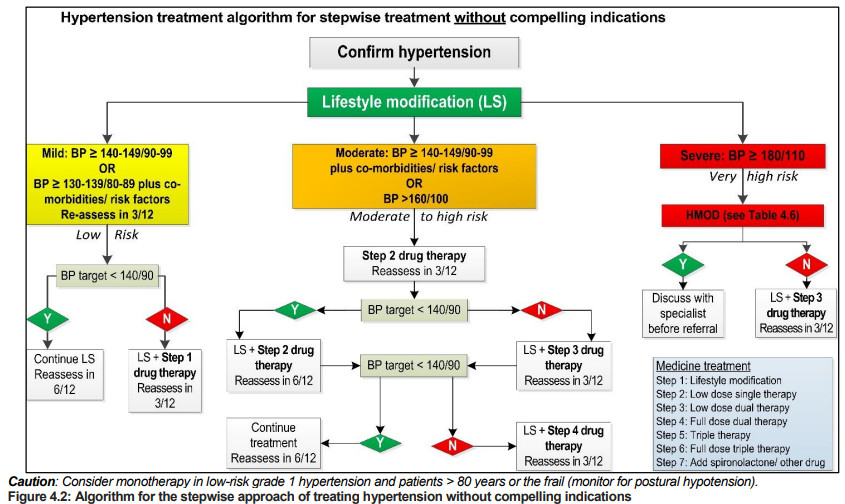
See Table 4.5: Treatment of hypertension with compelling indications, for a list of compelling indications and recommendations for specific medicines. In the absence of compelling indications, see Table 4.4: Stepwise approach of treating hypertension without compelling indications.
|
Advise patient to take medication regularly, including on the day of the clinic visit, but a single missed dose does not account for severe elevations in BP
|
Note
- Check adherence to antihypertensive therapy by doing pill counts and questioning family members
- The use of fixed dose combination medication for control of hypertension provides greater adherence and such agents should be used when they are available
LoE:IIIb44
- The prescribing of antihypertensive medication should be guided by the time of day that is most convenient for patients and that would optimize adherence and minimize side effects for individual patients
- Monitor patients monthly and adjust therapy if necessary, until the BP is stable
- Check adherence to medication before escalating therapy
- After target BP is achieved, patients may be seen at 3–6 monthly intervals
Mild hypertension
- When there are no cardiovascular risk factors, initiate lifestyle modification measures (Step 1). If there is poor response to lifestyle modification measures after 3 months, initiate medicine therapy (Step 2)
- If mild hypertension with the presence of risk factors (See: Prevention of ischaemic heart disease and atherosclerosis), initiate medicine therapy as well as lifestyle modification (Step 2)
Moderate hypertension
- Confirm diagnosis within 2 weeks. Initiate treatment after confirmation of diagnosis (medicine and lifestyle modification) at Step 2
Severe hypertension
- Confirm diagnosis within 1 hour
- In patients who are not symptomatic, initiate treatment (medicine and lifestyle modification) at Step 3
- Patients with symptoms of progressive target organ damage or associated clinical conditions: See: hypertensive urgency below and Hypertensive emergency
Special cases
Pregnancy-induced hypertension
See: Hypertensive disorders of pregnancy
Asymptomatic severe hypertension
- These patients have severe hypertension, are asymptomatic and have no evidence of progressive target organ damage
- Observe the patient in the health care setting and repeat BP measurement after the patient has rested for 1 hour
- If the second measurement is still elevated at the same level, start oral treatment with 2 agents (Step 3), one of which should be low dose hydrochlorothiazide and the second medicine is usually a calcium channel blocker, e.g. amlodipine
- Patient should be followed up within a week
- Refer to doctor if BP > 160/100 mmHg after 4 weeks
Hypertensive urgency
- Most have a systolic BP > 180 mmHg and/or diastolic BP > 110 mmHg
- Patients are symptomatic, usually with severe headache, shortness of breath and oedema, but there are no immediate life threatening neurological or cardiac complications such as are seen in the hypertensive emergencies (see: Hypertensive emergency)
- Start treatment with 2 oral agents (Step 3) with the aim to lower diastolic BP to 100 mmHg slowly, over 48–72 hours
- Amlodipine and furosemide or hydrochlorothiazide should be used, if there is renal insufficiency or evidence of pulmonary congestion (See: Cardiac failure, congestive (CCF), adults)
- All patients with hypertensive urgency should be referred to a hospital
Stroke
BP is often elevated in acute stroke. Do not treat elevated BP at PHC, but refer patient urgently.
Elderly
In patients without co-existing disease, initiate medicine treatment only when the BP > 160/90 mmHg.
|
CAUTION - Lower BP over a few days |
RISK ASSESSMENT OF HYPERTENSIVE PATIENTS
-
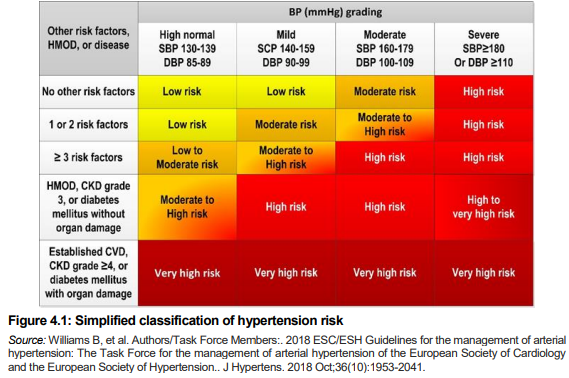
Cardiovascular risk should be assessed in all hypertensive patients based on BP levels, additional risk factors, hypertension-mediated organ damage (HMOD), and previous disease, before starting treatment. Refer to the simplified classification of hypertension risk, below
-
Other risk factors include: Age (>65 years), sex (male>female), heart rate (>80 beats/min), increased body weight, diabetes, high LDL-C/triglyceride, family history of CVD, family history of hypertension, early-onset menopause, smoking habits, psychosocial or socioeconomic factors
-
HMOD includes: LVH (LVH on ECG), moderate-severe CKD (eGFR <60 mL/min/1.73m2), any other available measure of organ damage
-
Previous disease includes: previous coronary heart disease (CHD), CCF, stroke, peripheral vascular disease, atrial fibrillation, CKD stage 3+
LoE:IIIb45
Click on the image to enlarge
Click on the image to enlarge
STEPWISE TREATMENT WITHOUT COMPELLING INDICATIONS
STEP 1: Lifestyle modification
|
Entry to Step 1 |
Treatment |
Target |
| - Diastolic BP 90-99 mmHg and/or systolic BP 140-159 mmHg without any existing disease AND - No major risk factors |
- Lifestyle modification | - BP control within 3 months to BP <140/90 mmHg |
STEP 2: Add hydrochlorothiazide
Entry to Step 2 |
Treatment |
Target |
| - Diastolic BP 90-99 mmHg and systolic BP 140-159 mmHg without any existing disease AND - No major risk factors AND - Failure of lifestyle modification alone to reduce BP after 3 months OR - Mild hypertension with major risk factors or existing disease OR - Moderate hypertension at diagnosis |
- Lifestyle modification AND - Hydrochlorothiazide, oral, 12.5 mg daily LoE:IIIb47
|
- BP control within 1 month to BP < 140/90 mmHg |
STEP 3: Add a second antihypertensive medicine
|
Entry to Step 3 |
Treatment |
Target |
|
- Failure to achieve targets in Step 2 after 1 month despite adherence to therapy
OR - Severe hypertension (See table below) |
- Lifestyle modification
ORAND - Hydrochlorothiazide, oral, 12.5 mg daily ADD - Long-acting calcium channel blocker, e.g.: - Amlodipine, oral 5 mg at night - ACE-inhibitor e.g.: - Enalapril, oral, 10 mg once daily LoE:IVb48
|
- BP control within 1 month to
< 140/90 mmHg |
STEP 4: Increase the dose of the second antihypertensive medicine
STEP 5: Add a third antihypertensive medicine
|
Entry to Step 5 |
Treatment |
Target |
| - Failure of Step 4 after 1 month of adherence | - Lifestyle modification AND - Hydrochlorothiazide, oral, 12.5 mg daily AND - ACE-inhibitor, e.g.: - Enalapril, oral: continue Step 4 dose, or if not started previously start at 10 mg once daily AND - Long acting calcium channel blocker, e.g.: - Amlodipine, oral: continue Step 4 dose, or if not started previously start at 5 mg once daily |
- BP control within 1 month to < 140/90 mmHg, with no adverse medicine reactions |
STEP 6: Increase the dose of the third antihypertensive medicine
|
Entry to Step 6
|
Treatment
|
Target
|
|
- Failure of Step 5 after 1 month of adherence
|
- Lifestyle modification
AND
- Hydrochlorothiazide, oral, 12.5 mg daily
AND
- ACE-inhibitor, e.g.:
Enalapril, oral, 20 mg at night AND
- Long-acting calcium channel blocker, e.g.:
- Amlodipine, oral, 10 mg once daily |
- BP control within 1 month to < 140/90 mmHg with no adverse medicine reactions
|
STEP 7: Increase the dose of HCTZ and add a fourth antihypertensive medicine
|
Entry to Step 7
|
Treatment
|
Target
|
|
- Failure of Step 7 after 1 month of adherence
|
- Lifestyle modification
AND - Hydrochlorothiazide, oral, 25 mg daily AND - ACE-inhibitor, e.g.: - Enalapril, 20 mg once daily AND - Long-acting calcium channel blocker, e.g.:
- Amlodipine, oral 10 mg once daily AND ADD - Spironolactone, oral, 25
mg daily (Doctor initiated)
LoE:Ia49
|
- BP control within 1 month to < 140/90 mmHg, with no adverse medicine reactions |
Table 4.4: Stepwise approach of treating hypertension without compelling indications
|
CAUTION Spironolactone can cause severe hyperkalemia and should only be used when serum potassium and renal function can be monitored Check potassium levels within one month of starting therapy and thereafter, as per clinical need. Routine monitoring of potassium levels is essential if spironolactone is used with an ACE-inhibitor, other potassium sparing agent or in the elderly Do not use together with potassium supplements Avoid NSAIDs with spironolactone use Do not use in kidney failure (Do not use if eGFR < 30 mL/min) |
If not controlled on Step 7 – refer
LoE:IVb50
Note
- If lifestyle modification failed to achieve BP control: Counsel patient on the risk of major cardiovascular events associated with elevated BP; and initiate monotherapy
- If BP control is suboptimal: Up titrate treatment (maximise dose of current antihypertensive and/or add additional medicine). Evidence suggests that treatment inertia contributes to suboptimal BP control with patients remaining on monotherapy and/or suboptimal doses
- Initiate combination medicine therapy in cases of severe hypertension and hypertension urgency (See: Hypertensive emergency)
LoE:IIIb51
TREATMENT OF HYPERTENSION WITH COMPELLING INDICATIONS
|
Compelling Indications for Specific Medicines
|
Medicine Therapeutic Class |
| Angina | - Beta-blocker OR - Long-acting calcium channel blocker |
| Prior myocardial infarction | - Beta-blocker AND - ACE-inhibitor |
| Heart failure | - ACE-inhibitor AND - Carvedilol, oral OR - Spironolactone, oral For significant volume overload: - Loop diuretic |
| Left ventricular hypertrophy (confirmed by ECG) | - ACE-inhibitor |
| Stroke: secondary prevention | - Hydrochlorothiazide, oral AND - ACE-inhibitor |
| Diabetes type 1 and 2 with/ without evidence of microalbuminuria or proteinuria | - ACE-inhibitor, usually in combination with diuretic |
| Chronic kidney disease | - ACE-inhibitor, usually in combination with diuretic |
| Isolated systolic hypertension | - Hydrochlorothiazide, oral OR - Long-acting calcium channel blocker |
| Pregnancy | - Methyldopa, oral |
Table 4.5: Treatment of hypertension with compelling indications
Contraindications to individual medicines
Hydrochlorothiazide
- Gout
- Pregnancy
- Severe liver impairment
- Kidney impairment (eGFR < 30 mL/min)
- Use with caution in patients with a history or family history of skin cancer; and counsel all patients on sun avoidance and sun protection
LoE:IIIb52
Calcium channel blockers
- Untreated heart failure
Spironolactone
- Kidney impairment (eGFR < 30 mL/min)
- Pregnancy
LoE:IVb53
ACE-inhibitors
- Pregnancy
- Bilateral renal artery stenosis or stenosis of an artery to a dominant/ single kidney
- Aortic valve stenosis
- History of angioedema
- Hyperkalaemia
- Severe renal impairment (eGFR < 30 mL/min), unless dose-adjusted usage is recommended by a specialist – See: Chronic kidney disease (CKD)
LoE:IVb54
|
CAUTION Advise all patients receiving ACE-inhibitors about the symptoms of ACE-induced angioedema |
REFERRAL
- Young adults (< 30 years of age)
- BP not controlled by 4 medicines and where there is no doctor available
- Pregnancy
- Signs of target organ damage e.g. oedema, dyspnoea, proteinuria, angina etc
- If severe adverse drug reactions develop
- Hypertensive urgency and hypertensive emergency
- Severe renal impairment (eGFR < 30 mL/min)
Standard Treatment Guidelines and Essential Medicines List for South Africa, Primary Healthcare, 2020-2024_Version 1.0_1 November 2024
Chapter 4: Cardiovascular Conditions_4.7.1 Hypertension in Adults